Romero Pedro, Belanche Alejandro, Jiménez Elisabeth, Hueso Rafael, Ramos-Morales Eva, Salwen Joan King, Kebreab Ermias, Yáñez-Ruiz David R
Estación Experimental del Zaidín, Consejo Superior de Investigaciones Científicas (CSIC), Profesor Albareda 1, Granada, 18008, Spain.
Department of Animal Production and Food Sciences, University of Zaragoza, Miguel Servet 177, Saragossa, 50013, Spain.
J Anim Sci Biotechnol. 2023 Nov 1;14(1):133. doi: 10.1186/s40104-023-00935-z.
The red macroalgae Asparagopsis is an effective methanogenesis inhibitor due to the presence of halogenated methane (CH) analogues, primarily bromoform (CHBr). This study aimed to investigate the degradation process of CHBr from A. taxiformis in the rumen and whether this process is diet-dependent. An in vitro batch culture system was used according to a 2 × 2 factorial design, assessing two A. taxiformis inclusion rates [0 (CTL) and 2% DM diet (AT)] and two diets [high-concentrate (HC) and high-forage diet (HF)]. Incubations lasted for 72 h and samples of headspace and fermentation liquid were taken at 0, 0.5, 1, 3, 6, 8, 12, 16, 24, 48 and 72 h to assess the pattern of degradation of CHBr into dibromomethane (CHBr) and fermentation parameters. Additionally, an in vitro experiment with pure cultures of seven methanogens strains (Methanobrevibacter smithii, Methanobrevibacter ruminantium, Methanosphaera stadtmanae, Methanosarcina barkeri, Methanobrevibacter millerae, Methanothermobacter wolfei and Methanobacterium mobile) was conducted to test the effects of increasing concentrations of CHBr (0.4, 2, 10 and 50 µmol/L).
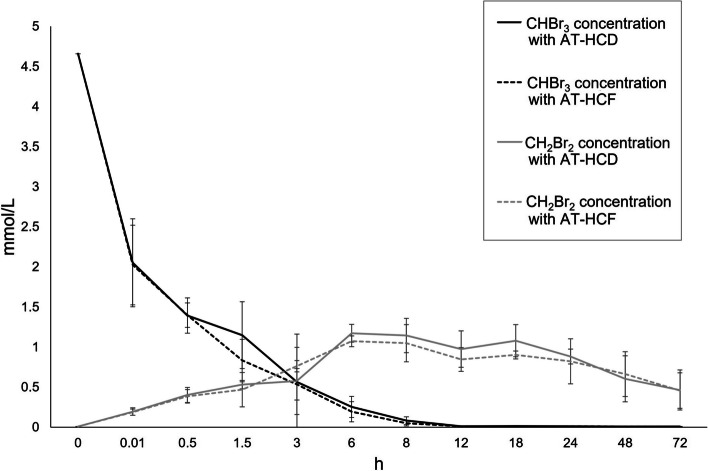
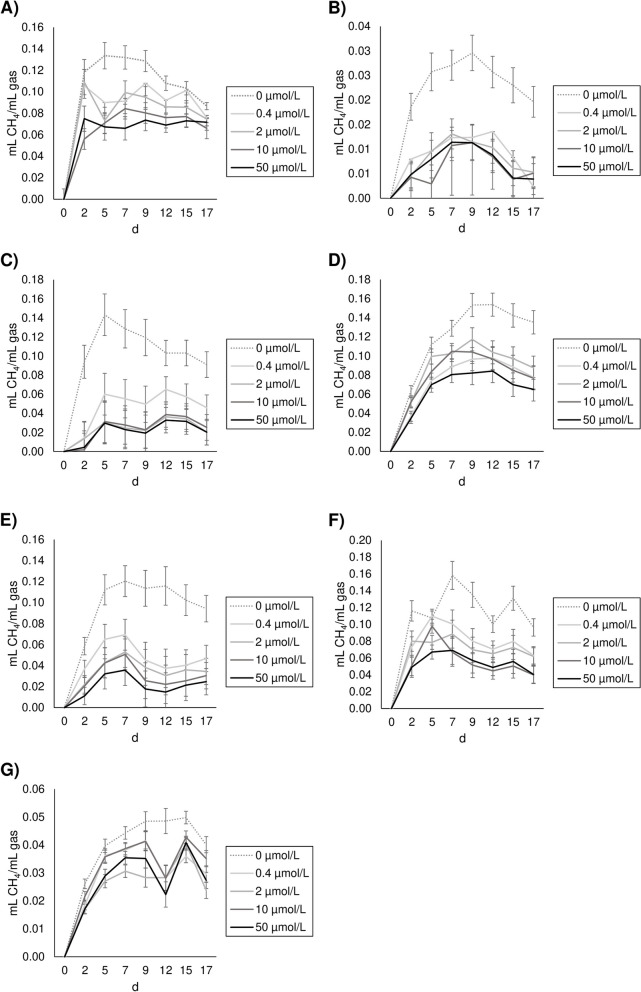
The addition of AT significantly decreased CH production (P = 0.002) and the acetate:propionate ratio (P = 0.003) during a 72-h incubation. The concentrations of CHBr showed a rapid decrease with nearly 90% degraded within the first 3 h of incubation. On the contrary, CHBr concentration quickly increased during the first 6 h and then gradually decreased towards the end of the incubation. Neither CHBr degradation nor CHBr synthesis were affected by the type of diet used as substrate, suggesting that the fermentation rate is not a driving factor involved in CHBr degradation. The in vitro culture of methanogens showed a dose-response effect of CHBr by inhibiting the growth of M. smithii, M. ruminantium, M. stadtmanae, M. barkeri, M. millerae, M. wolfei, and M. mobile.
The present work demonstrated that CHBr from A. taxiformis is quickly degraded to CHBr in the rumen and that the fermentation rate promoted by different diets is not a driving factor involved in CHBr degradation.
红藻龙须菜是一种有效的甲烷生成抑制剂,因其含有卤代甲烷(CH)类似物,主要是溴仿(CHBr₃)。本研究旨在探究瘤胃中来自塔形龙须菜的CHBr₃的降解过程,以及该过程是否依赖于日粮。根据2×2析因设计使用体外批次培养系统,评估两种龙须菜添加比例[0(对照)和2%干物质日粮(AT)]以及两种日粮[高浓缩日粮(HC)和高粗饲料日粮(HF)]。培养持续72小时,并在0、0.5、1、3、6、8、12、16、24、48和72小时采集顶空和发酵液样本,以评估CHBr₃降解为二溴甲烷(CH₂Br₂)的模式和发酵参数。此外,进行了一项使用七种产甲烷菌菌株(史氏甲烷短杆菌、反刍甲烷短杆菌、施氏甲烷球形菌、巴氏甲烷八叠球菌、米勒甲烷短杆菌、沃氏嗜热甲烷杆菌和运动甲烷杆菌)纯培养物的体外实验,以测试增加浓度的CHBr₃(0.4、2、10和50 μmol/L)的影响。
添加AT在72小时培养期间显著降低了CH₄产量(P = 0.002)和乙酸盐:丙酸盐比例(P = 0.003)。CHBr₃浓度迅速下降,在培养的前3小时内近90%被降解。相反,CH₂Br₂浓度在最初6小时内迅速增加,然后在培养结束时逐渐下降。用作底物的日粮类型对CHBr₃降解和CH₂Br₂合成均无影响,这表明发酵速率不是参与CHBr₃降解的驱动因素。产甲烷菌的体外培养显示CHBr₃对史氏甲烷短杆菌、反刍甲烷短杆菌、施氏甲烷球形菌、巴氏甲烷八叠球菌、米勒甲烷短杆菌、沃氏嗜热甲烷杆菌和运动甲烷杆菌的生长具有剂量反应效应。
目前的研究表明,来自塔形龙须菜的CHBr₃在瘤胃中迅速降解为CH₂Br₂,并且不同日粮促进的发酵速率不是参与CHBr₃降解的驱动因素。