Sahin Suzan, Buyuktiryaki Mehmet, Okur Nilufer, Akcan Abdullah Baris, Deveci Mehmet Fatih, Yurttutan Sadik, Gunes Sezgin, Anik Ayse, Ozdemir Ramazan, Uygur Ozgun, Oncel Mehmet Yekta
Faculty of Medicine, Department of Pediatrics, Division of Neonatology, Izmir Democracy University, Izmir, Türkiye.
Faculty of Medicine, Department of Pediatrics, Division of Neonatology, Istanbul Medipol University, Istanbul, Türkiye.
Front Pediatr. 2023 Oct 20;11:1270442. doi: 10.3389/fped.2023.1270442. eCollection 2023.
Data on the effectiveness of hydrolyzed infant formula containing both pre- and probiotics (synbiotic formula) on the growth of infants is still scarce. This retrospective study was designed to evaluate the effect of a partially hydrolyzed synbiotic formula on growth parameters and the possible occurrence of major gastrointestinal adverse events or morbidities in infants born via cesarean section (C-section) delivery.
C-section-delivered term and late preterm infants who received either partially hydrolyzed synbiotic formula, standard formula, or maternal milk and followed at seven different hospitals from five different regions of Turkey, during a 1-year period with a minimum follow-up duration of 3 months were evaluated retrospectively. All the included infants were evaluated for their growth patterns and any kind of morbidity such as diarrhea, constipation, vomiting, infection, or history of hospitalization.
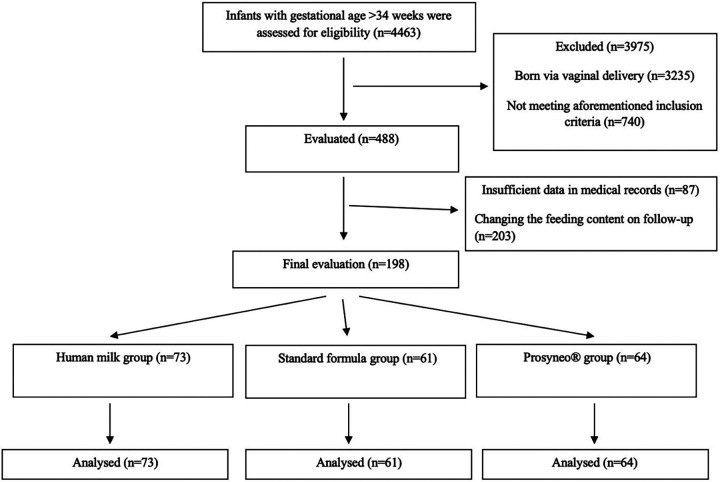
A total of 198 infants (73 in the human milk group, 61 in the standard formula group, and 64 in the partially hydrolyzed synbiotic formula group) reached the final analysis. The groups were similar regarding their demographic and perinatal characteristics. No difference was observed between the three groups regarding gastrointestinal major side effects. Growth velocities of the infants in the human milk and partially hydrolyzed synbiotic formula groups during the first month of life were similar whereas the weight gain of infants in the standard formula group was significantly less than these two groups (< 0.001). Growth velocities were similar among the three groups between 1st and 3rd months of age.
A partially hydrolyzed synbiotic formula provided better weight gain in late-preterm and term infants who were delivered via C-section delivery compared to the standard formula during the first month of life. This weight gain was similar to the infants receiving exclusively human milk. This difference was not observed in length and head circumference gain. No difference was observed in any of the parameters during the 1st-3rd months of age. Specially formulated partially hydrolyzed synbiotic formulas may reverse at least some of the negative impacts of C-section delivery on the infant and help to provide better growth, especially during the early periods of life.
关于含有益生元和益生菌的水解婴儿配方奶粉(合生元配方奶粉)对婴儿生长有效性的数据仍然很少。这项回顾性研究旨在评估部分水解合生元配方奶粉对剖宫产出生婴儿生长参数的影响,以及主要胃肠道不良事件或疾病的可能发生情况。
回顾性评估在土耳其五个不同地区的七家不同医院接受部分水解合生元配方奶粉、标准配方奶粉或母乳的剖宫产足月儿和晚期早产儿,随访期为1年,最短随访时间为3个月。对所有纳入的婴儿进行生长模式评估以及任何疾病评估,如腹泻、便秘、呕吐、感染或住院史。
共有198名婴儿(母乳组73名,标准配方奶粉组61名,部分水解合生元配方奶粉组64名)进入最终分析。三组在人口统计学和围产期特征方面相似。三组在胃肠道主要副作用方面未观察到差异。母乳组和部分水解合生元配方奶粉组婴儿在出生后第一个月的生长速度相似,而标准配方奶粉组婴儿的体重增加明显低于这两组(<0.001)。三组在1至3个月龄之间的生长速度相似。
与标准配方奶粉相比,部分水解合生元配方奶粉在出生后第一个月为剖宫产的晚期早产儿和足月儿提供了更好的体重增加。这种体重增加与纯母乳喂养的婴儿相似。在身长和头围增加方面未观察到差异。在1至3个月龄期间,任何参数均未观察到差异。特殊配方的部分水解合生元配方奶粉可能至少逆转剖宫产对婴儿的一些负面影响,并有助于提供更好的生长,尤其是在生命早期。