Dept of International Health, International Vaccine Access Center, Johns Hopkins Bloomberg School of Public Health, Baltimore, Maryland, USA.
Department of Epidemiology, Johns Hopkins University Bloomberg School of Public Health, Baltimore, Maryland, USA.
BMJ Paediatr Open. 2023 Nov;7(1). doi: 10.1136/bmjpo-2023-002165.
The rapid development and deployment of effective COVID-19 vaccines have been critical to halt the spread of the pandemic. India started vaccinating children in early 2022, however, vaccine uptake has been suboptimal.
Between September and November 2022, we conducted an online survey that was disseminated to eligible participants via email, text messages and social media platforms across India. The survey aimed to gather the perspectives of Indian healthcare providers regarding key factors related to the rollout of paediatric COVID-19 vaccines. Descriptive statistics were used to analyse participant demographics and responses on knowledge about paediatric COVID-19 vaccines, perceived risks and benefits, and vaccine rollout strategies.
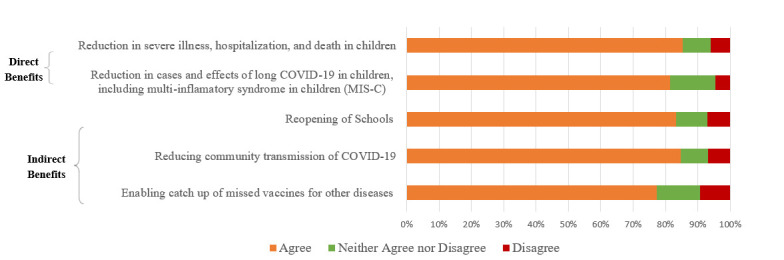
The survey yielded 805 respondents from 23 Indian states; 63.5% were men, 97.3% were paediatricians, median age was 44 years (IQR 25-81). Eighty-one per cent and 65.2% respondents had heard about the most common paediatric COVID-19 vaccines in India, Covaxin and Corbevax, but only 52.9%, 53.7% and 62.1% felt adequately informed about their safety, efficacy and vaccination schedules, respectively. Thirty per cent of respondents were unaware of vaccination guidelines. Eighty-five per cent of respondents felt that vaccines would reduce the incidence of severe disease, hospitalisation and deaths, and 60.6% felt children with comorbidities should be prioritised for vaccination. Perceived supply side barriers included lack of enforcement of guidelines (45.2%) and adverse effects following immunisation monitoring systems (37.6%), and on the demand side, parental vaccine hesitancy (64.4%). Eighty-one per cent believed that school-based vaccination strategies would be highly effective in increasing uptake.
Most respondents were in support of the COVID-19 paediatric vaccination, although just over half did not feel adequately informed. Concerns about vaccine hesitancy among caregivers were the leading reported barrier. Targeted interventions are needed to provide adequate knowledge support to healthcare providers and evidence-based public health messaging to reduce vaccine hesitancy among caregivers.
有效 COVID-19 疫苗的快速开发和部署对于阻止大流行的传播至关重要。印度已于 2022 年初开始为儿童接种疫苗,但疫苗接种率并不理想。
在 2022 年 9 月至 11 月期间,我们通过电子邮件、短信和社交媒体平台在印度各地向符合条件的参与者分发了在线调查。该调查旨在收集印度医疗保健提供者对与儿童 COVID-19 疫苗推出相关的关键因素的看法。使用描述性统计数据来分析参与者的人口统计学特征以及对儿童 COVID-19 疫苗的知识、感知风险和益处以及疫苗推出策略的回答。
该调查从印度 23 个邦共收到 805 名受访者的回复;其中 63.5%为男性,97.3%为儿科医生,中位年龄为 44 岁(IQR 25-81)。81%和 65.2%的受访者听说过印度最常见的两种儿童 COVID-19 疫苗,即 Covaxin 和 Corbevax,但只有 52.9%、53.7%和 62.1%的人对它们的安全性、有效性和接种时间表有足够的了解。30%的受访者不知道接种指南。85%的受访者认为疫苗将降低严重疾病、住院和死亡的发生率,60.6%的受访者认为患有合并症的儿童应优先接种疫苗。感知到的供应方障碍包括缺乏对指导方针的执行(45.2%)和疫苗接种监测系统的不良反应(37.6%),而在需求方面,父母对接种疫苗的犹豫(64.4%)。81%的人认为基于学校的疫苗接种策略将非常有效地提高接种率。
大多数受访者支持 COVID-19 儿童疫苗接种,但只有一半以上的人认为自己没有得到足够的信息。父母对接种疫苗犹豫不决的担忧是报告的主要障碍。需要有针对性的干预措施,为医疗保健提供者提供充分的知识支持,并向父母提供基于证据的公共卫生信息,以减少他们对接种疫苗的犹豫。