Department of Environmental Health and Ecological Sciences, Ifakara Health Institute, Off Mlabani Passage, P.O. Box 53, Ifakara, Morogoro, Tanzania.
Department of Microbiology, Parasitology and Biotechnology, College of Veterinary Medicine and Biomedical Sciences, Sokoine University of Agriculture, P.O. Box 3019, Morogoro, Tanzania.
Malar J. 2023 Nov 8;22(1):340. doi: 10.1186/s12936-023-04778-x.
Malaria vectors vary in feeding preference depending on their innate behaviour, host availability and abundance. Host preference and human biting rate in malaria vectors are key factors in establishing zooprophylaxis and zoopotentiation. This study aimed at assessing the impact of non-human hosts in close proximity to humans on the human biting rate of primary and secondary malaria vectors, with varying host preferences.
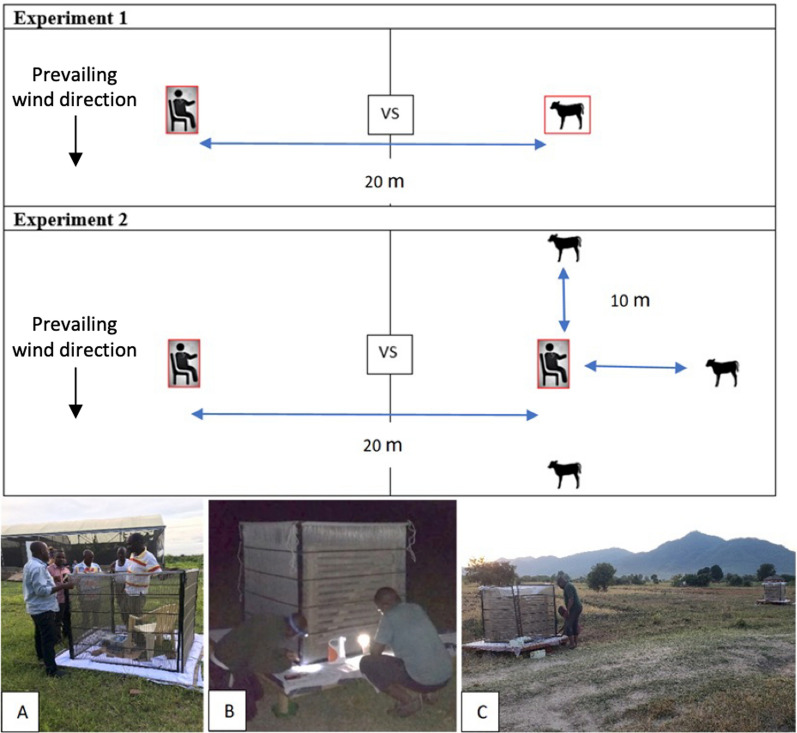
The effect of the presence of non-human hosts in close proximity to the human host on the mean catches per person per night, as a proxy for mosquito biting rate, was measured using mosquito-electrocuting traps (METs), in Sagamaganga, Kilombero Valley, Tanzania. Two experiments were designed: (1) a human versus a calf, each enclosed in a MET, and (2) a human surrounded by three calves versus a human alone, with each human volunteer enclosed individually in a MET spaced 10 m apart. Each experiment was conducted on alternate days and lasted for 36 nights per experiment. During each experiment, the positions of hosts were exchanged daily (except the human in experiment 2). All anopheline mosquitoes caught were assayed for Plasmodium sporozoites using enzyme-linked immunosorbent assay.
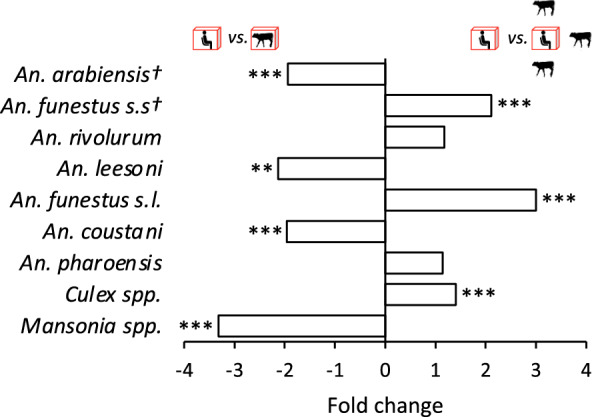
A total of 20,574 mosquitoes were captured and identified during the study, of which 3608 were anophelines (84.4% primary and 15.6% secondary malaria vectors) and 17,146 were culicines. In experiment 1, the primary malaria vector, Anopheles arabiensis, along with Culex spp. demonstrated a preference for cattle, while the primary vectors, Anopheles funestus, preferred humans. In experiment 2, both primary vectors, An. arabiensis and An. funestus, as well as the secondary vector Anopheles rivolurum, demonstrated behaviours amenable to zooprophylaxis, whereas Culex spp. increased their attraction to humans in the presence of nearby cattle. All anopheline mosquitoes tested negative for sporozoites.
The findings of this study provide support for the zooprophylaxis model for malaria vectors present in the Kilombero Valley, and for the zoopotentiation model, as it pertains to the Culex spp. in the region. However, the factors regulating zooprophylaxis and zoopotentiation are complex, with different species-dependent mechanisms regulating these behaviours, that need to be considered when designing integrated vector management programmes.
疟疾病媒根据其固有行为、宿主的可及性和丰度而在取食偏好上有所不同。疟疾病媒对宿主的偏好和人类叮咬率是建立动物防病和动物增强作用的关键因素。本研究旨在评估与人类近距离接触的非人类宿主对具有不同宿主偏好的主要和次要疟疾病媒的人类叮咬率的影响。
在坦桑尼亚基隆贝罗谷的萨加马甘加,使用诱蚊诱捕器(MET)测量人类宿主附近存在非人类宿主对人均每晚捕获量(代表蚊子叮咬率)的影响。设计了两项实验:(1)一个 MET 内装一个人,另一个 MET 内装一头小牛,(2)一个人被三头小牛包围,另一个人单独在一个 MET 中,每个 MET 相隔 10 米。每个实验每 36 晚进行 36 天,每天交换宿主位置(实验 2 中的人除外)。捕获的所有按蚊均通过酶联免疫吸附试验检测疟原虫孢子。
研究期间共捕获并鉴定了 20574 只蚊子,其中 3608 只为按蚊(84.4%为主要疟疾病媒,15.6%为次要疟疾病媒),17146 只为库蚊。在实验 1 中,主要疟疾病媒,阿拉伯按蚊,以及库蚊表现出对牛的偏好,而主要媒介,冈比亚按蚊,偏好人类。在实验 2 中,两种主要媒介,阿拉伯按蚊和冈比亚按蚊,以及次要媒介雷氏按蚊,表现出有利于动物防病的行为,而库蚊在附近有牛的情况下,对人类的吸引力增加。所有按蚊的检测结果均为孢子虫阴性。
本研究结果为基隆贝罗谷存在的疟疾病媒的动物防病模型提供了支持,也为该地区库蚊的动物增强作用模型提供了支持。然而,调节动物防病和动物增强作用的因素很复杂,不同物种的调节机制不同,在设计综合病媒管理方案时需要考虑这些因素。