Department of Medical Parasitology, University of Gondar, Gondar, Ethiopia.
Department of Biology, Arba Minch University, Arba Minch, Ethiopia.
Parasit Vectors. 2020 Jun 22;13(1):322. doi: 10.1186/s13071-020-04194-z.
The success of indoor interventions that target mosquitoes for malaria control is partially dependent on early evening and outdoor biting behaviours of mosquito vectors. In southwest Ethiopia, people and cattle live in proximity, which calls to investigate whether the presence of cattle increase or decrease bites from malaria mosquito vectors. This study assessed both host-seeking and overnight activity of malaria mosquito vectors given the presence or absence of cattle in Chano Mille village, Arba Minch district, Ethiopia.
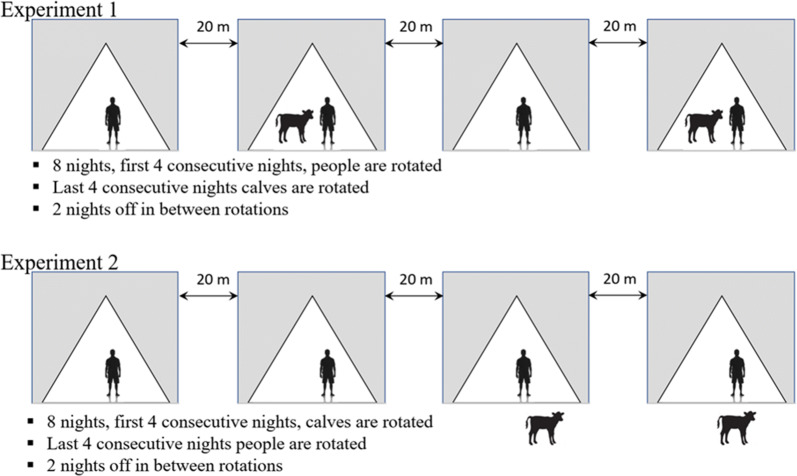
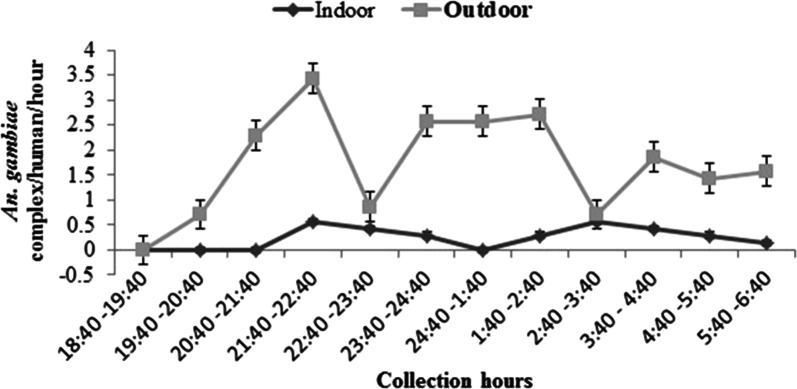
Anopheles species density and activity time was compared when a calf was: (i) placed inside; (ii) 1 m away from; or (iii) absent from a tent with a human volunteer resting insides using hourly human landing catches (HLC) conducted from 18:00-0:00 h for 3 months. This trial was performed close to the shore of the Lake Abaya to minimize the interference of other animals on mosquito movement. The overnight activity of malaria vectors was assessed within a Chano village from 18:00-6:00 h with collections carried out both indoors and outdoors by HLC. Generalized estimating equations were used to statistically assess differences.
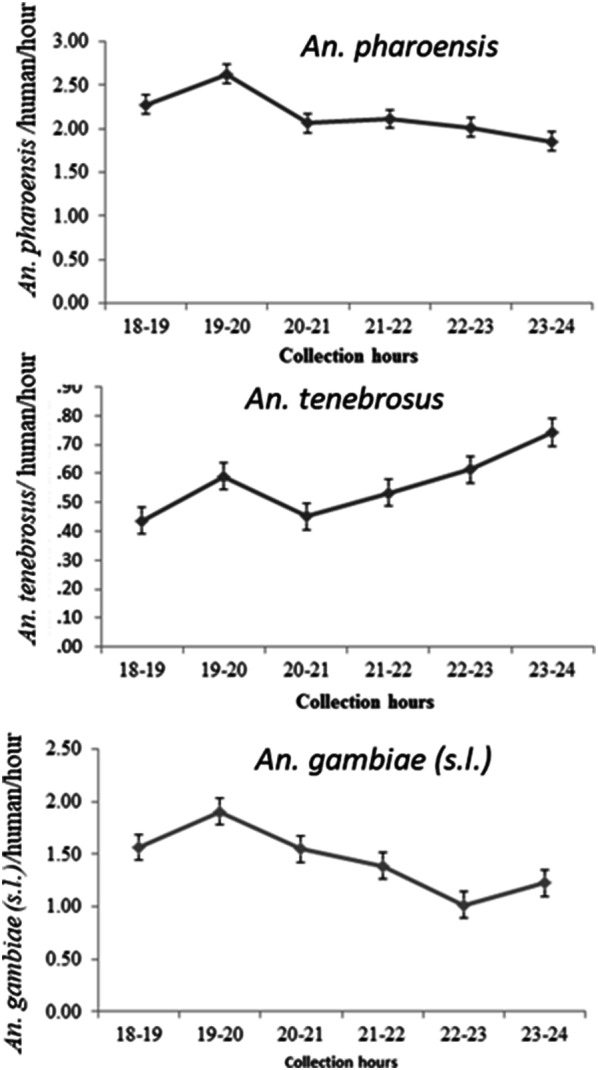
Anopheles pharoensis was significantly more prevalent when a calf was present either inside (42%, P < 0.001), or adjacent to (46%, P = 0.002) a tent relative to a tent without a calf present. The presence of a calf did not affect densities of the primarily anthropophilic species A. gambiae (s.l.), or An. tenebrosus. Anopheles gambiae (s.l.) (P < 0.001) and An. pharoensis (P = 0.015) both had a tendency for early evening biting between 19:00 h and 20:00 h. Anopheles gambiae (s.l.) was mainly biting humans outdoors in the village.
The presence of calves within and close to human dwellings acts to draw malaria mosquitoes toward the human occupant with the potential to increase their risk of malaria. Hence, deployment of cattle far from human residence could be recommended to reduce human exposure. Outdoor and early evening biting could threaten the success of current indoor-based interventions. Hence, tools could be designed to reduce this threat.
室内干预措施针对疟疾控制的蚊子取得成功的部分取决于蚊子媒介傍晚和户外叮咬行为。在埃塞俄比亚西南部,人和牛生活在一起,这就需要调查牛的存在是否会增加或减少疟疾病媒蚊子的叮咬。本研究在埃塞俄比亚阿鲁巴明奇区查诺米尔村评估了在牛存在或不存在的情况下,疟疾病媒蚊子的宿主寻找和夜间活动。
在三个月内,使用每小时进行一次的人体着陆捕获(HLC),比较当小牛在:(i)放在里面;(ii)距离 1 米处;或(iii)从一个里面有休息的人类志愿者的帐篷中取出时,按蚊种类密度和活动时间。当靠近亚贝亚湖岸边进行这项试验时,尽量减少其他动物对蚊子运动的干扰。在查诺村,从 18:00 到 6:00 进行夜间疟疾病媒活动评估,通过 HLC 在室内和室外进行收集。使用广义估计方程对差异进行统计学评估。
当小牛在帐篷内(42%,P<0.001)或紧邻(46%,P=0.002)帐篷时,疟蚊 Pharoensis 明显更为常见,而没有小牛的帐篷。小牛的存在并不影响主要嗜人血的 A. gambiae(s.l.)或 An. tenebrosus 种群的密度。疟蚊(s.l.)(P<0.001)和疟蚊(P=0.015)都有傍晚 19:00 到 20:00 之间的叮咬倾向。疟蚊(s.l.)主要在村庄户外叮咬人类。
牛在人和住所内及其附近的存在会将疟疾病媒蚊子吸引到人类居住者身上,从而增加他们患疟疾的风险。因此,建议将牛部署在远离人类居住地的地方,以减少人类的暴露。户外和傍晚叮咬可能会威胁到当前基于室内的干预措施的成功。因此,可以设计工具来减少这种威胁。