Ecological Sciences Department, Ifakara Health Institute, Environmental Health, Kiko Avenue, P.O. Box 78373, Mikocheni, Dar es Salaam, United Republic of Tanzania.
Swiss Tropical and Public Health Institute, Basel, Switzerland.
Malar J. 2020 Nov 20;19(1):418. doi: 10.1186/s12936-020-03495-z.
Host preference is a critical determinant of human exposure to vector-borne infections and the impact of vector control interventions. Widespread use of long-lasting insecticide-treated nets (LLINs) and indoor residual spraying (IRS) across sub-Saharan Africa, which protect humans against mosquitoes, may select for altered host preference traits of malaria vectors over the long term. Here, the host preferences of Anopheles arabiensis and Anopheles gambiae sensu stricto (s.s.) were experimentally assessed in the field, using direct host-preference assays in two distinct ecological settings in Tanzania.
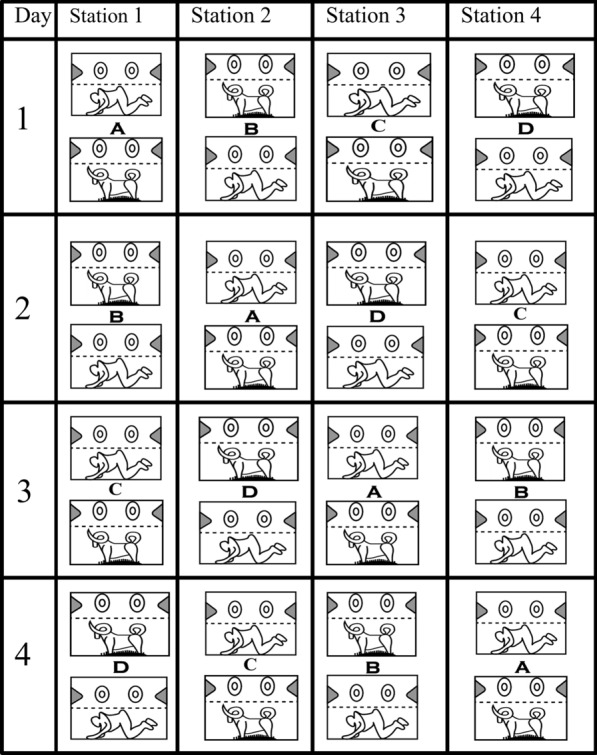
Eight Ifakara Tent Trap (ITT), four baited with humans and four with bovine calves, were simultaneously used to catch malaria vectors in open field sites in urban and rural Tanzania. The numbers of mosquitoes collected in human-baited traps versus calf-baited traps were used to estimate human feeding preference for each site's vector species.
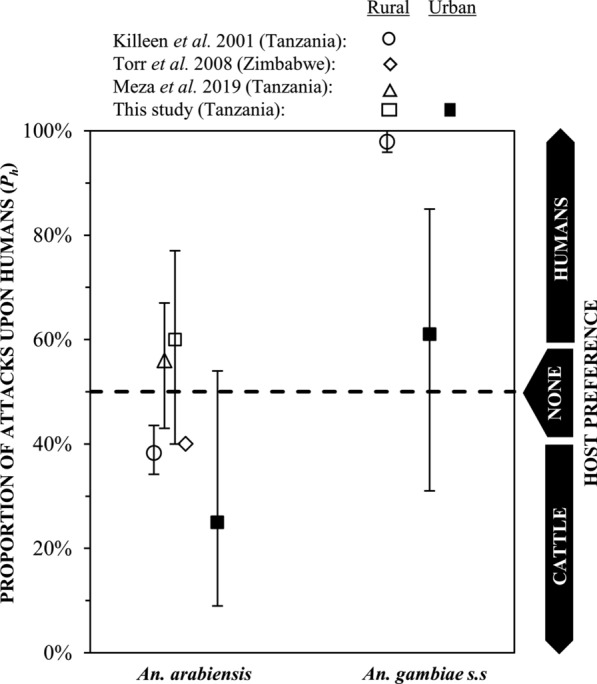
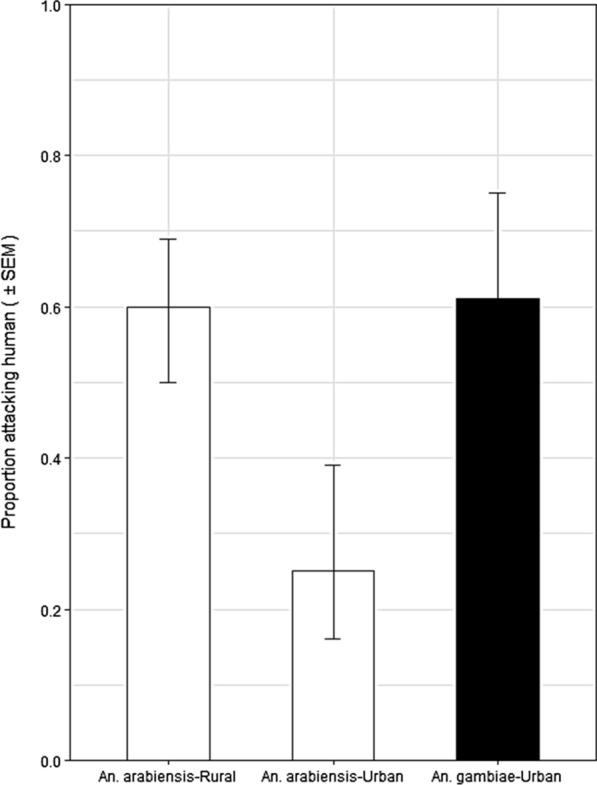
The estimated proportion [95% confidence interval (CI)] of mosquitoes attacking humans rather than cattle was 0.60 [0.40, 0.77] for An. arabiensis in the rural setting and 0.61 [0.32, 0.85] for An. gambiae s.s. in the urban setting, indicating no preference for either host in both cases (P = 0.32 and 0.46, respectively) and no difference in preference between the two (Odds Ratio (OR) [95%] = 0.95 [0.30, 3.01], P = 0.924). However, only a quarter of An. arabiensis in the urban setting attacked humans (0.25 [0.09, 0.53]), indicating a preference for cattle that approached significance (P = 0.08). Indeed, urban An. arabiensis were less likely to attack humans rather than cattle when compared to the same species in the rural setting (OR [95%] = 0.21 [0.05, 0.91], P = 0.037).
Urban An. arabiensis had a stronger preference for cattle than the rural population and urban An. gambiae s.s. showed no clear preference for either humans or cattle. In the urban setting, both species exhibited stronger tendencies to attack cattle than previous studies of the same species in rural contexts. Cattle keeping may, therefore, particularly limit the impact of human-targeted vector control interventions in Dar es Salaam and perhaps in other African towns and cities.
宿主偏好是人类接触媒介传播感染的关键决定因素,也是媒介控制干预措施影响的关键决定因素。在撒哈拉以南非洲地区广泛使用长效驱虫蚊帐(LLINs)和室内滞留喷洒(IRS),这些措施保护人类免受蚊子叮咬,这可能会导致疟疾传播媒介的宿主偏好特征在长期内发生改变。在这里,通过在坦桑尼亚两个不同生态环境中的实地直接宿主偏好测定实验,评估了阿拉伯按蚊和冈比亚按蚊(s.s.)的宿主偏好。
在坦桑尼亚城市和农村的开阔场地中,同时使用 8 个 Ifakara 帐篷陷阱(ITT),其中 4 个用人类诱饵,4 个用牛犊诱饵,来捕获疟疾媒介。在人类诱饵陷阱中捕获的蚊子数量与在牛犊诱饵陷阱中捕获的蚊子数量之比,用于估计每个地点的媒介物种对人类的摄食偏好。
在农村环境中,阿拉伯按蚊攻击人类的比例估计为 0.60 [0.40,0.77],在城市环境中,冈比亚按蚊 s.s.攻击人类的比例估计为 0.61 [0.32,0.85],这表明两种情况下对两种宿主都没有偏好(分别为 P=0.32 和 0.46),并且两者之间的偏好没有差异(优势比(OR)[95%]为 0.95 [0.30,3.01],P=0.924)。然而,只有四分之一的城市环境中的阿拉伯按蚊攻击人类(0.25 [0.09,0.53]),这表明对牛的偏好接近显著(P=0.08)。事实上,与农村环境中的同一物种相比,城市环境中的阿拉伯按蚊更不可能攻击人类,而更倾向于攻击牛(OR [95%]为 0.21 [0.05,0.91],P=0.037)。
城市环境中的阿拉伯按蚊比农村种群更喜欢牛,而城市环境中的冈比亚按蚊 s.s.对人类或牛都没有明显的偏好。在城市环境中,这两个物种攻击牛的倾向都比之前在农村环境中对同一物种的研究更强烈。因此,在达累斯萨拉姆,甚至在其他非洲城镇和城市,饲养牛可能会特别限制针对人类的媒介控制干预措施的影响。