Ministry of Education Key Laboratory of Environment and Health, and State Key Laboratory of Environmental Health (Incubating), School of Public Health, Tongji Medical College, Huazhong University of Science and Technology, No.13 Hangkong Road, Wuhan, 430030, China.
Department of Maternal and Child Health, School of Public Health, Tongji Medical College, Huazhong University of Science and Technology, No.13 Hangkong Road, Wuhan, 430030, China.
BMC Med. 2023 Nov 9;21(1):427. doi: 10.1186/s12916-023-03136-7.
Research on the association between telomere length (TL) and incident non-alcoholic fatty liver disease (NAFLD) is limited. This study examined this association and further assessed how TL contributes to the association of NAFLD with its known risk factors.
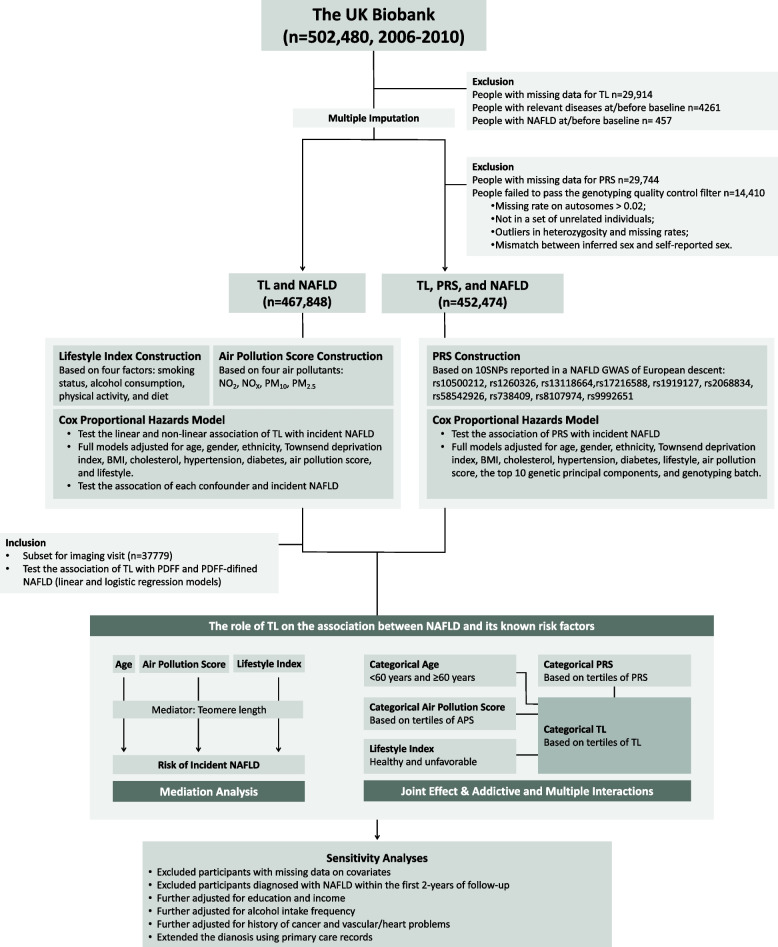
Quantitative PCR (polymerase chain reaction) was employed to assess leucocyte telomere length. Polygenic risk score (PRS) for NAFLD, air pollution score, and lifestyle index were constructed. Cox proportional hazard models were conducted to estimate the hazard ratios (HRs) and 95% confidence intervals.
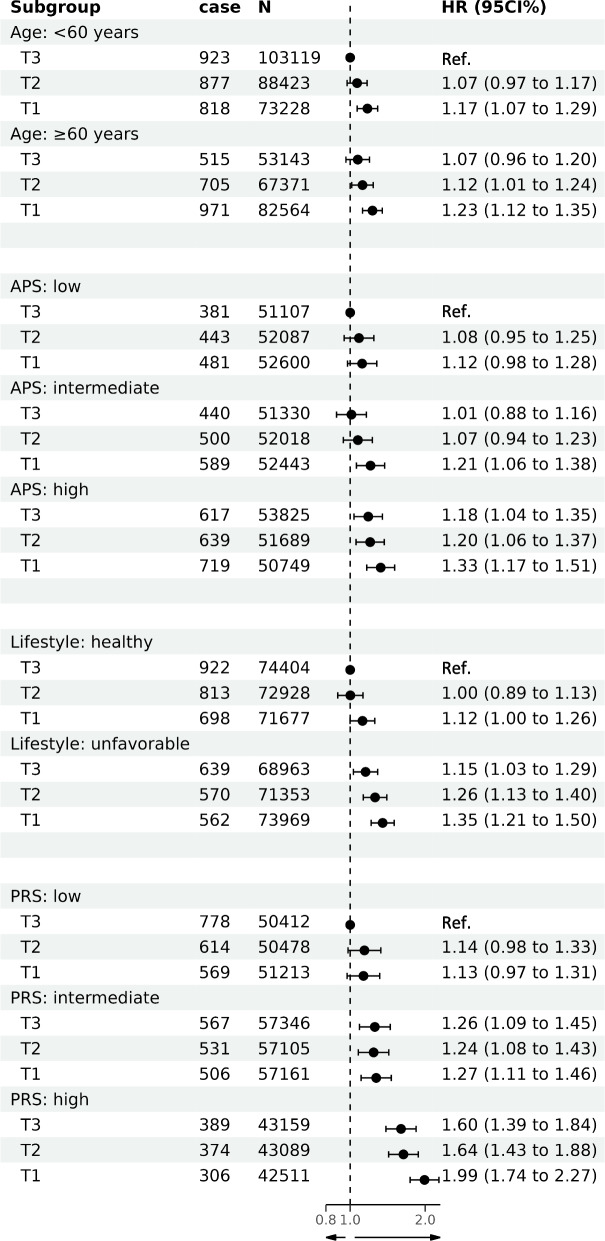
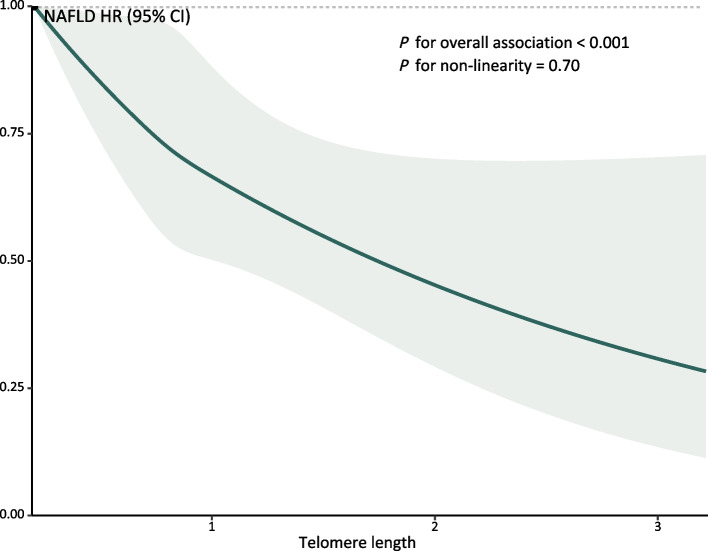
Among 467,848 participants in UK Biobank, we identified 4809 NAFLD cases over a median follow-up of 12.83 years. We found that long TL was associated with decreased risk of incident NAFLD, as each interquartile range increase in TL resulted in an HR of 0.93 (95% CI 0.89, 0.96). TL partly mediated the association between age and NAFLD (proportion mediated: 15.52%). When assessing the joint effects of TL and other risk factors, the highest risk of NAFLD was found in participants with low TL and old age, low TL and high air pollution score, low TL and unfavorable lifestyle, and low TL and high PRS, compared to each reference group. A positive addictive interaction was observed between high PRS and low TL, accounting for 14.57% (2.51%, 27.14%) of the risk of NAFLD in participants with low telomere length and high genetic susceptibility.
Long telomere length was associated with decreased risk of NAFLD incidence. Telomere length played an important role in NAFLD.
端粒长度(TL)与非酒精性脂肪性肝病(NAFLD)之间关联的研究有限。本研究检验了这种关联,并进一步评估了 TL 如何促进 NAFLD 与其已知危险因素的关联。
采用聚合酶链反应(PCR)定量检测白细胞端粒长度。构建了 NAFLD 的多基因风险评分(PRS)、空气污染评分和生活方式指数。采用 Cox 比例风险模型估计风险比(HR)和 95%置信区间。
在英国生物库中 467848 名参与者中,我们在中位随访 12.83 年期间确定了 4809 例 NAFLD 病例。我们发现,长 TL 与 NAFLD 发病风险降低相关,TL 每增加一个四分位间距,HR 为 0.93(95%CI 0.89,0.96)。TL 部分介导了年龄与 NAFLD 之间的关联(介导比例:15.52%)。在评估 TL 与其他危险因素的联合效应时,与每个参照组相比,TL 低且年龄大、TL 低且空气污染评分高、TL 低且生活方式不良、TL 低且 PRS 高的参与者患 NAFLD 的风险最高。在 TL 低且遗传易感性高的参与者中,观察到高 PRS 和 TL 之间存在正相加交互作用,占 TL 短且遗传易感性高的参与者患 NAFLD 风险的 14.57%(2.51%,27.14%)。
长端粒长度与 NAFLD 发病风险降低相关。端粒长度在 NAFLD 中起重要作用。