Department of Sociology, Stony Brook University, Stony Brook, New York, United States of America.
Department of Computer Science, Stony Brook University, Stony Brook, New York, United States of America.
PLoS One. 2023 Nov 9;18(11):e0294028. doi: 10.1371/journal.pone.0294028. eCollection 2023.
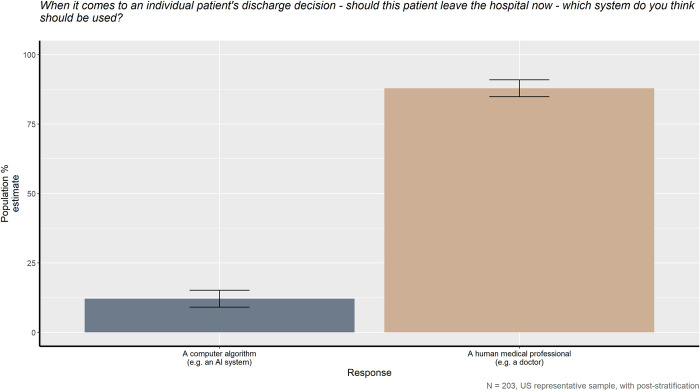
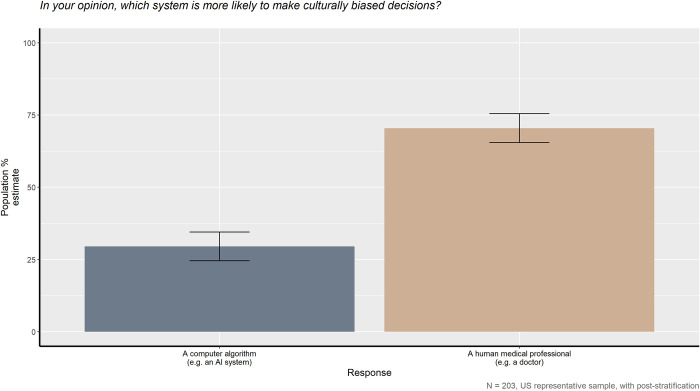
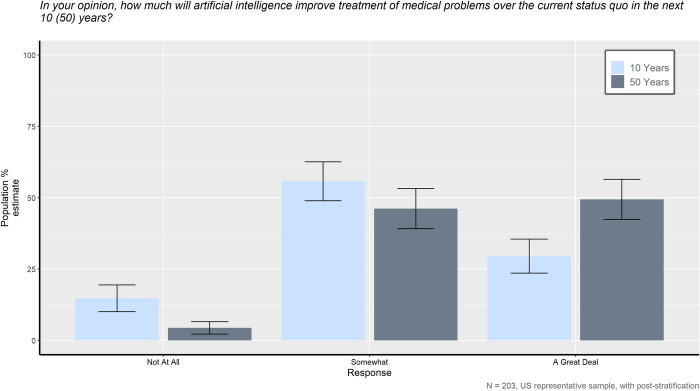
Billions of dollars are being invested into developing medical artificial intelligence (AI) systems and yet public opinion of AI in the medical field seems to be mixed. Although high expectations for the future of medical AI do exist in the American public, anxiety and uncertainty about what it can do and how it works is widespread. Continuing evaluation of public opinion on AI in healthcare is necessary to ensure alignment between patient attitudes and the technologies adopted. We conducted a representative-sample survey (total N = 203) to measure the trust of the American public towards medical AI. Primarily, we contrasted preferences for AI and human professionals to be medical decision-makers. Additionally, we measured expectations for the impact and use of medical AI in the future. We present four noteworthy results: (1) The general public strongly prefers human medical professionals make medical decisions, while at the same time believing they are more likely to make culturally biased decisions than AI. (2) The general public is more comfortable with a human reading their medical records than an AI, both now and "100 years from now." (3) The general public is nearly evenly split between those who would trust their own doctor to use AI and those who would not. (4) Respondents expect AI will improve medical treatment but more so in the distant future than immediately.
数十亿美元正投入到开发医学人工智能(AI)系统中,但公众对医学领域 AI 的看法似乎褒贬不一。尽管美国公众对医学 AI 的未来抱有很高的期望,但对其能做什么以及如何运作的焦虑和不确定性却普遍存在。为了确保患者态度与采用的技术保持一致,有必要持续评估公众对医疗 AI 的看法。我们进行了一项具有代表性的样本调查(总样本量为 203 人),以衡量美国公众对医疗 AI 的信任度。首先,我们对比了公众对 AI 和人类专业人员作为医疗决策者的偏好。此外,我们还衡量了对未来医疗 AI 的影响和使用的期望。我们提出了四个值得注意的结果:(1)公众强烈倾向于由人类医疗专业人员做出医疗决策,尽管他们同时认为人类专业人员比 AI 更有可能做出带有文化偏见的决策。(2)公众现在和“100 年后”都更愿意让人类医生读取他们的医疗记录,而不是让 AI 读取。(3)在是否信任自己的医生使用 AI 方面,受访者几乎平分秋色。(4)受访者期望 AI 将改善医疗,但更多的是在遥远的未来,而不是现在。