
酰基辅酶 A 合成酶长链家族成员 5(ACSL5)通过细胞外信号调节激酶(ERK)信号通路在软脂酸(C16:0)抑制肿瘤功能中的调控作用。
Regulatory roles of ACSL5 in the anti-tumor function of palmitic acid (C16:0) <em>via</em> the ERK signaling pathway.
机构信息
The Affiliated People's Hospital of Ningbo University, Ningbo, Zhejiang.
Ningbo Zhenhai People's Hospital, Ningbo, Zhejiang.
出版信息
Eur J Histochem. 2023 Nov 8;67(4):3867. doi: 10.4081/ejh.2023.3867.
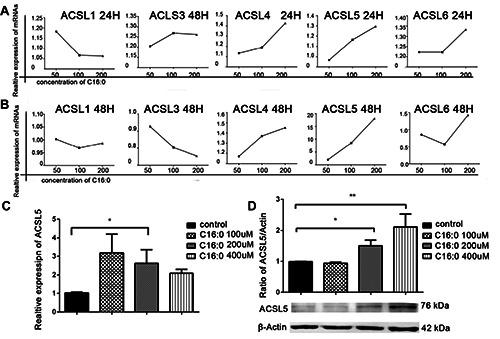
Previous studies have highlighted the susceptibility of cancer to perturbations in lipid metabolism. In particular, C16:0 has emerged as a promising novel treatment for hepatocellular carcinoma. In our study, we investigated the levels of C16:0 in the serum of non-small lung cancer patients were significant downregulation compared to healthy individuals (n=10; p<0.05). Moreover, our in vitro experiments using A549 cells demonstrated that C16:0 effectively inhibited proliferation, apoptosis, migration, and invasion. Despite these promising results, its pathogenesis remains poorly understood. CCK-8 assay, annexin V-FITC/PI double staining assay, wound healing assay and transwell assay were performed to evaluate the effects of C16:0, on proliferation, apoptosis, migration and invasion of A549 cells. RNA sequencing was used to identify essential factors involved in C16:0-growth inhibition in lung cancer. Further, the expression levels of related gene and proteins were detected by quantitative RT-PCR and Western blotting. Mouse NSCLC subcutaneous xenograft tumor model was established, and gastric lavage was given with C16:0. Tumor volume assay and hematoxylin-eosin staining were used to detect tumor growth in vivo. Our analysis revealed a significant upregulation of ACSL5 and its associated proteins in C16:0-treated A549 cells compared to the control group both in vivo and in vitro. Moreover, the knockdown of ACSL5 reversed the anti-tumor effect, resulting in an increased rate of the malignant phenotype mentioned above. Additionally, the expression of phosphorylated ERK protein was significantly inhibited with increasing concentrations of C16:0 in A549 cells. These results reveal for the first time that C16:0, as a novel target, regulates ACLS5 through the ERK signaling pathway, to inhibit the proliferation and apoptosis and inhibits cell migration and invasion of NSCLC. These findings may lead to the development of a novel therapeutic approach for non-small lung cancer.
先前的研究强调了癌症对脂质代谢扰动的易感性。特别是,C16:0 已成为治疗肝细胞癌的一种有前途的新方法。在我们的研究中,我们发现与健康个体相比(n=10;p<0.05),非小细胞肺癌患者的血清中 C16:0 水平显著下调。此外,我们使用 A549 细胞进行的体外实验表明,C16:0 能有效抑制增殖、凋亡、迁移和侵袭。尽管这些结果很有前景,但它的发病机制仍知之甚少。通过 CCK-8 法、Annexin V-FITC/PI 双染法、划痕愈合试验和 Transwell 试验评价 C16:0 对 A549 细胞增殖、凋亡、迁移和侵袭的影响。采用 RNA 测序鉴定 C16:0 抑制肺癌生长过程中的关键因素。进一步通过定量 RT-PCR 和 Western blot 检测相关基因和蛋白的表达水平。建立小鼠 NSCLC 皮下移植瘤模型,给予 C16:0 灌胃。通过肿瘤体积测定和苏木精-伊红染色检测体内肿瘤生长情况。我们的分析显示,与对照组相比,C16:0 处理的 A549 细胞中 ACSL5 及其相关蛋白的表达水平显著上调,无论是在体内还是在体外。此外,ACSL5 的敲低逆转了抗肿瘤作用,导致上述恶性表型的发生率增加。此外,随着 C16:0 浓度的增加,A549 细胞中磷酸化 ERK 蛋白的表达显著受到抑制。这些结果首次表明,C16:0 作为一种新的靶点,通过 ERK 信号通路调节 ACLS5,抑制 NSCLC 的增殖和凋亡,并抑制细胞迁移和侵袭。这些发现可能为非小细胞肺癌的治疗提供新的方法。




 Zotero 插件