National Clinical Research Center for Geriatric Disorders, Department of Geriatrics, Xiangya Hospital, Central South University, Changsha, Hunan 410008, China.
Department of Neurology, Xiangya Hospital, Central South University, Changsha, Hunan 410008, China.
Nucleic Acids Res. 2024 Jan 5;52(D1):D1478-D1489. doi: 10.1093/nar/gkad1061.
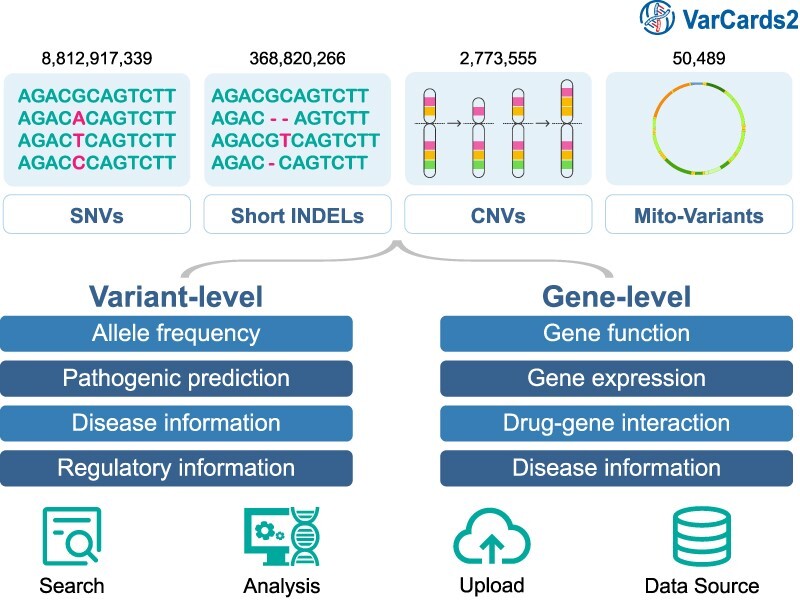
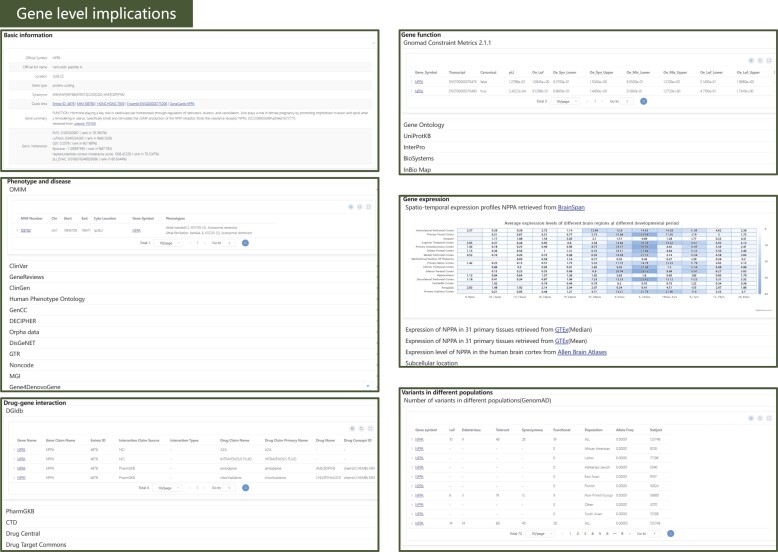
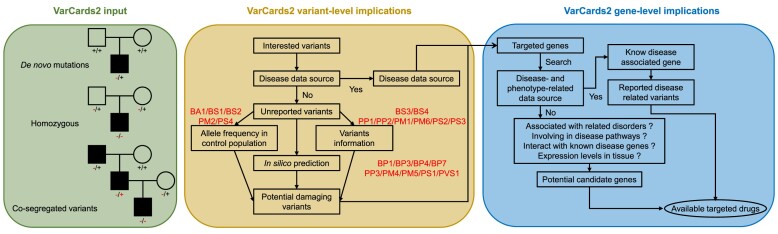
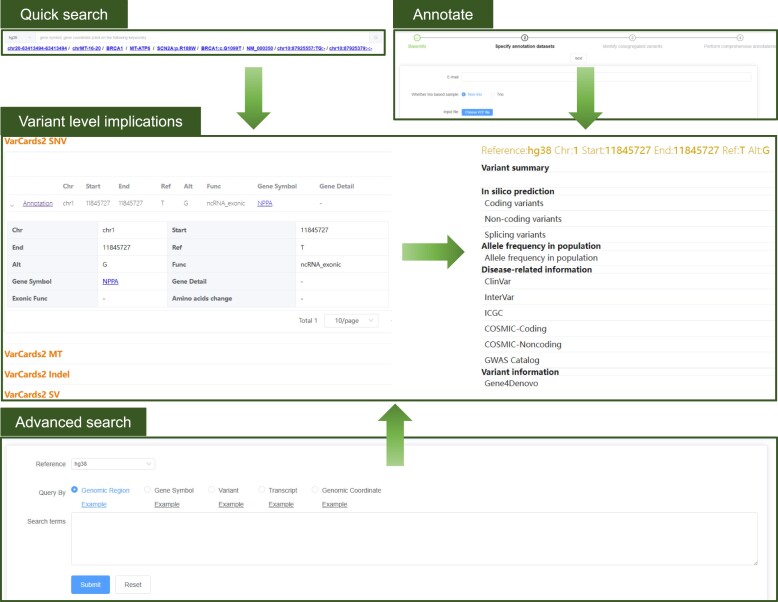
VarCards, an online database, combines comprehensive variant- and gene-level annotation data to streamline genetic counselling for coding variants. Recognising the increasing clinical relevance of non-coding variations, there has been an accelerated development of bioinformatics tools dedicated to interpreting non-coding variations, including single-nucleotide variants and copy number variations. Regrettably, most tools remain as either locally installed databases or command-line tools dispersed across diverse online platforms. Such a landscape poses inconveniences and challenges for genetic counsellors seeking to utilise these resources without advanced bioinformatics expertise. Consequently, we developed VarCards2, which incorporates nearly nine billion artificially generated single-nucleotide variants (including those from mitochondrial DNA) and compiles vital annotation information for genetic counselling based on ACMG-AMP variant-interpretation guidelines. These annotations include (I) functional effects; (II) minor allele frequencies; (III) comprehensive function and pathogenicity predictions covering all potential variants, such as non-synonymous substitutions, non-canonical splicing variants, and non-coding variations and (IV) gene-level information. Furthermore, VarCards2 incorporates 368 820 266 documented short insertions and deletions and 2 773 555 documented copy number variations, complemented by their corresponding annotation and prediction tools. In conclusion, VarCards2, by integrating over 150 variant- and gene-level annotation sources, significantly enhances the efficiency of genetic counselling and can be freely accessed at http://www.genemed.tech/varcards2/.
VarCards 是一个在线数据库,它结合了全面的变异体和基因水平注释数据,以简化编码变异体的遗传咨询。认识到非编码变异的临床相关性不断增加,专门用于解释非编码变异的生物信息学工具得到了加速发展,包括单核苷酸变异和拷贝数变异。遗憾的是,大多数工具仍然是本地安装的数据库或命令行工具,分散在各种在线平台上。这种情况给寻求利用这些资源但没有先进的生物信息学专业知识的遗传咨询师带来了不便和挑战。因此,我们开发了 VarCards2,它包含了近 90 亿个人工生成的单核苷酸变异体(包括来自线粒体 DNA 的变异体),并根据 ACMG-AMP 变异体解释指南为遗传咨询编译重要的注释信息。这些注释包括 (I) 功能影响;(II) 次要等位基因频率;(III) 涵盖所有潜在变异的综合功能和致病性预测,如非 synonymous 取代、非规范剪接变异体和非编码变异体;以及 (IV) 基因水平信息。此外,VarCards2 还包含了 368,820,266 个已记录的短插入和缺失以及 2,773,555 个已记录的拷贝数变异体,以及它们相应的注释和预测工具。总之,VarCards2 通过整合超过 150 个变异体和基因水平注释来源,大大提高了遗传咨询的效率,可以在 http://www.genemed.tech/varcards2/ 免费访问。