Sola Antonella, Trinchi Adrian
Advanced Materials and Processing, Manufacturing Business Unit, Commonwealth Scientific and Industrial Research Organisation (CSIRO), Clayton, Melbourne, VIC 3169, Australia.
Polymers (Basel). 2023 Oct 25;15(21):4219. doi: 10.3390/polym15214219.
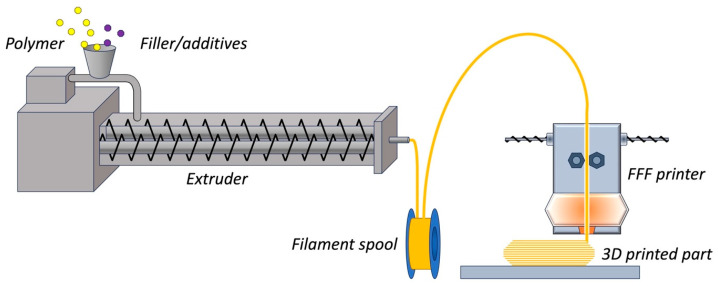
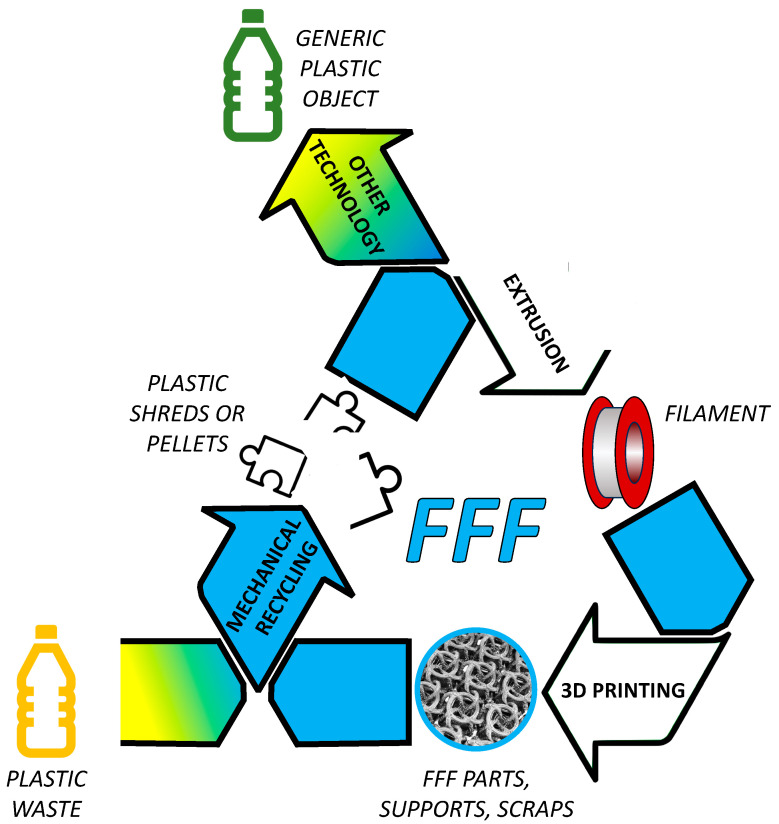
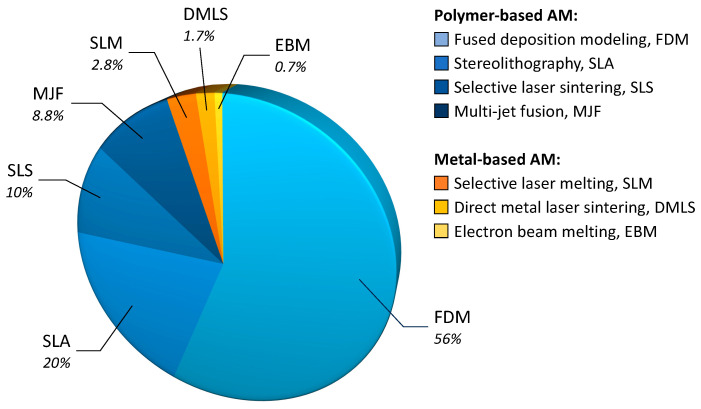
Additive manufacturing (AM, aka 3D printing) is generally acknowledged as a "green" technology. However, its wider uptake in industry largely relies on the development of composite feedstock for imparting superior mechanical properties and bespoke functionality. Composite materials are especially needed in polymer AM, given the otherwise poor performance of most polymer parts in load-bearing applications. As a drawback, the shift from mono-material to composite feedstock may worsen the environmental footprint of polymer AM. This perspective aims to discuss this chasm between the advantage of embedding advanced functionality, and the disadvantage of causing harm to the environment. Fused filament fabrication (FFF, aka fused deposition modelling, FDM) is analysed here as a case study on account of its unparalleled popularity. FFF, which belongs to the material extrusion (MEX) family, is presently the most widespread polymer AM technique for industrial, educational, and recreational applications. On the one hand, the FFF of composite materials has already transitioned "from lab to fab" and finally to community, with far-reaching implications for its sustainability. On the other hand, feedstock materials for FFF are thermoplastic-based, and hence highly amenable to recycling. The literature shows that recycled thermoplastic materials such as poly(lactic acid) (PLA), acrylonitrile-butadiene-styrene (ABS), and polyethylene terephthalate (PET, or its glycol-modified form PETG) can be used for printing by FFF, and FFF printed objects can be recycled when they are at the end of life. Reinforcements/fillers can also be obtained from recycled materials, which may help valorise waste materials and by-products from a wide range of industries (for example, paper, food, furniture) and from agriculture. Increasing attention is being paid to the recovery of carbon fibres (for example, from aviation), and to the reuse of glass fibre-reinforced polymers (for example, from end-of-life wind turbines). Although technical challenges and economical constraints remain, the adoption of recycling strategies appears to be essential for limiting the environmental impact of composite feedstock in FFF by reducing the depletion of natural resources, cutting down the volume of waste materials, and mitigating the dependency on petrochemicals.
增材制造(AM,又称3D打印)通常被认为是一项“绿色”技术。然而,它在工业领域的更广泛应用在很大程度上依赖于复合原料的开发,以赋予材料卓越的机械性能和定制功能。鉴于大多数聚合物部件在承重应用中性能不佳,聚合物增材制造尤其需要复合材料。作为一个缺点,从单一材料向复合原料的转变可能会使聚合物增材制造的环境足迹恶化。本文旨在探讨在嵌入先进功能的优势与对环境造成危害的劣势之间的这一差距。鉴于熔融长丝制造(FFF,又称熔丝沉积建模,FDM)无与伦比的受欢迎程度,本文将其作为一个案例进行分析。FFF属于材料挤出(MEX)类别,目前是工业、教育和娱乐应用中最广泛使用的聚合物增材制造技术。一方面,复合材料的熔融长丝制造已经从“实验室走向工厂”,最终走向大众,对其可持续性产生了深远影响。另一方面,FFF的原料是热塑性的,因此非常适合回收利用。文献表明,聚乳酸(PLA)、丙烯腈-丁二烯-苯乙烯(ABS)和聚对苯二甲酸乙二酯(PET,或其二醇改性形式PETG)等回收热塑性材料可用于FFF打印,并且FFF打印的物体在使用寿命结束时可以回收。增强材料/填料也可以从回收材料中获得,这可能有助于使来自广泛行业(例如造纸、食品、家具)和农业的废料和副产品增值。人们越来越关注碳纤维的回收(例如来自航空领域)以及玻璃纤维增强聚合物的再利用(例如来自报废风力涡轮机)。尽管技术挑战和经济限制仍然存在,但采用回收策略对于通过减少自然资源的消耗、减少废料量以及减轻对石化产品的依赖来限制FFF中复合原料的环境影响似乎至关重要。