Section of Molecular Epidemiology, Department of Biomedical Data Sciences, Leiden University Medical Center, PO Box 9600, Post-zone S-05-P, 2300 RC, Leiden, The Netherlands.
Center for Molecular Medicine, Division of Laboratories, Pharmacy and Biomedical Genetics, University Medical Center Utrecht, Utrecht, The Netherlands.
Geroscience. 2024 Apr;46(2):2359-2369. doi: 10.1007/s11357-023-01001-2. Epub 2023 Nov 14.
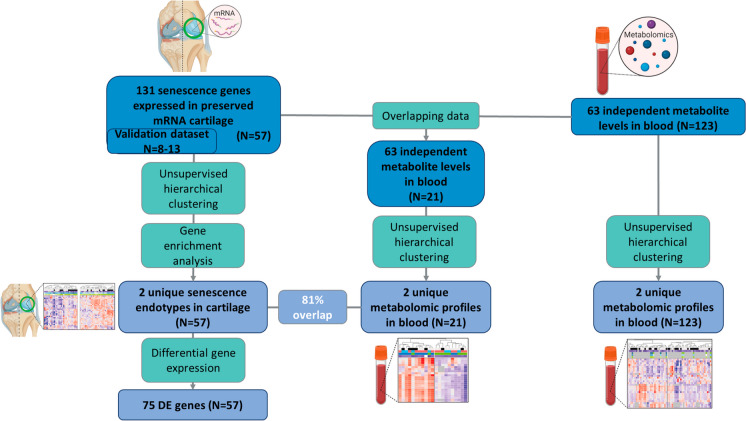
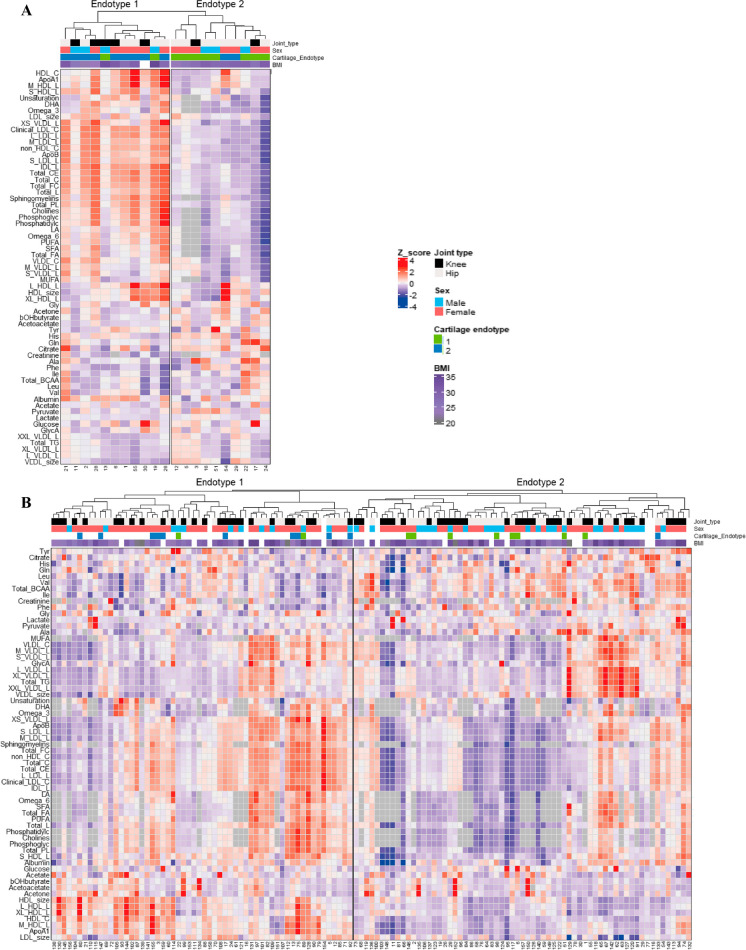
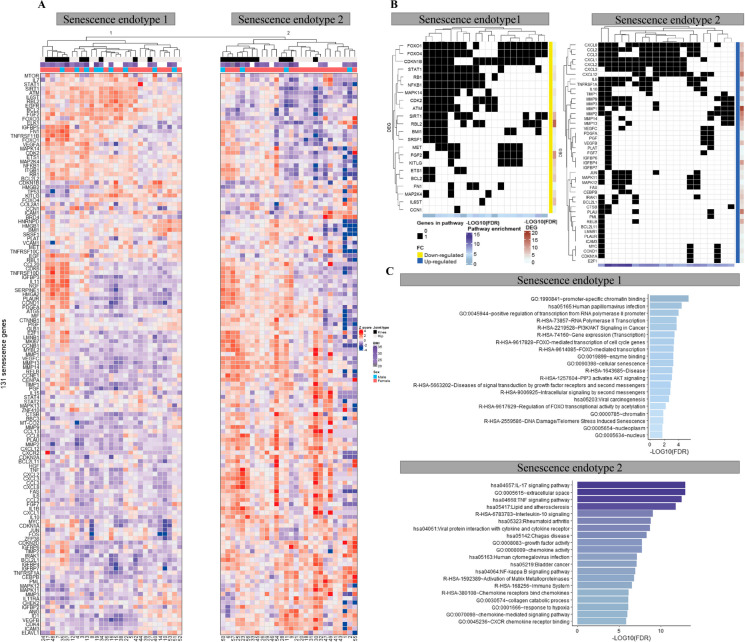
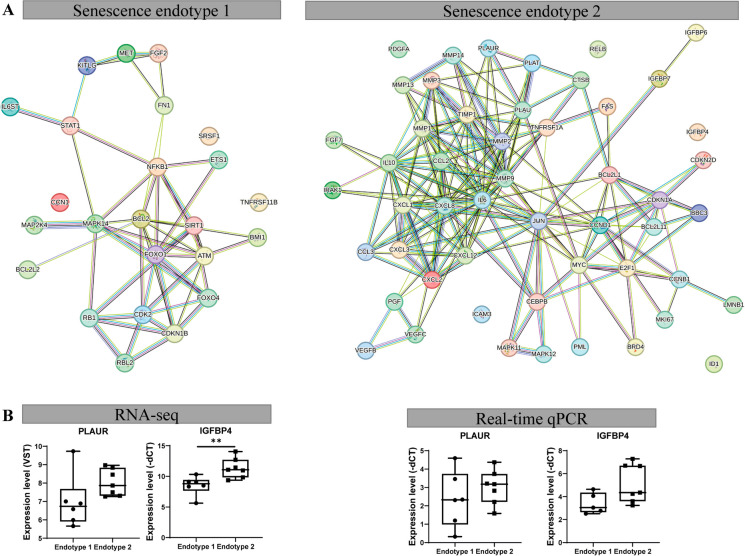
Heterogeneous accumulation of senescent cells expressing the senescence-associated secretory phenotype (SASP) affects tissue homeostasis which leads to diseases, such as osteoarthritis (OA). In this study, we set out to characterize heterogeneity of cellular senescence within aged articular cartilage and explored the presence of corresponding metabolic profiles in blood that could function as representative biomarkers. Hereto, we set out to perform cluster analyses, using a gene-set of 131 senescence genes (N = 57) in a previously established RNA sequencing dataset of aged articular cartilage and a generated metabolic dataset in overlapping blood samples. Using unsupervised hierarchical clustering and pathway analysis, we identified two robust cellular senescent endotypes. Endotype-1 was enriched for cell proliferating pathways, expressing forkhead box protein O4 (FOXO4), RB transcriptional corepressor like 2 (RBL2), and cyclin-dependent kinase inhibitor 1B (CDKN1B); the FOXO mediated cell cycle was identified as possible target for endotype-1 patients. Endotype-2 showed enriched inflammation-associated pathways, expressed by interleukin 6 (IL6), matrix metallopeptidase (MMP)1/3, and vascular endothelial growth factor (VEGF)C and SASP pathways were identified as possible targets for endotype-2 patients. Notably, plasma-based metabolic profiles in overlapping blood samples (N = 21) showed two corresponding metabolic clusters in blood. These non-invasive metabolic profiles could function as biomarkers for patient-tailored targeting of senescence in OA.
衰老细胞的异质性积累表达衰老相关分泌表型 (SASP) 会影响组织内稳态,从而导致疾病,如骨关节炎 (OA)。在这项研究中,我们旨在描述老年关节软骨内细胞衰老的异质性,并探索血液中存在的相应代谢特征,这些特征可能作为有代表性的生物标志物。为此,我们使用先前建立的 RNA 测序数据集和重叠血液样本中的生成代谢数据集,对 131 个衰老基因的基因集(N=57)进行聚类分析。通过无监督层次聚类和通路分析,我们确定了两种稳健的细胞衰老终末类型。终末 1 型富含细胞增殖途径,表达叉头框蛋白 O4 (FOXO4)、RB 转录核心抑制因子样 2 (RBL2) 和细胞周期蛋白依赖性激酶抑制剂 1B (CDKN1B);FOXO 介导的细胞周期可能是终末 1 型患者的潜在靶点。终末 2 型表现出丰富的炎症相关途径,表达白细胞介素 6 (IL6)、基质金属蛋白酶 (MMP)1/3 和血管内皮生长因子 (VEGF)C 和 SASP 途径被确定为终末 2 型患者的潜在靶点。值得注意的是,重叠血液样本中的基于血浆的代谢特征(N=21)在血液中显示出两个对应的代谢簇。这些非侵入性的代谢特征可作为 OA 中针对衰老的个体化靶向治疗的生物标志物。