Department of Epidemiology and Biostatistics, School of Public Health, Peking University, Beijing, 100191, China.
Department of Intensive Care Unit, PLA Rocket Force Characteristic Medical Center, Beijing, 100088, China.
Hum Genomics. 2023 Nov 14;17(1):101. doi: 10.1186/s40246-023-00547-8.
Comorbidities of coronavirus disease 2019 (COVID-19)/coronary heart disease (CHD) pose great threats to disease outcomes, yet little is known about their shared pathology. The study aimed to examine whether comorbidities of COVID-19/CHD involved shared genetic pathology, as well as to clarify the shared genetic variants predisposing risks common to COVID-19 severity and CHD risks.
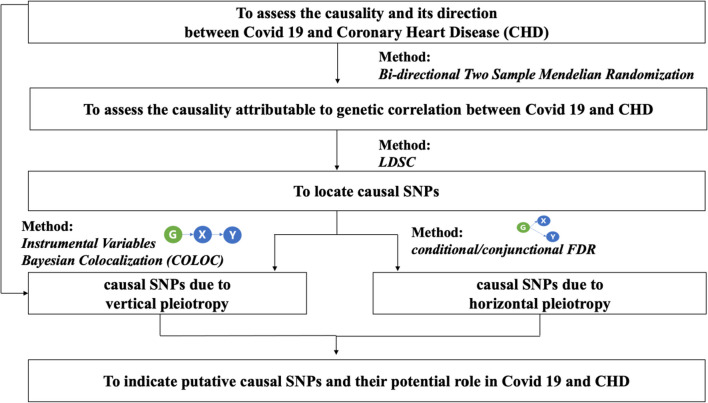
By leveraging publicly available summary statistics, we assessed the genetically determined causality between COVID-19 and CHD with bidirectional Mendelian randomization. To further quantify the causality contributed by shared genetic variants, we interrogated their genetic correlation with the linkage disequilibrium score regression method. Bayesian colocalization analysis coupled with conditional/conjunctional false discovery rate analysis was applied to decipher the shared causal single nucleotide polymorphisms (SNPs).
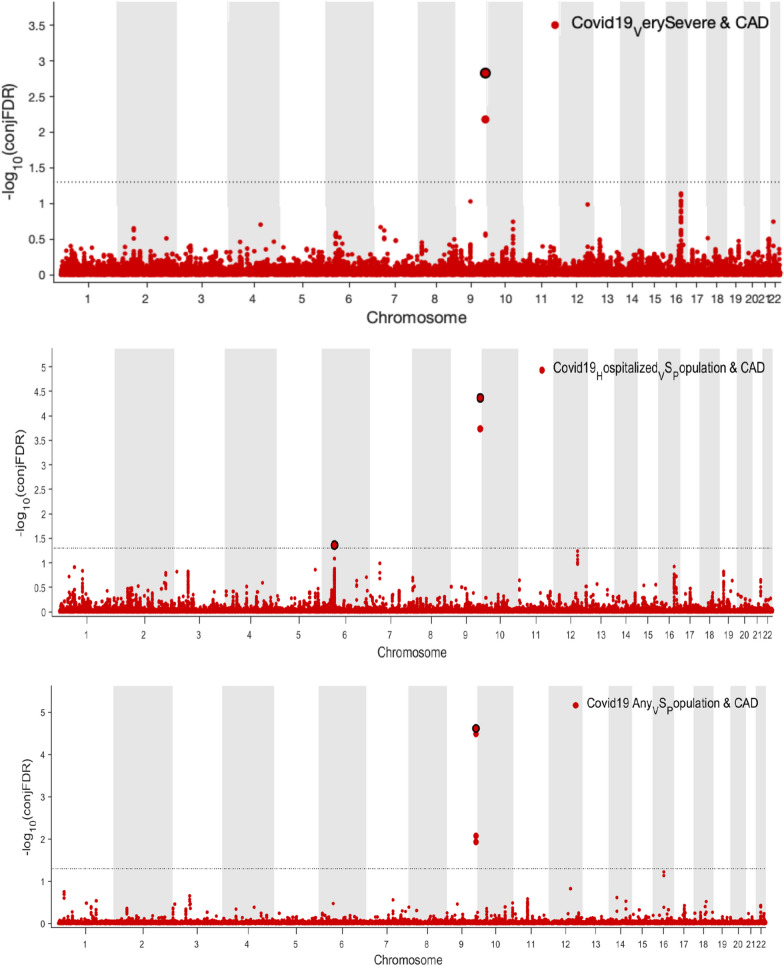
Briefly, we observed that the incident CHD risks post COVID-19 infection were partially determined by shared genetic variants. The shared genetic variants contributed to the causality at a proportion of 0.18 (95% CI 0.18-0.19) to 0.23 (95% CI 0.23-0.24). The SNP (rs10490770) located near LZTFL1 suggested direct causality (SNPs → COVID-19 → CHD), and SNPs in ABO (rs579459, rs495828), ILRUN(rs2744961), and CACFD1(rs4962153, rs3094379) may simultaneously influence COVID-19 severity and CHD risks.
Five SNPs located near LZTFL1 (rs10490770), ABO (rs579459, rs495828), ILRUN (rs2744961), and CACFD1 (rs4962153, rs3094379) may simultaneously influence their risks. The current study suggested that there may be shared mechanisms predisposing to both COVID-19 severity and CHD risks. Genetic predisposition to COVID-19 is a causal risk factor for CHD, supporting that reducing the COVID-19 infection risk or alleviating COVID-19 severity among those with specific genotypes might reduce their subsequent CHD adverse outcomes. Meanwhile, the shared genetic variants identified may be of clinical implications for identifying the target population who are more vulnerable to adverse CHD outcomes post COVID-19 and may also advance treatments of 'Long COVID-19.'
2019 年冠状病毒病(COVID-19)/冠心病(CHD)的合并症对疾病结局构成了巨大威胁,但人们对其共同的发病机制知之甚少。本研究旨在探讨 COVID-19/CHD 的合并症是否涉及共同的遗传发病机制,并阐明导致 COVID-19 严重程度和 CHD 风险共同的遗传变异。
通过利用公开的汇总统计数据,我们使用双向 Mendelian 随机化来评估 COVID-19 和 CHD 之间由遗传决定的因果关系。为了进一步量化共同遗传变异所贡献的因果关系,我们使用连锁不平衡评分回归方法探究了它们与 COVID-19 严重程度和 CHD 风险的遗传相关性。贝叶斯共定位分析结合条件/联合假发现率分析用于破译共同的因果单核苷酸多态性(SNP)。
简要地说,我们观察到 COVID-19 感染后发生 CHD 的风险部分由共同的遗传变异决定。共同的遗传变异对因果关系的贡献比例为 0.18(95%CI 0.18-0.19)至 0.23(95%CI 0.23-0.24)。位于 LZTFL1 附近的 SNP(rs10490770)提示直接因果关系(SNP→COVID-19→CHD),而 ABO(rs579459、rs495828)、ILRUN(rs2744961)和 CACFD1(rs4962153、rs3094379)中的 SNP 可能同时影响 COVID-19 严重程度和 CHD 风险。
位于 LZTFL1(rs10490770)、ABO(rs579459、rs495828)、ILRUN(rs2744961)和 CACFD1(rs4962153、rs3094379)附近的五个 SNP 可能同时影响它们的风险。本研究提示,可能存在共同的发病机制导致 COVID-19 严重程度和 CHD 风险。遗传易感性是 COVID-19 发生的因果风险因素,这支持了减少 COVID-19 感染风险或减轻 COVID-19 严重程度的措施可能会降低特定基因型患者的后续 CHD 不良结局。同时,鉴定出的共同遗传变异可能对识别更易发生 COVID-19 后不良 CHD 结局的目标人群具有临床意义,并且也可能为“长 COVID-19”的治疗提供新的思路。