Department of Experimental, Diagnostic and Specialty Medicine, University of Bologna, Via Giuseppe Massarenti 9, 40134 Bologna, Italy.
Cardiovascular Program ICCC-Research Institute Hospital de la Santa Creu i Sant Pau, IIB-Sant Pau, CiberCV, Barcelona, Spain.
Cardiovasc Res. 2021 Dec 17;117(14):2705-2729. doi: 10.1093/cvr/cvab298.
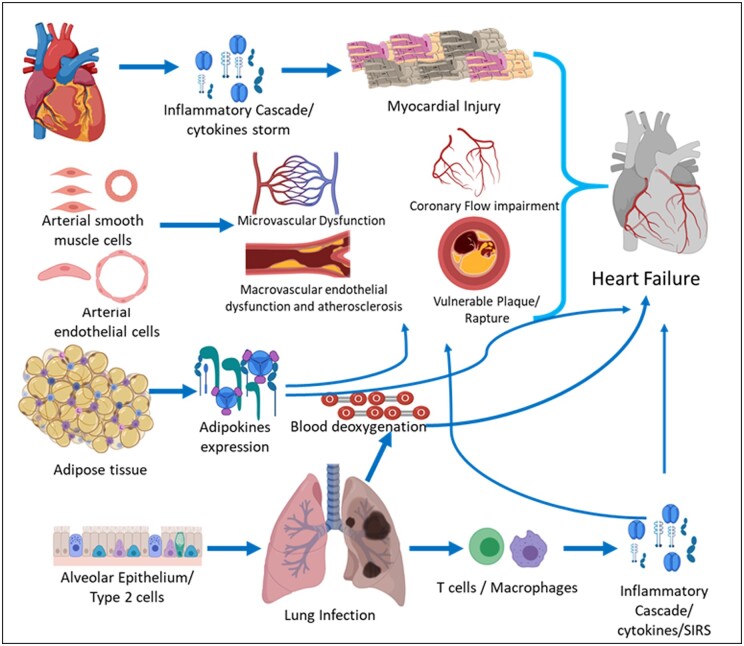
The cardiovascular system is significantly affected in coronavirus disease-19 (COVID-19). Microvascular injury, endothelial dysfunction, and thrombosis resulting from viral infection or indirectly related to the intense systemic inflammatory and immune responses are characteristic features of severe COVID-19. Pre-existing cardiovascular disease and viral load are linked to myocardial injury and worse outcomes. The vascular response to cytokine production and the interaction between severe acute respiratory syndrome coronavirus-2 (SARS-CoV-2) and angiotensin-converting enzyme 2 receptor may lead to a significant reduction in cardiac contractility and subsequent myocardial dysfunction. In addition, a considerable proportion of patients who have been infected with SARS-CoV-2 do not fully recover and continue to experience a large number of symptoms and post-acute complications in the absence of a detectable viral infection. This conditions often referred to as 'post-acute COVID-19' may have multiple causes. Viral reservoirs or lingering fragments of viral RNA or proteins contribute to the condition. Systemic inflammatory response to COVID-19 has the potential to increase myocardial fibrosis which in turn may impair cardiac remodelling. Here, we summarize the current knowledge of cardiovascular injury and post-acute sequelae of COVID-19. As the pandemic continues and new variants emerge, we can advance our knowledge of the underlying mechanisms only by integrating our understanding of the pathophysiology with the corresponding clinical findings. Identification of new biomarkers of cardiovascular complications, and development of effective treatments for COVID-19 infection are of crucial importance.
心血管系统在 2019 冠状病毒病(COVID-19)中受到显著影响。微血管损伤、内皮功能障碍和血栓形成是由病毒感染引起的,或与强烈的全身炎症和免疫反应间接相关,是严重 COVID-19 的特征。先前存在的心血管疾病和病毒载量与心肌损伤和更差的结局有关。细胞因子产生的血管反应以及严重急性呼吸综合征冠状病毒 2(SARS-CoV-2)与血管紧张素转换酶 2 受体之间的相互作用可能导致心脏收缩力显著降低,随后出现心肌功能障碍。此外,相当一部分感染了 SARS-CoV-2 的患者并未完全康复,在没有可检测到的病毒感染的情况下,仍持续出现大量症状和急性后并发症。这种情况通常被称为“急性后 COVID-19”,可能有多种原因。病毒储库或残留的病毒 RNA 或蛋白质片段导致了这种情况。COVID-19 的全身炎症反应有可能增加心肌纤维化,进而可能损害心脏重塑。在这里,我们总结了 COVID-19 心血管损伤和急性后后遗症的现有知识。随着大流行的继续和新变体的出现,我们只有通过将对病理生理学的理解与相应的临床发现相结合,才能推进对潜在机制的认识。识别心血管并发症的新生物标志物和开发 COVID-19 感染的有效治疗方法至关重要。