Department of Medicine and Therapeutics, Faculty of Medicine, The Chinese University of Hong Kong, Shatin, New Territories, Hong Kong.
The Jockey Club Institute of Ageing, The Chinese University of Hong Kong, Shatin, New Territories, Hong Kong.
Clin Interv Aging. 2023 Nov 9;18:1851-1861. doi: 10.2147/CIA.S431218. eCollection 2023.
This study examined the psychometric properties of the Cantonese version of the SarQoL questionnaire.
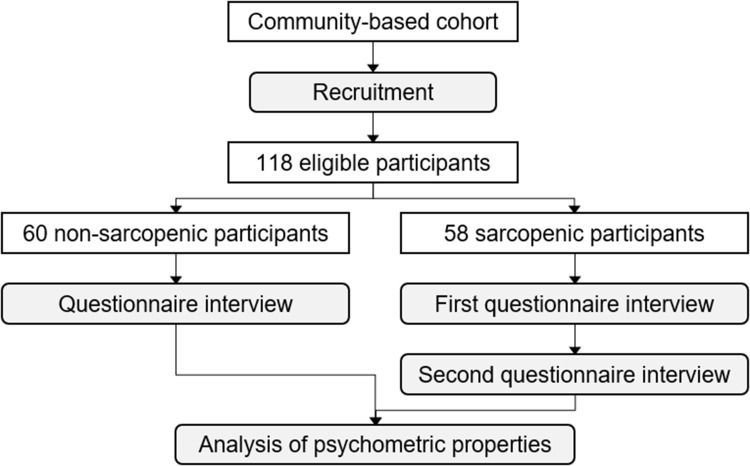
A total of 118 (including 60 non-sarcopenic and 58 sarcopenic) community-dwelling older adults aged 65 years or above with Cantonese as their mother tongue.
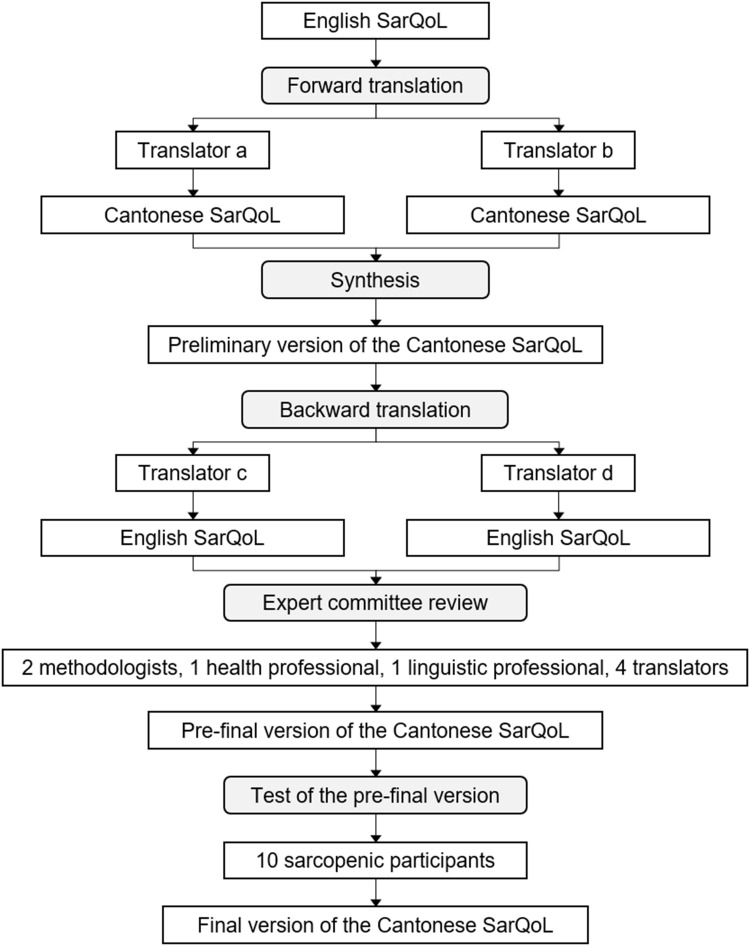
Translation and cultural adaptation of the SarQoL were conducted using a standardized protocol. To validate the Cantonese SarQoL, psychometric properties including discriminative power, reliability (including internal consistency and test-retest reliability), and construct validity (including convergent and divergent validity), as well as floor and ceiling effects, were assessed.
The translation of the questionnaire was completed without significant difficulties. Results indicated that the Cantonese SarQoL had (1) good discriminative power (sarcopenic participants had lower overall scores, mean = 66.1 vs 75.0, < 0.001; the overall score was negatively predictive of the presence of sarcopenia, adjusted OR = 0.949, 95% CI = [0.912, 0.983]), (2) good internal consistency (Cronbach's alpha = 0.835; correlations between domain and overall scores ranged from 0.576 to 0.868), (3) excellent test-retest agreement (intraclass correlation coefficient = 0.801), (4) good construct validity (convergent: moderate to strong correlations were found between the overall score and almost all of the SF-36 and EQ-5D domains; divergent: weaker correlations were found between the overall score and SF-36 social functioning, = -0.098, and EQ-5D self-care, = -0.331), and (5) no floor or ceiling effect.
The Cantonese SarQoL is valid and reliable, and thus can be used as an interviewer-administered questionnaire for assessing sarcopenia-specific quality of life in fieldwork practice.
本研究旨在检验粤语版 SarQoL 问卷的心理测量特性。
共有 118 名(包括 60 名非肌少症和 58 名肌少症)母语为粤语的社区居住的 65 岁及以上老年人。
采用标准化方案对 SarQoL 进行翻译和文化调适。为验证粤语版 SarQoL 的有效性,评估了心理测量特性,包括区分度、信度(包括内部一致性和重测信度)、结构效度(包括收敛和发散效度)以及地板效应和天花板效应。
问卷翻译过程顺利,未遇到明显困难。结果表明,粤语版 SarQoL 具有(1)良好的区分度(肌少症患者的总体得分较低,均值=66.1 分比 75.0 分,<0.001;总体得分与肌少症的存在呈负相关,调整后的优势比(OR)=0.949,95%置信区间(CI)=[0.912,0.983]);(2)良好的内部一致性(Cronbach's alpha=0.835;各领域与总体得分之间的相关性范围为 0.576 至 0.868);(3)极好的重测信度(组内相关系数=0.801);(4)良好的结构效度(收敛:总体得分与 SF-36 和 EQ-5D 几乎所有领域之间呈中度至高度相关;发散:总体得分与 SF-36 社会功能(r=-0.098)和 EQ-5D 自我照顾(r=-0.331)之间的相关性较弱);(5)无地板效应和天花板效应。
粤语版 SarQoL 具有有效性和可靠性,因此可作为现场工作实践中评估肌少症特异性生活质量的访谈者管理问卷使用。