Department of Health Information Technology, School of Paramedical, Ilam University of Medical Sciences, Ilam, Iran.
Department of Health Information Management, School of Health Management and Information Sciences, Iran University of Medical Sciences, Tehran, Iran.
BMC Med Inform Decis Mak. 2023 Nov 15;23(1):261. doi: 10.1186/s12911-023-02348-4.
Despite the fact that telemedicine can eliminate geographical and time limitations and offer the possibility of diagnosing, treating, and preventing diseases by sharing reliable information, many individuals still prefer to visit medical centers for in-person consultations. The aim of this study was to determine the level of acceptance of telemedicine compared to in-person visits, identify the perceived advantages of telemedicine over in-person visits, and to explore the reasons why patients choose either of these two types of visits.
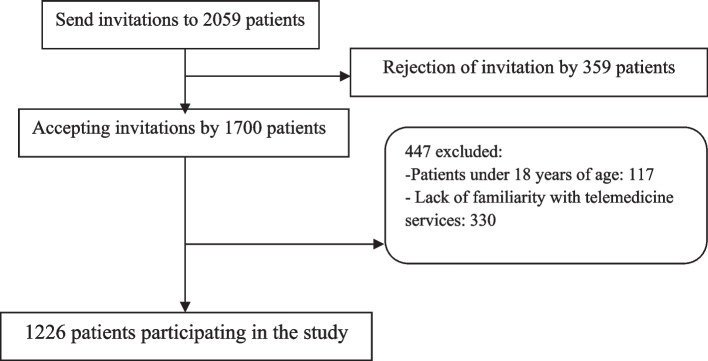
We developed a questionnaire using the rational method. The questionnaire consisted of multiple-choice questions and one open-ended question. A total of 2059 patients were invited to participate in the study. Chi-square tests and descriptive statistics were employed for data analysis. To analyze the data from the open-ended question, we conducted qualitative content analysis using MAXQDA 18.
Out of the 1226 participants who completed the questionnaire, 865 (71%) preferred in-person visits, while 361 (29%) preferred telemedicine. Factors such as education level, specific health conditions, and prior experience with telemedicine influenced the preference for telemedicine. The participants provided a total of 183 different reasons for choosing either telemedicine (108 reasons) or in-person visits (75 reasons). Avoiding infectious diseases, saving cost, and eliminating and overcoming geographical distance barriers were three primary telemedicine benefits. The primary reasons for selecting an in-person visit were: more accurate diagnosis of the disease, more accurate and better examination of the patient by the physician, and more accurate and better treatment of the disease.
The results demonstrate that despite the numerous benefits offered by telemedicine, the majority of patients still exhibit a preference for in-person visits. In order to promote broader acceptance of telemedicine, it becomes crucial for telemedicine services to address patient preferences and concerns effectively. Employing effective change management strategies can aid in overcoming resistance and facilitating the widespread adoption of telemedicine within the population.
尽管远程医疗可以消除地理和时间限制,并通过共享可靠信息提供诊断、治疗和预防疾病的可能性,但许多人仍然更喜欢到医疗中心进行面对面咨询。本研究旨在确定与面对面就诊相比,远程医疗的接受程度,确定远程医疗相对于面对面就诊的优势,以及探索患者选择这两种就诊方式的原因。
我们使用合理的方法制定了一份问卷。问卷包括多项选择题和一个开放式问题。共邀请了 2059 名患者参与研究。采用卡方检验和描述性统计进行数据分析。为了分析开放式问题的数据,我们使用 MAXQDA 18 进行了定性内容分析。
在完成问卷的 1226 名参与者中,865 名(71%)更喜欢面对面就诊,而 361 名(29%)更喜欢远程医疗。教育程度、特定健康状况和远程医疗的既往经验等因素影响了对远程医疗的偏好。参与者总共提供了 183 种选择远程医疗(108 种原因)或面对面就诊(75 种原因)的不同原因。避免传染病、节省成本以及消除和克服地理距离障碍是远程医疗的三个主要优势。选择面对面就诊的主要原因是:疾病的更准确诊断、医生对患者更准确和更好的检查以及疾病的更准确和更好的治疗。
结果表明,尽管远程医疗提供了许多好处,但大多数患者仍然更倾向于面对面就诊。为了促进远程医疗更广泛的接受,远程医疗服务必须有效解决患者的偏好和关注点,这一点至关重要。采用有效的变革管理策略可以帮助克服阻力,促进远程医疗在人群中的广泛应用。