Dragano Nico, Burr Hermann, Formazin Maren, Schulz Anika, Rose Uwe
Institut für Medizinische Soziologie, Universitätsklinikum Düsseldorf, Düsseldorf, Germany.
Fachbereich 3 Arbeit und Gesundheit, Bundesanstalt für Arbeitsschutz und Arbeitsmedizin Standort Berlin, Berlin, Germany.
Gesundheitswesen. 2023 Nov;85(11):1016-1026. doi: 10.1055/a-2090-1553. Epub 2023 Nov 16.
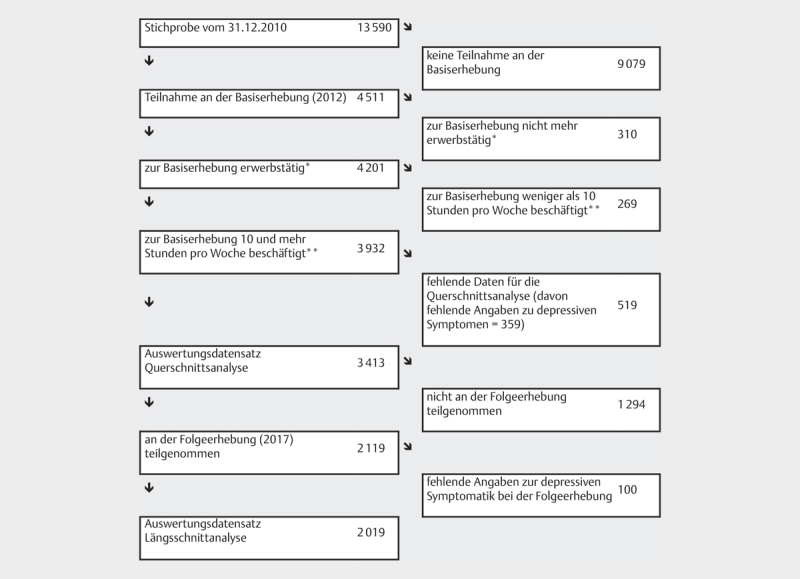
Regular long working and commuting hours are thought to have negative consequences for mental health. However, the study results are not clear and vary by country. The present analysis examines associations between working or commuting hours and depressive symptoms in Germany. The S-MGA study (German Study on Mental Health at Work) is a longitudinal cohort of a random sample of employees subject to social insurance contributions. We analysed data on 3,413 participants of the baseline survey (cross-sectional analysis) and on 2,019 people who participated at baseline and at a follow-up survey five years later (longitudinal analysis). Weekly working and commuting hours as well as covariates (age, gender, occupational position, psychosocial working conditions) were collected at baseline. Depressive symptoms were recorded with the Patient Health Questionnaire at both waves. To investigate associations, odds ratios with 95% confidence intervals were calculated by means of logistic regression. Both cross-sectional (baseline survey only) and longitudinal analyses (baseline and post-survey) were conducted. At baseline survey, 7% of the employees had long working hours of≥55 hours per week, and another 8% worked 49–54 hours. In the cross-sectional analysis, long working hours were associated with moderately elevated depressive symptoms compared to normal working hours (35-<40 h/week). When new depressive symptoms after five years were considered, the correlation was significant for>55 weekly working hours (odds ratio [OR] 2,14; 95% confidence interval [CI] 1,11;4,12), but not for 49–54 h (OR 1,26, CI 0,65;2,43). Employees who commuted ten hours or more per week had more depressive symptoms in the cross-sectional analysis (OR 1,83; CI 1,13;2,94) compared to the reference group who commuted<2,5 hours. This correlation was not observed in the longitudinal analysis. The results suggest that excessive working and commuting time is associated with depressive symptoms in employees, although the effects of commuting time were only found cross-sectionally. The results underline the importance of adhering to working time regulations and avoiding excessive working hours. Further research is needed on the role of commuting in mental health.
人们认为长期的长时间工作和通勤会对心理健康产生负面影响。然而,研究结果并不明确,且因国家而异。本分析研究了德国工作或通勤时间与抑郁症状之间的关联。S-MGA研究(德国工作心理健康研究)是一个对参加社会保险的员工随机抽样的纵向队列研究。我们分析了基线调查中3413名参与者的数据(横断面分析),以及5年后参加基线调查和随访调查的2019人的数据(纵向分析)。在基线时收集了每周的工作和通勤时间以及协变量(年龄、性别、职业地位、心理社会工作条件)。在两个时间点均使用患者健康问卷记录抑郁症状。为了研究关联,通过逻辑回归计算了具有95%置信区间的比值比。进行了横断面分析(仅基线调查)和纵向分析(基线和调查后)。在基线调查中,7%的员工每周工作时长≥55小时,另有8%的员工工作49 - 54小时。在横断面分析中,与正常工作时间(每周35 - <40小时)相比,长时间工作与抑郁症状中度升高有关。当考虑五年后的新抑郁症状时,每周工作>55小时的相关性显著(比值比[OR] 2.14;95%置信区间[CI] 1.11;4.12),但49 - 54小时的情况并非如此(OR 1.26,CI 0.65;2.43)。与通勤时间<2.5小时的参考组相比,在横断面分析中,每周通勤10小时或更长时间的员工有更多的抑郁症状(OR 1.83;CI 1.13;2.94)。在纵向分析中未观察到这种相关性。结果表明,尽管通勤时间的影响仅在横断面分析中发现,但工作和通勤时间过长与员工的抑郁症状有关。结果强调了遵守工作时间规定和避免工作时间过长的重要性。需要进一步研究通勤在心理健康中的作用。