Pozzi Daniela, Caracciolo Giulio
NanoDelivery Lab, Department of Molecular Medicine, Sapienza University of Rome, Viale Regina Elena 291, 00161 Rome, Italy.
ACS Pharmacol Transl Sci. 2023 Oct 24;6(11):1561-1573. doi: 10.1021/acsptsci.3c00185. eCollection 2023 Nov 10.
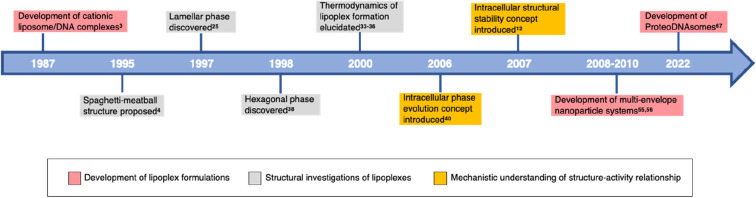
Lipid nanoparticles (LNPs) have shown remarkable success in delivering genetic materials like COVID-19 LNP vaccines, such as mRNA-1273/SpikeVax by Moderna and BNT162b2/Comirnaty by BioNTech/Pfizer, as well as siRNA for rare inherited diseases, such as Onpattro from Alnylam Pharmaceuticals. These LNPs are advantageous since they minimize side effects, target specific cells, and regulate payload delivery. There has been a surge of interest in these particles due to their success stories; however, we still do not know much about how they work. This perspective will recapitulate the evolution of lipid-based gene delivery, starting with Felgner's pioneering 1987 PNAS paper, which introduced the initial DNA-transfection method utilizing a synthetic cationic lipid. Our journey takes us to the early 2020s, a time when advancements in bionano interactions enabled us to create biomimetic lipoplexes characterized by a remarkable ability to evade capture by immune cells in vivo. Through this overview, we propose leveraging previous achievements to assist us in formulating improved research goals when optimizing LNPs for medical conditions such as infectious diseases, cancer, and heritable disorders.
脂质纳米颗粒(LNPs)在递送遗传物质方面取得了显著成功,如新冠病毒LNP疫苗,例如Moderna公司的mRNA-1273/SpikeVax和BioNTech/辉瑞公司的BNT162b2/Comirnaty,以及用于罕见遗传性疾病的小干扰RNA(siRNA),如Alnylam制药公司的Onpattro。这些LNPs具有优势,因为它们能将副作用降至最低,靶向特定细胞,并调节有效载荷的递送。由于它们的成功案例,人们对这些颗粒的兴趣激增;然而,我们对它们的工作原理仍知之甚少。这篇综述将概述基于脂质的基因递送的发展历程,始于费尔格纳1987年发表在《美国国家科学院院刊》上的开创性论文,该论文介绍了利用合成阳离子脂质的初始DNA转染方法。我们的历程将带我们进入21世纪20年代初,那时生物纳米相互作用的进展使我们能够创造出仿生脂质体复合物,其特点是在体内具有显著的逃避免疫细胞捕获的能力。通过这一综述,我们建议利用以往的成就来帮助我们在为传染病、癌症和遗传性疾病等医疗状况优化LNPs时制定改进的研究目标。