Department of Computer Science, Vanderbilt University, Nashville, TN, United States.
Department of Biomedical Informatics, Vanderbilt University Medical Center, Nashville, TN, United States.
J Med Internet Res. 2023 Nov 17;25:e48193. doi: 10.2196/48193.
Alzheimer disease or related dementias (ADRD) are severe neurological disorders that impair the thinking and memory skills of older adults. Most persons living with dementia receive care at home from their family members or other unpaid informal caregivers; this results in significant mental, physical, and financial challenges for these caregivers. To combat these challenges, many informal ADRD caregivers seek social support in online environments. Although research examining online caregiving discussions is growing, few investigations have distinguished caregivers according to their kin relationships with persons living with dementias. Various studies have suggested that caregivers in different relationships experience distinct caregiving challenges and support needs.
This study aims to examine and compare the online behaviors of adult-child and spousal caregivers, the 2 largest groups of informal ADRD caregivers, in an open online community.
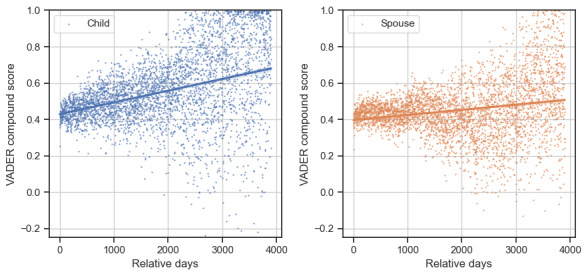
We collected posts from ALZConnected, an online community managed by the Alzheimer's Association. To gain insights into online behaviors, we first applied structural topic modeling to identify topics and topic prevalence between adult-child and spousal caregivers. Next, we applied VADER (Valence Aware Dictionary for Sentiment Reasoning) and LIWC (Linguistic Inquiry and Word Count) to evaluate sentiment changes in the online posts over time for both types of caregivers. We further built machine learning models to distinguish the posts of each caregiver type and evaluated them in terms of precision, recall, F-score, and area under the precision-recall curve. Finally, we applied the best prediction model to compare the temporal trend of relationship-predicting capacities in posts between the 2 types of caregivers.
Our analysis showed that the number of posts from both types of caregivers followed a long-tailed distribution, indicating that most caregivers in this online community were infrequent users. In comparison with adult-child caregivers, spousal caregivers tended to be more active in the community, publishing more posts and engaging in discussions on a wider range of caregiving topics. Spousal caregivers also exhibited slower growth in positive emotional communication over time. The best machine learning model for predicting adult-child, spousal, or other caregivers achieved an area under the precision-recall curve of 81.3%. The subsequent trend analysis showed that it became more difficult to predict adult-child caregiver posts than spousal caregiver posts over time. This suggests that adult-child and spousal caregivers might gradually shift their discussions from questions that are more directly related to their own experiences and needs to questions that are more general and applicable to other types of caregivers.
Our findings suggest that it is important for researchers and community organizers to consider the heterogeneity of caregiving experiences and subsequent online behaviors among different types of caregivers when tailoring online peer support to meet the specific needs of each caregiver group.
阿尔茨海默病或相关痴呆症(ADRD)是严重的神经退行性疾病,会损害老年人的思维和记忆能力。大多数痴呆症患者在家中接受家庭成员或其他无薪非正式照顾者的照顾;这给这些照顾者带来了巨大的精神、身体和经济挑战。为了应对这些挑战,许多非正式的 ADRD 照顾者在在线环境中寻求社会支持。尽管研究在线护理讨论的研究在不断增加,但很少有研究根据与痴呆症患者的亲属关系来区分照顾者。多项研究表明,不同关系的照顾者体验到不同的护理挑战和支持需求。
本研究旨在考察和比较最大的两个非正式 ADRD 照顾者群体,即成年子女和配偶照顾者,在一个开放的在线社区中的在线行为。
我们从阿尔茨海默病协会管理的在线社区 ALZConnected 中收集帖子。为了深入了解在线行为,我们首先应用结构主题建模来识别成年子女和配偶照顾者之间的主题和主题普遍性。接下来,我们应用 VADER(情感感知词典用于情感推理)和 LIWC(语言调查和词频)来评估两种类型的照顾者随时间在线帖子中的情绪变化。我们进一步构建了机器学习模型来区分每个照顾者类型的帖子,并根据精度、召回率、F 分数和精度-召回曲线下的面积来评估它们。最后,我们应用最佳预测模型来比较这两种类型的照顾者在帖子中预测关系能力的时间趋势。
我们的分析表明,两种类型的照顾者的帖子数量都遵循长尾分布,这表明该在线社区的大多数照顾者都是不频繁的用户。与成年子女照顾者相比,配偶照顾者在社区中往往更活跃,发布的帖子更多,并且更广泛地参与了各种护理主题的讨论。配偶照顾者的积极情感沟通也随着时间的推移呈现出较慢的增长。用于预测成年子女、配偶或其他照顾者的最佳机器学习模型的精度-召回曲线下面积达到 81.3%。随后的趋势分析表明,随着时间的推移,预测成年子女照顾者帖子比预测配偶照顾者帖子变得更加困难。这表明成年子女和配偶照顾者可能会逐渐将他们的讨论从更直接与自己的经验和需求相关的问题转移到更普遍且适用于其他类型照顾者的问题。
我们的研究结果表明,研究人员和社区组织者在根据每个照顾者群体的特定需求定制在线同伴支持时,考虑不同类型照顾者的照顾经验和随后的在线行为的异质性非常重要。