Ozen Selin, Guzel Sukran, Senlikci Huma Boluk, Cosar Sacide Nur Saracgil, Selcuk Ebru Selin
Faculty of Medicine, Department of Physical Medicine and Rehabilitation, Baskent University, Ankara, Turkey.
Ankara Etlik City Hospital, Physical Medicine and Rehabilitation Hospital, Ankara, Turkey.
BMC Sports Sci Med Rehabil. 2023 Nov 20;15(1):157. doi: 10.1186/s13102-023-00769-2.
Lumbar disk herniation (LDH) is a cause of chronic low back pain (CLBP) treated using physical therapy (PT), including exercise and physical modalities such as ultrasound (US) and short wave diathermy (SWD). Despite the use of US and SWD, there is inconclusive evidence on their efficacy. The aim of this study was to investigate the efficacy of US and SWD in the treatment of CLBP in patients with LDH.
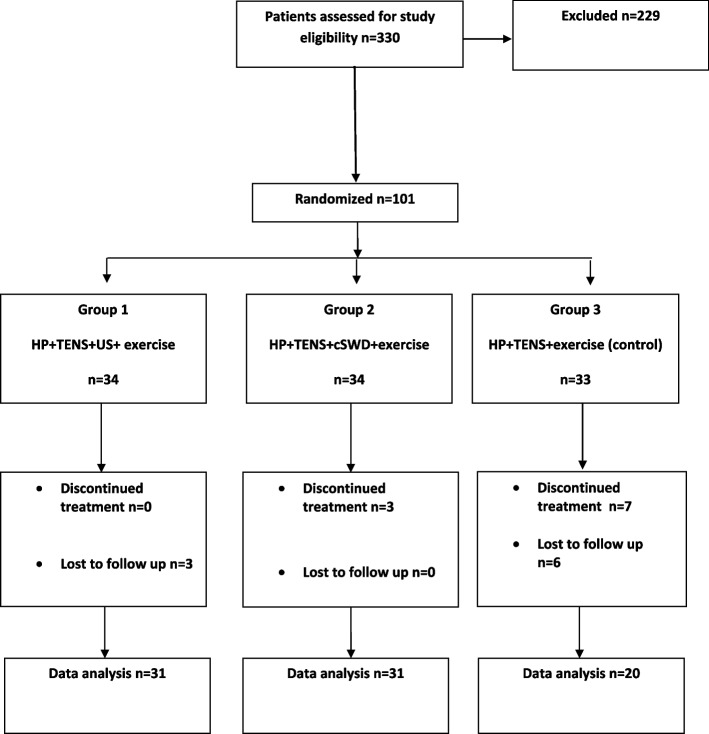
A prospective randomized control clinical study. Individuals with radicular CLBP and LDH on magnetic resonance imaging, presenting to the Physical and Rehabilitation Medicine Department were randomized into 3 treatment groups. All participants received 10 sessions of hotpack, transcutaneous nerve stimulation (TENS) and therapeutic exercises. In addition, Group 1 received 10 sessions of therapeutic US (1 MHz, 1.5W/cm2, 10 min), Group 2 SWD (27.12 MHz, wavelength 11.06 m, induction technique, 20 min) to the lower back. Group 3 (control group) received hotpack, TENS and therapeutic exercises alone. Visual analogue scale (VAS) for LBP, Modified Oswestry Disability Index (MODI) and Short Form 36 (SF-36) were evaluated pre and post treatment and at one and three months follow up.
In all groups, VAS for LBP and MODI improved with treatment and at the one and three month follow up (p < 0.001). In Groups 1 and 2, MODI scores continued to reduce at 1 and 3 months (p < 0.001 and p = 0.012 respectively). SF-36 physical, social function and pain parameters reduced in all groups (p < 0.05). Role limitation due to physical and emotional problems, emotional well-being, vitality and mental health improved in Groups 1 and 2 (p < 0.05).
Deep heating agents can be used as part of the physical therapy for CLBP in those with LDH with positive mid-term effects.
NCT03835182, 02/04/2019.
腰椎间盘突出症(LDH)是慢性下腰痛(CLBP)的一个病因,可采用物理治疗(PT),包括运动以及诸如超声波(US)和短波透热疗法(SWD)等物理治疗方式。尽管使用了US和SWD,但其疗效证据尚无定论。本研究的目的是调查US和SWD在治疗LDH患者CLBP中的疗效。
一项前瞻性随机对照临床研究。将磁共振成像显示有神经根性CLBP和LDH、前来物理与康复医学科就诊的个体随机分为3个治疗组。所有参与者均接受10次热敷、经皮神经电刺激(TENS)和治疗性运动。此外,第1组接受10次治疗性US(1兆赫,1.5瓦/平方厘米,10分钟),第2组接受SWD(27.12兆赫,波长11.06米,感应技术,20分钟)照射下背部。第3组(对照组)仅接受热敷、TENS和治疗性运动。在治疗前、治疗后以及1个月和3个月随访时评估下腰痛视觉模拟量表(VAS)、改良Oswestry功能障碍指数(MODI)和简明健康调查问卷(SF-36)。
在所有组中,下腰痛VAS和MODI在治疗时以及1个月和3个月随访时均有所改善(p < 0.001)。在第1组和第2组中,MODI评分在1个月和3个月时持续降低(分别为p < 0.001和p = 0.012)。所有组的SF-36身体、社会功能和疼痛参数均降低(p < 0.05)。第1组和第2组在因身体和情感问题导致的角色受限、情感健康、活力和心理健康方面有所改善(p < 0.05)。
深部热疗剂可作为LDH患者CLBP物理治疗的一部分使用,具有中期积极效果。
NCT03835182,2019年4月2日。