David Guilherme, Lourenço André, Von Rekowski Cristiana P, Pinto Iola, Calado Cecília R C, Bento Luís
ISEL-Instituto Superior de Engenharia de Lisboa, Instituto Politécnico de Lisboa, Rua Conselheiro Emídio Navarro 1, 1959-007 Lisbon, Portugal.
NOVA LINCS-NOVA Laboratory for Computer Science and Informatics and CardioID Technologies, 2829-516 Caparica, Portugal.
J Clin Med. 2025 Jul 28;14(15):5312. doi: 10.3390/jcm14155312.
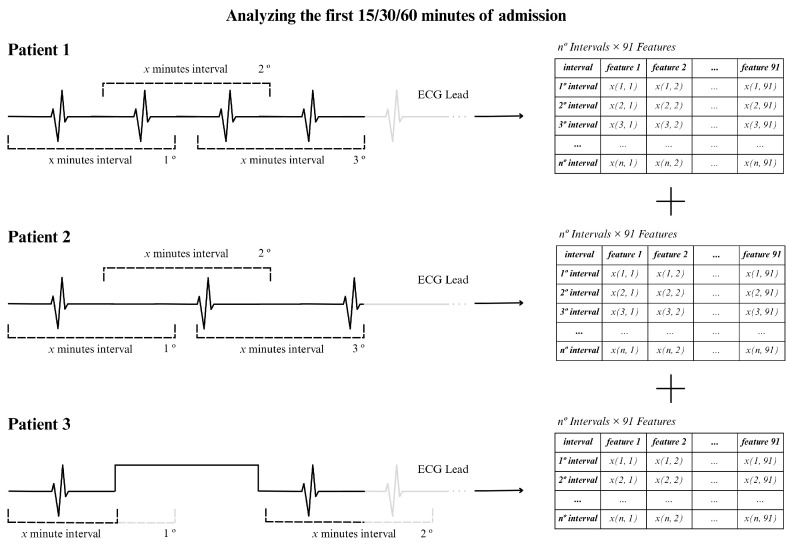
Heart rate variability (HRV) has been widely investigated as a predictor of disease and mortality across diverse patient populations; however, there remains no consensus on the optimal set or combination of time and frequency domain nor on nonlinear features for reliable prediction across clinical contexts. Given the relevance of the COVID-19 pandemic and the unique clinical profiles of these patients, this retrospective observational study explored the potential of HRV analysis for early prediction of in-hospital mortality using ECG signals recorded during the initial moments of ICU admission in COVID-19 patients. HRV indices were extracted from four ECG leads (I, II, III, and aVF) using sliding windows of 2, 5, and 7 min across observation intervals of 15, 30, and 60 min. The raw data posed significant challenges in terms of structure, synchronization, and signal quality; thus, from an original set of 381 records from 321 patients, after data pre-processing steps, a final dataset of 82 patients was selected for analysis. To manage data complexity and evaluate predictive performance, two feature selection methods, four feature reduction techniques, and five classification models were applied to identify the optimal approach. Among the feature aggregation methods, compiling feature means across patient windows (Method D) yielded the best results, particularly for longer observation intervals (e.g., using LDA, the best AUC of 0.82±0.13 was obtained with Method D versus 0.63±0.09 with Method C using 5 min windows). Linear Discriminant Analysis (LDA) was the most consistent classification algorithm, demonstrating robust performance across various time windows and further improvement with dimensionality reduction. Although Gradient Boosting and Random Forest also achieved high AUCs and F1-scores, their performance outcomes varied across time intervals. These findings support the feasibility and clinical relevance of using short-term HRV as a noninvasive, data-driven tool for early risk stratification in critical care, potentially guiding timely therapeutic decisions in high-risk ICU patients and thereby reducing in-hospital mortality.
心率变异性(HRV)已被广泛研究,作为不同患者群体疾病和死亡率的预测指标;然而,对于时域和频域的最佳集合或组合,以及跨临床环境进行可靠预测的非线性特征,仍未达成共识。鉴于新冠疫情的相关性以及这些患者独特的临床特征,这项回顾性观察性研究探讨了利用新冠患者入住重症监护病房(ICU)初期记录的心电图信号进行HRV分析以早期预测院内死亡率的潜力。使用2分钟、5分钟和7分钟的滑动窗口,在15分钟、30分钟和60分钟的观察间隔内,从四个心电图导联(I、II、III和aVF)提取HRV指标。原始数据在结构、同步性和信号质量方面带来了重大挑战;因此,在对来自321名患者的381条记录进行数据预处理步骤后,最终选择了82名患者的数据集进行分析。为了管理数据复杂性并评估预测性能,应用了两种特征选择方法、四种特征约简技术和五种分类模型来确定最佳方法。在特征聚合方法中,汇总患者窗口的特征均值(方法D)产生了最佳结果,特别是对于较长的观察间隔(例如,使用线性判别分析(LDA),使用方法D在5分钟窗口时获得的最佳曲线下面积(AUC)为0.82±0.13,而使用方法C时为0.63±0.09)。线性判别分析(LDA)是最一致的分类算法,在各种时间窗口中表现稳健,并且通过降维进一步改善。尽管梯度提升和随机森林也获得了较高的AUC和F1分数,但它们的性能结果在不同时间间隔内有所不同。这些发现支持了将短期HRV作为一种无创、数据驱动的工具用于重症监护中早期风险分层的可行性和临床相关性,有可能指导高危ICU患者及时做出治疗决策,从而降低院内死亡率。