Scarth Morgan, Hauger Lisa Evju, Thorsby Per Medbøe, Leknes Siri, Hullstein Ingunn R, Westlye Lars T, Bjørnebekk Astrid
Anabolic Androgenic Steroid Research Group, Section for Clinical Addiction Research, Division of Mental Health and Addiction, Oslo University Hospital, Postbox 4959, Nydalen, 0424, Oslo, Norway.
Department of Psychology, University of Oslo, Oslo, Norway.
Psychopharmacology (Berl). 2024 Apr;241(4):701-715. doi: 10.1007/s00213-023-06497-2. Epub 2023 Nov 22.
Anabolic-androgenic steroids (AAS) are used to improve physical performance and appearance, but have been associated with deficits in social cognitive functioning. Approximately 30% of people who use AAS develop a dependence, increasing the risk for undesired effects.
To assess the relationship between AAS use (current/previous), AAS dependence, and the ability to recognize emotional facial expressions, and investigate the potential mediating role of hormone levels.
In total 156 male weightlifters, including those with current (n = 45) or previous (n = 34) AAS use and never-using controls (n = 77), completed a facial Emotion Recognition Task (ERT). Participants were presented with faces expressing one out of six emotions (sadness, happiness, fear, anger, disgust, and surprise) and were instructed to indicate which of the six emotions each face displayed. ERT accuracy and response time were recorded and evaluated for association with AAS use status, AAS dependence, and serum reproductive hormone levels. Mediation models were used to evaluate the mediating role of androgens in the relationship between AAS use and ERT performance.
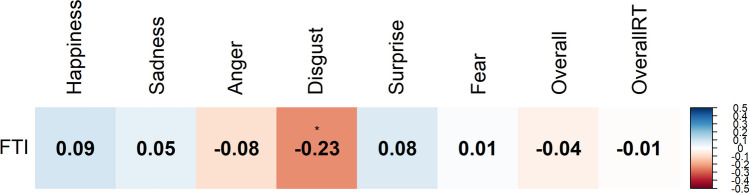
Compared to never-using controls, men currently using AAS exhibited lower recognition accuracy for facial emotional expressions, particularly anger (Cohen's d = -0.57, p = 0.03) and disgust (d = -0.51, p = 0.05). Those with AAS dependence (n = 47) demonstrated worse recognition of fear relative to men without dependence (d = 0.58, p = 0.03). Recognition of disgust was negatively correlated with serum free testosterone index (FTI); however, FTI did not significantly mediate the association between AAS use and recognition of disgust.
Our findings demonstrate impaired facial emotion recognition among men currently using AAS compared to controls. While further studies are needed to investigate potential mechanisms, our analysis did not support a simple mediation effect of serum FTI.
合成代谢雄激素类固醇(AAS)被用于提高身体机能和改善外貌,但与社会认知功能缺陷有关。约30%使用AAS的人会产生依赖,增加了出现不良影响的风险。
评估AAS使用(当前/既往)、AAS依赖与识别面部情绪表情能力之间的关系,并研究激素水平的潜在中介作用。
总共156名男性举重运动员,包括当前使用(n = 45)或既往使用(n = 34)AAS的运动员以及从未使用过AAS的对照组(n = 77),完成了一项面部情绪识别任务(ERT)。向参与者展示表达六种情绪(悲伤、快乐、恐惧、愤怒、厌恶和惊讶)之一的面部,并要求他们指出每张脸显示的是六种情绪中的哪一种。记录并评估ERT的准确性和反应时间,以确定其与AAS使用状态、AAS依赖和血清生殖激素水平的关联。使用中介模型评估雄激素在AAS使用与ERT表现之间关系中的中介作用。
与从未使用过AAS的对照组相比,当前使用AAS的男性对面部情绪表情的识别准确性较低,尤其是对愤怒(科恩d值 = -0.57,p = 0.03)和厌恶(d = -0.51,p = 0.05)的识别。与无AAS依赖的男性相比,有AAS依赖的男性(n = 47)对恐惧的识别更差(d = 0.58,p = 0.03)。对厌恶的识别与血清游离睾酮指数(FTI)呈负相关;然而,FTI并未显著介导AAS使用与厌恶识别之间的关联。
我们的研究结果表明,与对照组相比,当前使用AAS的男性存在面部情绪识别受损的情况。虽然需要进一步研究来探究潜在机制,但我们的分析不支持血清FTI的简单中介作用。