Anabolic Androgenic Steroid Research Group, Section for Clinical Addiction Research, Division of Mental Health and Addiction, Oslo University Hospital, Postbox 4959, Nydalen, Oslo, 0424, Norway.
Department of Psychology, University of Oslo, Oslo, Norway.
BMC Psychiatry. 2023 May 16;23(1):342. doi: 10.1186/s12888-023-04781-1.
Anabolic-androgenic steroid (AAS) dependence has numerous adverse health consequences, and may be driven in part by body image concerns, primarily muscle dysmorphia. This study aims to further understand and identify potential clinical targets using network analyses of AAS dependence and muscle dysmorphia symptoms in males who used AAS and weightlifting controls.
A sample of 153 men who currently or previously used AAS and 88 weight-lifting controls were recruited through social media and relevant online forums, and via posters and flyers distributed in select gyms in Oslo, Norway. Symptoms of AAS dependence and muscle dysmorphia were assessed using clinical interviews and standardized questionnaires. Severity of muscle dysmorphia symptoms were compared between the groups using independent samples t-tests. The following symptom networks were computed using Gaussian graphical modeling or mixed graphical modeling: (1) AAS dependence symptoms among men with AAS use (2) muscle dysmorphia symptoms among men with AAS use and weight-lifting controls in two separate networks, which were compared using a network comparison test, and (3) AAS dependence and muscle dysmorphia symptoms among men with AAS use.
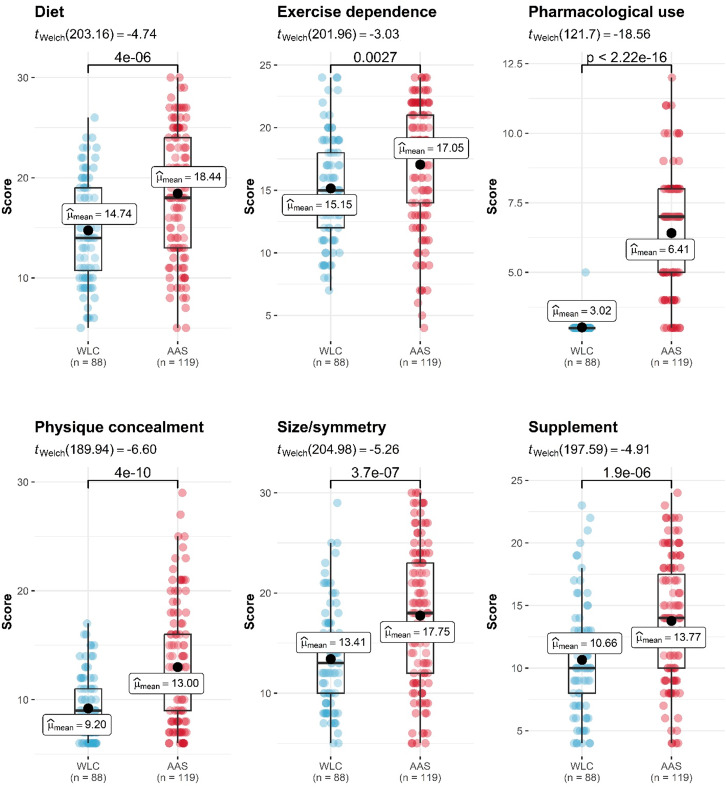
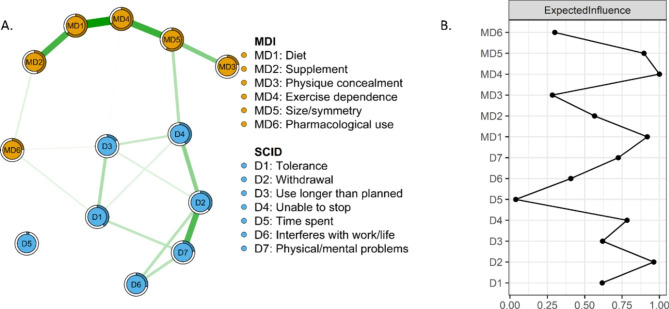
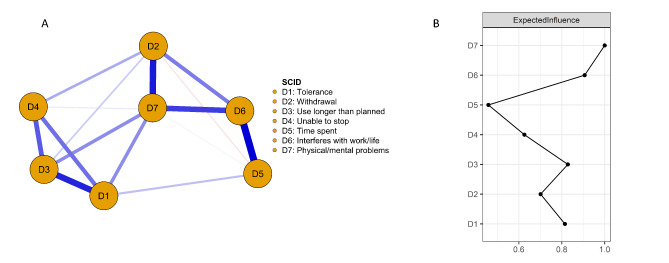
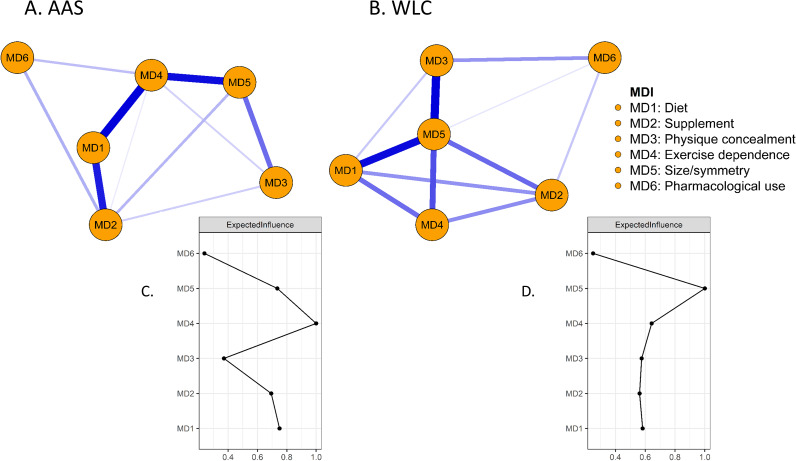
In a network of AAS dependence symptoms, continuing use despite physical and mental side effects, using longer than planned, tolerance, and work/life interference were the most central symptoms. When comparing symptom structures of muscle dysmorphia between those who used AAS and controls, the most central symptoms in each group were exercise dependence and size/symmetry concerns, respectively. Men with AAS use demonstrated elevated muscle dysmorphia symptoms compared to controls, indicating that both the severity and structure of symptoms differ between these groups. In a network including both AAS dependence and muscle dysmorphia symptoms, no significant connections between symptom groups were identified.
AAS dependence is complex, with correlated somatic and psychological challenges driving the symptom network, indicating that alleviating physical and mental health concerns during both AAS use and cessation is an important clinical target. Muscle dysmorphia symptoms related to taking action (diet, exercise, and supplement use) appear to cluster together more for those who use AAS than those who do not.
合成代谢雄激素类固醇(AAS)依赖会导致许多不良健康后果,部分原因可能是对身体形象的关注,主要是肌肉变形。本研究旨在通过对使用 AAS 和举重对照组的男性的 AAS 依赖和肌肉变形症状进行网络分析,进一步了解和确定潜在的临床目标。
通过社交媒体和相关在线论坛,以及在挪威奥斯陆的特定健身房张贴海报和传单,招募了 153 名目前或以前使用过 AAS 的男性和 88 名举重对照组。使用临床访谈和标准化问卷评估 AAS 依赖和肌肉变形的症状。使用独立样本 t 检验比较两组之间肌肉变形症状的严重程度。使用高斯图形模型或混合图形模型计算以下症状网络:(1)在使用 AAS 的男性中 AAS 依赖症状;(2)在使用 AAS 和举重对照组的男性中分别有肌肉变形症状的两个独立网络;(3)在使用 AAS 的男性中 AAS 依赖和肌肉变形症状。
在 AAS 依赖症状网络中,尽管存在身体和心理副作用,仍继续使用、使用时间超过计划、耐受性和工作/生活干扰是最核心的症状。在比较使用 AAS 和对照组的肌肉变形症状结构时,每组最核心的症状分别是运动依赖和大小/对称问题。与对照组相比,使用 AAS 的男性表现出更高的肌肉变形症状,这表明两组之间的症状严重程度和结构不同。在包括 AAS 依赖和肌肉变形症状的网络中,未发现症状组之间存在显著联系。
AAS 依赖很复杂,相关的躯体和心理挑战驱动着症状网络,这表明在 AAS 使用和戒断期间缓解身心健康问题是一个重要的临床目标。与使用 AAS 相关的与采取行动(饮食、运动和补充剂使用)相关的肌肉变形症状似乎在使用 AAS 的人群中比不使用 AAS 的人群更聚集在一起。