Faculty of Medicine, Imperial College London, London, UK.
Department of Ophthalmology, Harvard Medical School, Boston, MA, USA.
J Transl Med. 2023 Nov 24;21(1):847. doi: 10.1186/s12967-023-04737-9.
In primary open-angle glaucoma (POAG), lowering intraocular pressure (IOP) is the only proven way of slowing vision loss. Schlemm's canal (SC) is a hybrid vascular and lymphatic vessel that mediates aqueous humour drainage from the anterior ocular chamber. Animal studies support the importance of SC endothelial angiopoietin-TEK signalling, and more recently TIE1 signalling, in maintaining normal IOP. However, human genetic support for a causal role of TIE1 and TEK signalling in lowering IOP is currently lacking.
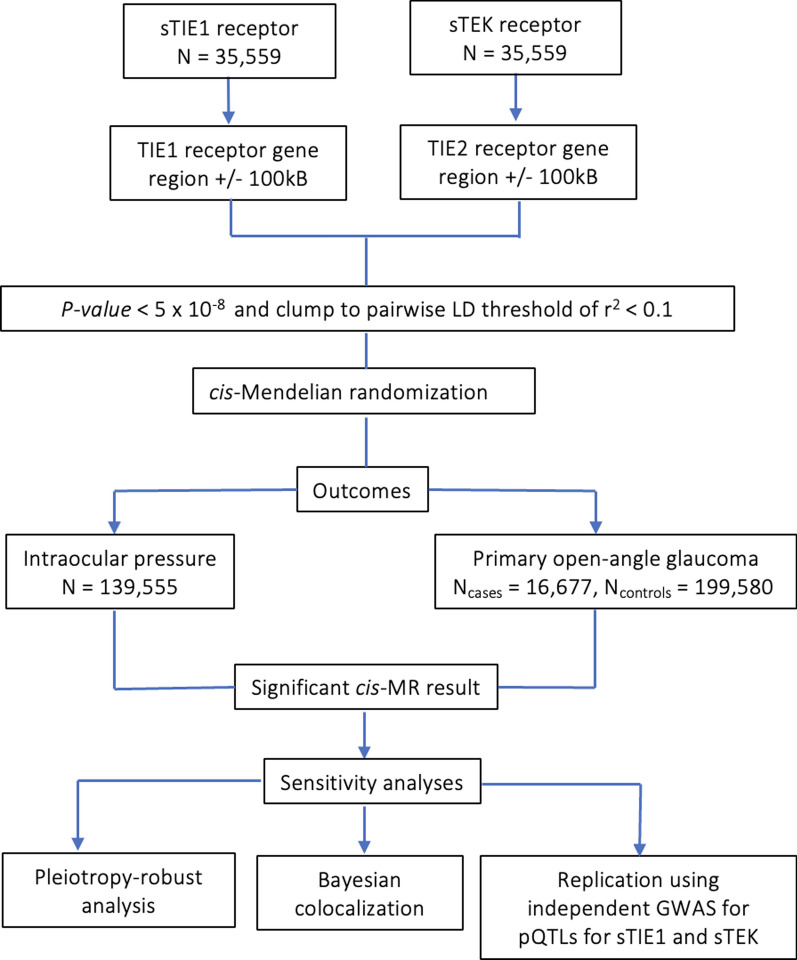
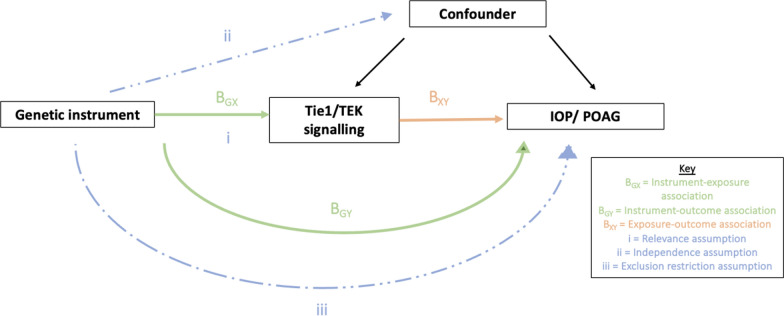
GWAS summary statistics were obtained for plasma soluble TIE1 (sTIE1) protein levels (N = 35,559), soluble TEK (sTEK) protein levels (N = 35,559), IOP (N = 139,555) and POAG (N = 16,677, N = 199,580). Mendelian randomization (MR) was performed to estimate the association of genetically proxied TIE1 and TEK protein levels with IOP and POAG liability. Where significant MR estimates were obtained, genetic colocalization was performed to assess the probability of a shared causal variant (PP) versus distinct (PP) causal variants underlying TIE1/TEK signalling and the outcome. Publicly available single-nucleus RNA-sequencing data were leveraged to investigate differential expression of TIE1 and TEK in the human ocular anterior segment.
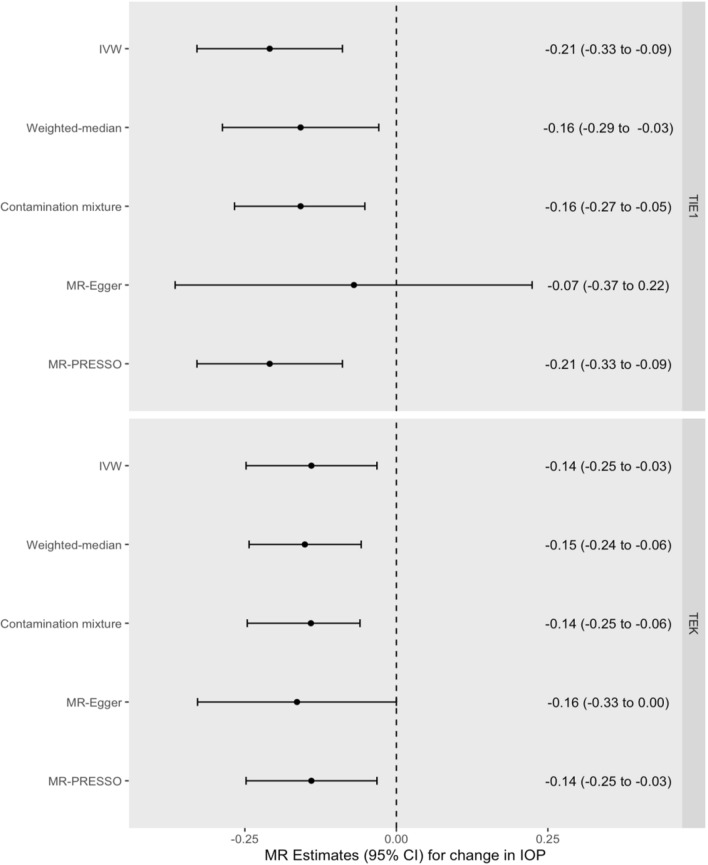
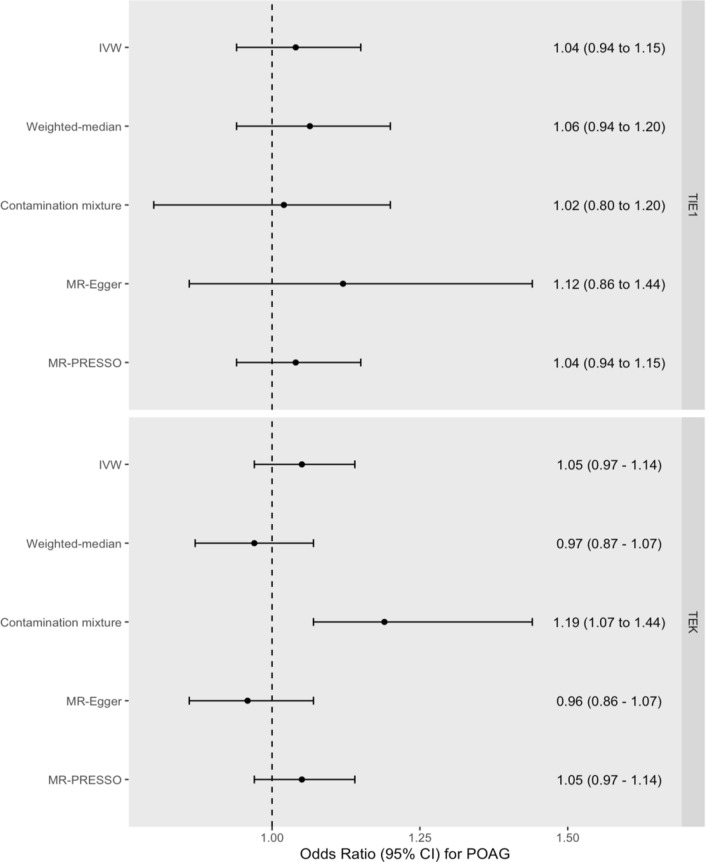
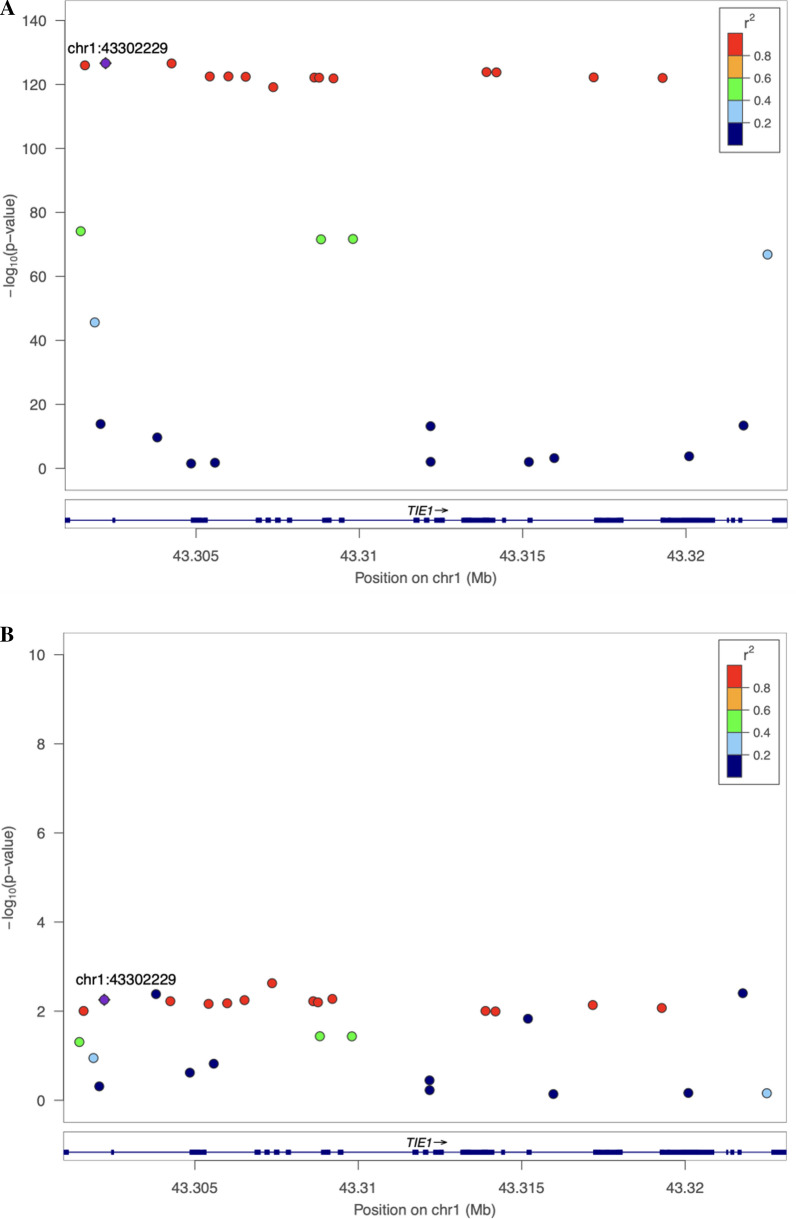
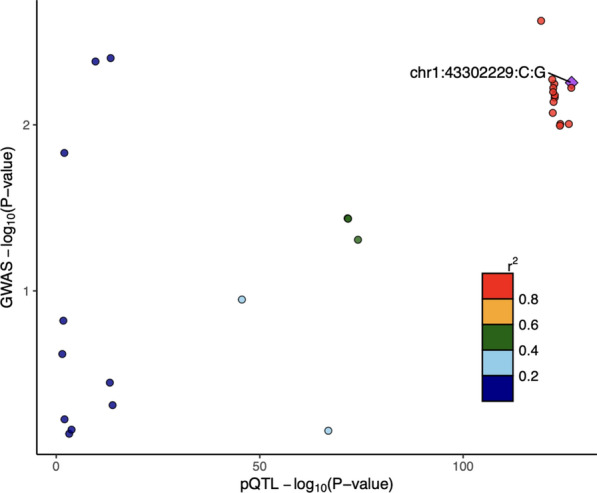
Increased genetically proxied TIE1 signalling and TEK signalling associated with a reduction in IOP (- 0.21 mmHg per SD increase in sTIE1, 95% CI = - 0.09 to - 0.33 mmHg, P = 6.57 × 10, and - 0.14 mmHg per SD decrease in sTEK, 95% CI = - 0.03 to - 0.25 mmHg, P = 0.011), but not with POAG liability. Colocalization analysis found that the probability of a shared causal variant was greater for TIE1 and IOP than for TEK and IOP (PP/(PP + PP) = 0.98 for TIE1 and 0.30 for TEK). In the anterior segment, TIE1 and TEK were preferentially expressed in SC, lymphatic, and vascular endothelium.
This study provides novel human genetic support for a causal role of both TIE1 and TEK signalling in regulating IOP. Here, combined evidence from cis-MR and colocalization analyses provide stronger support for TIE1 than TEK as a potential IOP-lowering therapeutic target.
在原发性开角型青光眼(POAG)中,降低眼内压(IOP)是减缓视力丧失的唯一有效方法。施莱姆氏管(SC)是一种混合的血管和淋巴管,介导房水从前房排出。动物研究支持 SC 内皮血管生成素-TIE1 信号在维持正常 IOP 中的重要性,最近也支持 TIE1 信号的重要性。然而,目前缺乏人类遗传支持 TIE1 和 TEK 信号在降低 IOP 中的因果作用。
获得了血浆可溶性 TIE1(sTIE1)蛋白水平(N=35559)、可溶性 TEK(sTEK)蛋白水平(N=35559)、IOP(N=139555)和 POAG(N=16677,N=199580)的 GWAS 汇总统计数据。进行了孟德尔随机化(MR)以估计遗传上接近的 TIE1 和 TEK 蛋白水平与 IOP 和 POAG 易感性的关联。在获得显著的 MR 估计值的情况下,进行了遗传共定位分析,以评估 TIE1/TEK 信号和结局下共享因果变异(PP)与不同(PP)因果变异的概率。利用公开的单核 RNA 测序数据,研究了 TIE1 和 TEK 在人眼前段的差异表达。
增加遗传上接近的 TIE1 信号和 TEK 信号与 IOP 降低相关(sTIE1 每增加一个 SD 降低 0.21mmHg,95%CI=-0.09 至-0.33mmHg,P=6.57×10,sTEK 每减少一个 SD 降低 0.14mmHg,95%CI=-0.03 至-0.25mmHg,P=0.011),但与 POAG 易感性无关。共定位分析发现,TIE1 和 IOP 之间共享因果变异的概率大于 TEK 和 IOP 之间的概率(TIE1 为 0.98,TEK 为 0.30)。在前节,TIE1 和 TEK 优先在 SC、淋巴管和血管内皮中表达。
本研究为 TIE1 和 TEK 信号在调节 IOP 中的因果作用提供了新的人类遗传证据。这里,来自顺式-MR 和共定位分析的综合证据为 TIE1 作为潜在的降低 IOP 治疗靶点提供了比 TEK 更强的支持。