Mitoma Hiroshi, Kakei Shinji, Tanaka Hirokazu, Manto Mario
Department of Medical Education, Tokyo Medical University, Tokyo 160-0023, Japan.
Department of Anatomy and Physiology, Jissen Women's University, Tokyo 191-8510, Japan.
Biology (Basel). 2023 Nov 16;12(11):1435. doi: 10.3390/biology12111435.
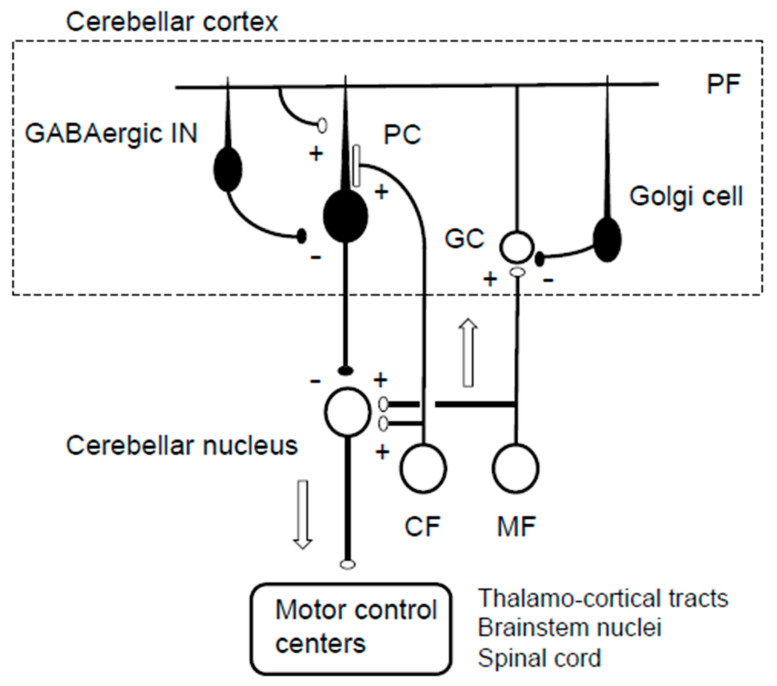
Cerebellar reserve compensates for and restores functions lost through cerebellar damage. This is a fundamental property of cerebellar circuitry. Clinical studies suggest (1) the involvement of synaptic plasticity in the cerebellar cortex for functional compensation and restoration, and (2) that the integrity of the cerebellar reserve requires the survival and functioning of cerebellar nuclei. On the other hand, recent physiological studies have shown that the internal forward model, embedded within the cerebellum, controls motor accuracy in a predictive fashion, and that maintaining predictive control to achieve accurate motion ultimately promotes learning and compensatory processes. Furthermore, within the proposed framework of the Kalman filter, the current status is transformed into a predictive state in the cerebellar cortex (prediction step), whereas the predictive state and sensory feedback from the periphery are integrated into a filtered state at the cerebellar nuclei (filtering step). Based on the abovementioned clinical and physiological studies, we propose that the cerebellar reserve consists of two elementary mechanisms which are critical for cerebellar functions: the first is involved in updating predictions in the residual or affected cerebellar cortex, while the second acts by adjusting its updated forecasts with the current status in the cerebellar nuclei. Cerebellar cortical lesions would impair predictive behavior, whereas cerebellar nuclear lesions would impact on adjustments of neuronal commands. We postulate that the multiple forms of distributed plasticity at the cerebellar cortex and cerebellar nuclei are the neuronal events which allow the cerebellar reserve to operate in vivo. This cortico-deep cerebellar nuclei loop model attributes two complementary functions as the underpinnings behind cerebellar reserve.
小脑储备可补偿并恢复因小脑损伤而丧失的功能。这是小脑神经回路的一项基本特性。临床研究表明:(1)小脑皮质中的突触可塑性参与功能补偿和恢复;(2)小脑储备的完整性需要小脑核的存活和功能正常。另一方面,最近的生理学研究表明,嵌入小脑中的内部前向模型以预测方式控制运动准确性,并且维持预测控制以实现精确运动最终会促进学习和补偿过程。此外,在卡尔曼滤波器的提议框架内,当前状态在小脑皮质中转换为预测状态(预测步骤),而预测状态和来自外周的感觉反馈在小脑核处整合为滤波状态(滤波步骤)。基于上述临床和生理学研究,我们提出小脑储备由对小脑功能至关重要的两种基本机制组成:第一种机制参与在残余或受影响的小脑皮质中更新预测,而第二种机制通过根据小脑核中的当前状态调整其更新的预测来发挥作用。小脑皮质损伤会损害预测行为,而小脑核损伤会影响神经元指令的调整。我们推测,小脑皮质和小脑核处多种形式的分布式可塑性是使小脑储备在体内发挥作用的神经元事件。这种小脑皮质 - 深部小脑核回路模型将两种互补功能视为小脑储备背后的支撑。