Tselebis Athanasios, Sikaras Christos, Milionis Charalampos, Sideri Eleni Paraskevi, Fytsilis Konstantinos, Papageorgiou Styliani Maria, Ilias Ioannis, Pachi Argyro
Psychiatric Department, Sotiria Thoracic Diseases Hospital of Athens, 11527 Athens, Greece.
Nursing Department, Sotiria Thoracic Diseases Hospital of Athens, 11527 Athens, Greece.
Eur J Investig Health Psychol Educ. 2023 Oct 29;13(11):2373-2387. doi: 10.3390/ejihpe13110167.
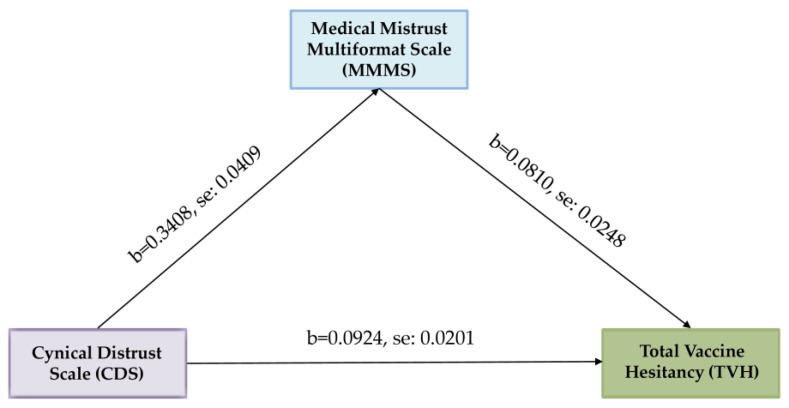
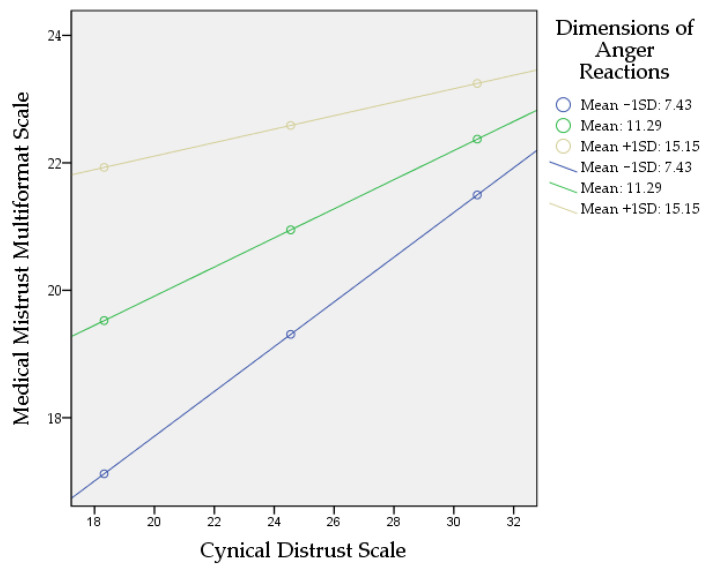
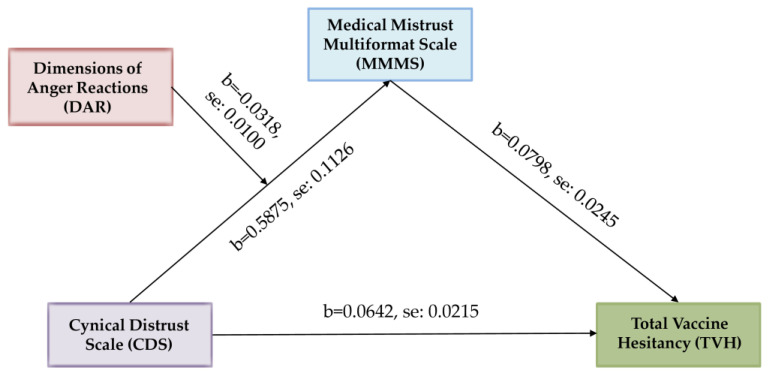
During the pandemic, nurses experienced anger that stemmed from a sense of threat, frustration, or even a sense of injustice. The purpose of this study was to examine the relationship between vaccination hesitancy, anger, cynicism, and medical mistrust among nurses, as there are no relevant studies in the literature. This study was conducted online by completing self-report questionnaires. The Dimensions of Anger Reactions-5, the 8-item "Cynical Distrust" scale, and the Medical Mistrust Multiformat Scale were used. For vaccination hesitancy, two questions with a 5-point scale were used: one question examining hesitancy to get vaccinated with the COVID-19 vaccine, and another question examining hesitancy to get vaccinated with the influenza vaccine. In total, 387 nurses (66 men and 321 women) participated in this study. Nurses showed statistically greater hesitancy toward the COVID-19 vaccine compared to hesitancy toward the influenza vaccine. The variation in vaccine hesitancy was explained by the scores in the Medical Mistrust Multiformat Scale, the Dimensions of Anger Reactions, and the Cynical Distrust Scale. The Medical Mistrust Multiformat Scale mediated the relationship between the Cynical Distrust Scale and total vaccine hesitancy. The Dimensions of Anger Reactions Scale significantly moderated the indirect effect of the Cynical Distrust Scale on total vaccine hesitancy through the Medical Mistrust Multiformat Scale. In conclusion, it is highly likely that anger is involved in reported vaccine hesitancy both by activating schemas of distrust in others and by adopting anti-systemic views of mistrust in the medical system.
在疫情期间,护士们经历了源于威胁感、挫败感甚至不公正感的愤怒情绪。本研究的目的是探讨护士群体中疫苗犹豫、愤怒、愤世嫉俗和对医疗不信任之间的关系,因为文献中尚无相关研究。本研究通过在线填写自我报告问卷的方式进行。使用了愤怒反应维度-5、8项“愤世嫉俗的不信任”量表和医疗不信任多维度量表。对于疫苗犹豫,使用了两个5分量表的问题:一个问题是关于接种新冠疫苗的犹豫程度,另一个问题是关于接种流感疫苗的犹豫程度。共有387名护士(66名男性和321名女性)参与了本研究。与流感疫苗相比,护士们对新冠疫苗表现出在统计学上更明显的犹豫。疫苗犹豫程度的差异可以通过医疗不信任多维度量表、愤怒反应维度和愤世嫉俗的不信任量表的得分来解释。医疗不信任多维度量表在愤世嫉俗的不信任量表与总体疫苗犹豫之间起到了中介作用。愤怒反应维度量表显著调节了愤世嫉俗的不信任量表通过医疗不信任多维度量表对总体疫苗犹豫的间接影响。总之,愤怒很有可能通过激活对他人不信任的模式以及采取对医疗系统不信任的反体制观点,而参与到所报告的疫苗犹豫之中。