Cosme Maximilien, Thomas Colin, Gaucherel Cédric
UMR AMAP, INRAE, University of Montpellier (Faculté des Sciences), IRD, CIRAD, CNRS, 34398 Montpellier, France.
UMR DECOD, Institut Agro Rennes-Angers (Campus Rennes), 65 rue de Saint-Brieuc, 35042 Rennes, France.
Entropy (Basel). 2023 Nov 8;25(11):1526. doi: 10.3390/e25111526.
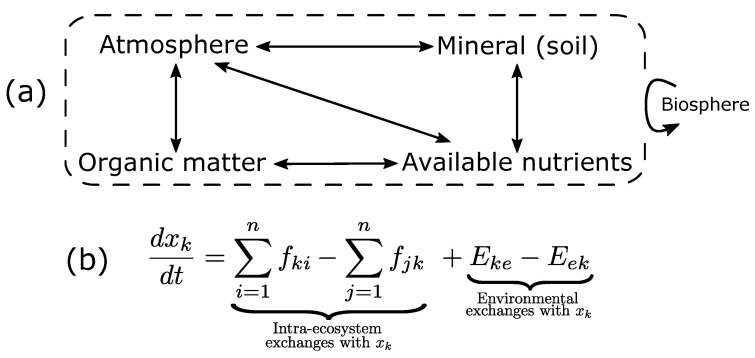
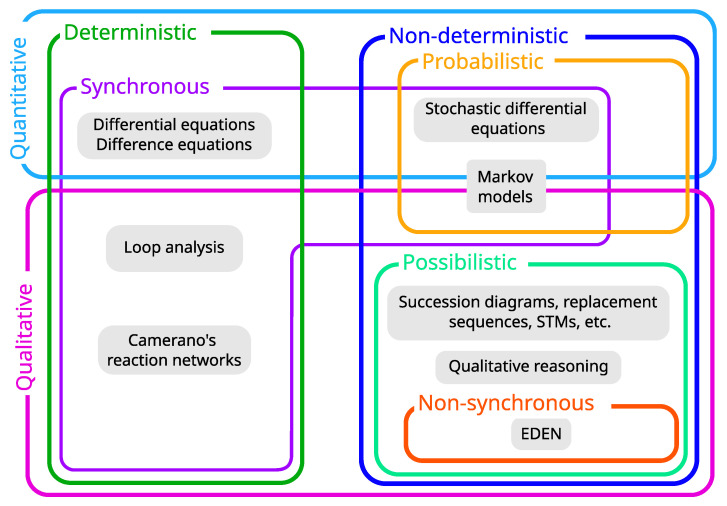
Ecosystem modeling is a complex and multidisciplinary modeling problem which emerged in the 1950s. It takes advantage of the computational turn in sciences to better understand anthropogenic impacts and improve ecosystem management. For that purpose, ecosystem simulation models based on difference or differential equations were built. These models were relevant for studying dynamical phenomena and still are. However, they face important limitations in data-poor situations. As a response, several formal and non-formal qualitative dynamical modeling approaches were independently developed to overcome some limitations of the existing methods. Qualitative approaches allow studying qualitative dynamics as relevant abstractions of those provided by quantitative models (e.g., response to press perturbations). Each modeling framework can be viewed as a different assemblage of properties (e.g., determinism, stochasticity or synchronous update of variable values) designed to satisfy some scientific objectives. Based on four stated objectives commonly found in complex environmental sciences ((1) grasping qualitative dynamics, (2) making as few assumptions as possible about parameter values, (3) being explanatory and (4) being predictive), our objectives were guided by the wish to model complex and multidisciplinary issues commonly found in ecosystem modeling. We then discussed the relevance of existing modeling approaches and proposed the ecological discrete-event networks (EDEN) modeling framework for this purpose. The EDEN models propose a qualitative, discrete-event, partially synchronous and possibilistic view of ecosystem dynamics. We discussed each of these properties through ecological examples and existing analysis techniques for such models and showed how relevant they are for environmental science studies.
生态系统建模是一个复杂的多学科建模问题,它出现在20世纪50年代。它利用科学领域的计算转向,以更好地理解人为影响并改善生态系统管理。为此,基于差分或微分方程构建了生态系统模拟模型。这些模型在研究动态现象方面很有价值,现在仍然如此。然而,它们在数据匮乏的情况下面临着重大局限性。作为回应,人们独立开发了几种形式化和非形式化的定性动态建模方法,以克服现有方法的一些局限性。定性方法允许将定性动态作为定量模型所提供动态的相关抽象来进行研究(例如,对压力扰动的响应)。每个建模框架都可以被视为为满足某些科学目标而设计的不同属性组合(例如,确定性、随机性或变量值的同步更新)。基于复杂环境科学中常见的四个既定目标((1)把握定性动态,(2)对参数值做出尽可能少的假设,(3)具有解释性,(4)具有预测性),我们的目标是受对生态系统建模中常见的复杂多学科问题进行建模的愿望所引导。然后,我们讨论了现有建模方法的相关性,并为此提出了生态离散事件网络(EDEN)建模框架。EDEN模型提出了一种关于生态系统动态的定性、离散事件、部分同步和可能性的观点。我们通过生态实例和针对此类模型的现有分析技术讨论了这些属性中的每一个,并展示了它们与环境科学研究的相关性。