Ortiz Marco, Levins Richard
Instituto Antofagasta, Instituto de Ciencias Naturales AvH, Universidad de Antofagasta, Casilla, Chile.
Department of Global Health and Population, Harvard TH Chan School of Public Health, Harvard University, 665 Huntington Ave, Boston, MA, United States of America.
PLoS One. 2017 Apr 28;12(4):e0176163. doi: 10.1371/journal.pone.0176163. eCollection 2017.
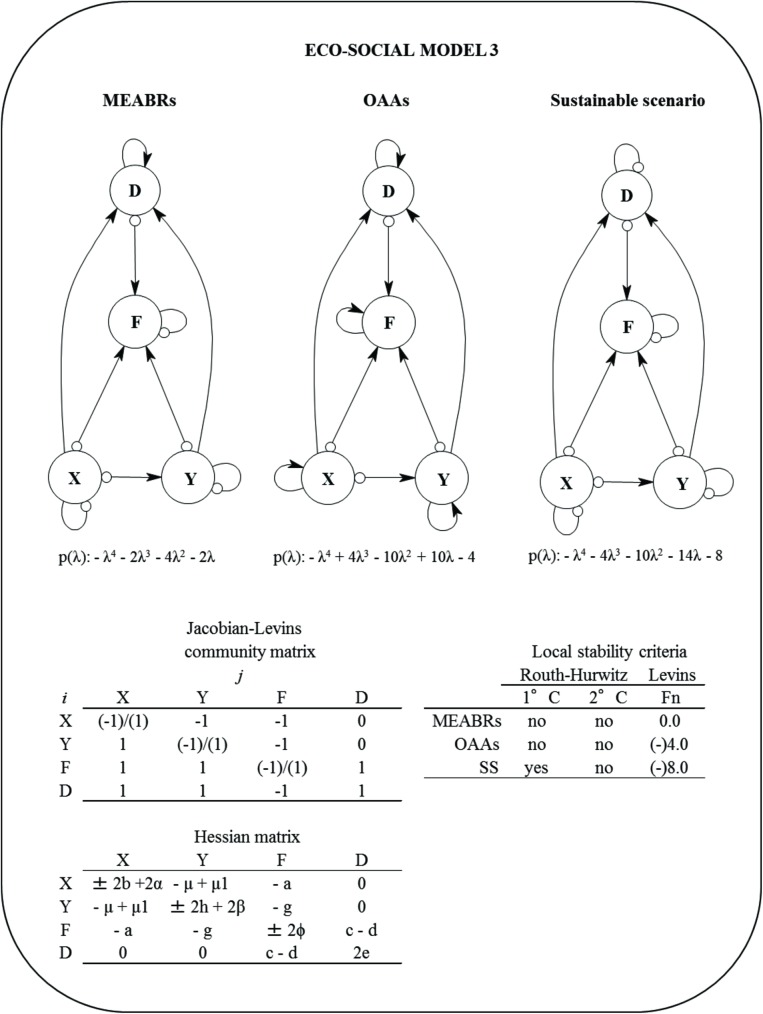
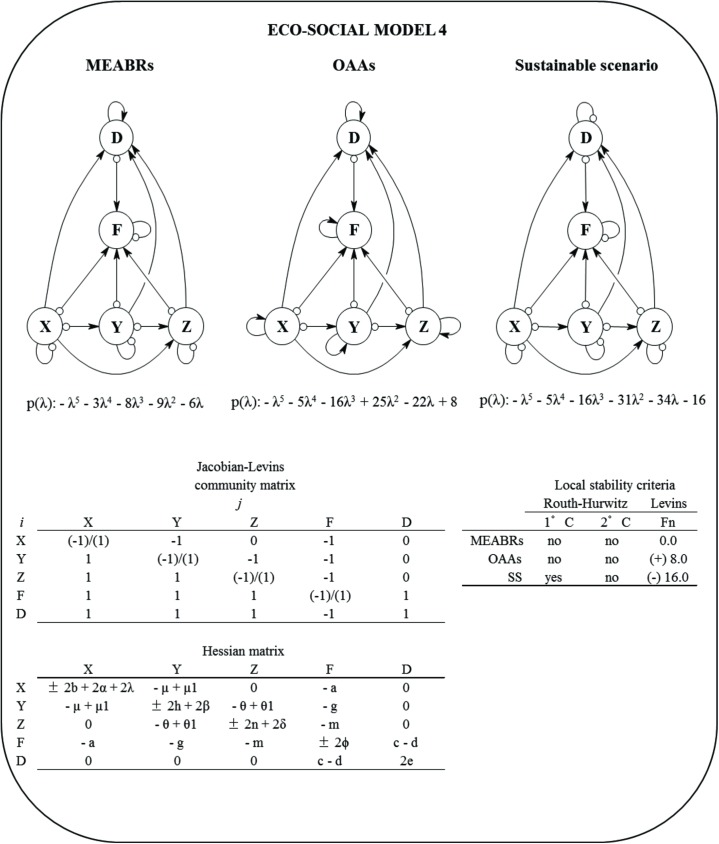
Several administrative polices have been implemented in order to reduce the negative impacts of fishing on natural ecosystems. Four eco-social models with different levels of complexity were constructed, which represent the seaweed harvest in central-northern Chile under two different regimes, Management and Exploitation Areas for Benthic Resources (MAEBRs) and Open Access Areas (OAAs). The dynamics of both regimes were analyzed using the following theoretical frameworks: (1) Loop Analysis, which allows the local stability or sustainability of the models and scenarios to be assessed; and (2) Hessian´s optimization procedure of a global fishery function (GFF) that represents each dynamics of each harvest. The results suggest that the current fishing dynamics in MAEBRs are not sustainable unless the market demand presents some type of control (i.e. taxes). Further, the results indicated that if the demand changes to a self-negative feedback (self-control) in MAEBRs, the stability is increased and, simultaneously, a relative maximum for the GFF is reached. Contrarily, the sustainability of the model/system representing the harvest (principally by cutting plants) in OAAs is not reached. The implementation of an "ecological" tax for intensive artisanal fisheries with low operational cost is proposed. The network analysis developed here is proposed as a general strategy for studying the effects of human interventions in marine coastal ecosystems under transient (short-term) dynamics.
为减少捕鱼对自然生态系统的负面影响,已实施了多项行政政策。构建了四种不同复杂程度的生态社会模型,它们代表了智利中北部在两种不同制度下的海藻收获情况,即底栖资源管理和开发区(MAEBRs)以及开放获取区(OAAs)。使用以下理论框架分析了这两种制度的动态:(1)回路分析,用于评估模型和情景的局部稳定性或可持续性;(2)代表每次收获动态的全球渔业函数(GFF)的黑森优化程序。结果表明,除非市场需求有某种形式的控制(即税收),否则MAEBRs目前的捕鱼动态是不可持续的。此外,结果表明,如果MAEBRs中的需求变为自我负反馈(自我控制),稳定性会增加,同时会达到GFF的相对最大值。相反,代表OAAs收获(主要通过切割植物)的模型/系统的可持续性未实现。建议对运营成本低的小型手工渔业实施“生态”税。本文开发的网络分析被提议作为研究短期动态下人类干预对海洋沿海生态系统影响的一般策略。