Koutra Katerina, Mouatsou Chrysi, Psoma Sofia
Addiction Psychology Laboratory, Department of Psychology, School of Social Sciences, University of Crete, 74100 Rethymnon, Crete, Greece.
Behav Sci (Basel). 2023 Nov 15;13(11):932. doi: 10.3390/bs13110932.
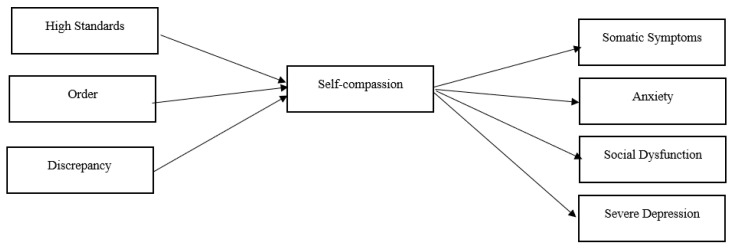
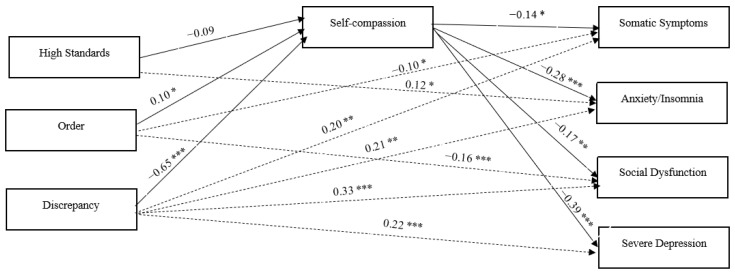
Perfectionism constitutes a multidimensional personality trait. According to the diathesis-stress model, perfectionism may predispose individuals to experience increased psychological distress during stressful periods. Since self-compassion is considered as a protective factor within the context of mental health difficulties, the primary objective of this study was to explore the mediating function of self-compassion in the relationship between positive (i.e., high standards and order) and negative (i.e., discrepancy) aspects of perfectionism and psychological distress among Greek emerging adults. The sample consisted of 410 university students (47.6% males and 52.4% females), with a mean age of 20.61 ± 1.88 years. The Almost Perfect Scale-Revised (APS-R), the Self-Compassion Scale (SCS), and the General Health Questionnaire-28 (GHQ-28) were used to assess perfectionism, self-compassion, and psychological distress, respectively. The results indicated that self-compassion mediated the association between positive and negative aspects of perfectionism and different dimensions of psychological distress (i.e., somatic symptoms, anxiety/insomnia, social dysfunction, and severe depression). Specifically, discrepancy and increased levels of high standards were related to lower levels of self-compassion, thus leading to greater endorsement of psychological distress. In contrast, order was associated with higher levels of self-compassion, thus leading to lower levels of psychological distress. The findings of the present study highlight that self-compassion is an overall important area to examine in nonclinical populations. These findings have implications for the effectiveness of cognitive behavioral therapy (CBT) in enhancing individuals' self-acceptance and awareness of their perfectionistic tendencies, as well as compassion-focused therapy (CFT) in elevating self-compassion, mindfulness, and overall psychological well-being while reducing psychological distress.
完美主义是一种多维度的人格特质。根据素质-应激模型,完美主义可能使个体在压力时期更容易经历更多的心理困扰。由于自我同情被认为是心理健康问题背景下的一个保护因素,本研究的主要目的是探讨自我同情在希腊新兴成年人完美主义的积极方面(即高标准和秩序)与消极方面(即差距)和心理困扰之间关系中的中介作用。样本包括410名大学生(47.6%为男性,52.4%为女性),平均年龄为20.61±1.88岁。分别使用修订后的近乎完美量表(APS-R)、自我同情量表(SCS)和一般健康问卷-28(GHQ-28)来评估完美主义、自我同情和心理困扰。结果表明,自我同情在完美主义的积极和消极方面与心理困扰的不同维度(即躯体症状、焦虑/失眠、社会功能障碍和严重抑郁)之间的关联中起中介作用。具体而言,差距和高标准水平的提高与较低的自我同情水平相关,从而导致对心理困扰的认可度更高。相比之下,秩序与较高的自我同情水平相关,从而导致较低的心理困扰水平。本研究结果强调,自我同情是在非临床人群中需要研究的一个总体重要领域。这些发现对认知行为疗法(CBT)在增强个体自我接纳和对其完美主义倾向的认识方面的有效性,以及对以同情为重点的疗法(CFT)在提高自我同情、正念和整体心理健康同时减少心理困扰方面的有效性具有启示意义。