Pröhl Heike, Rodríguez Ariel
Institute of Zoology, University of Veterinary Medicine of Hannover, Bünteweg 17, 30559 Hannover, Germany.
Animals (Basel). 2023 Nov 18;13(22):3564. doi: 10.3390/ani13223564.
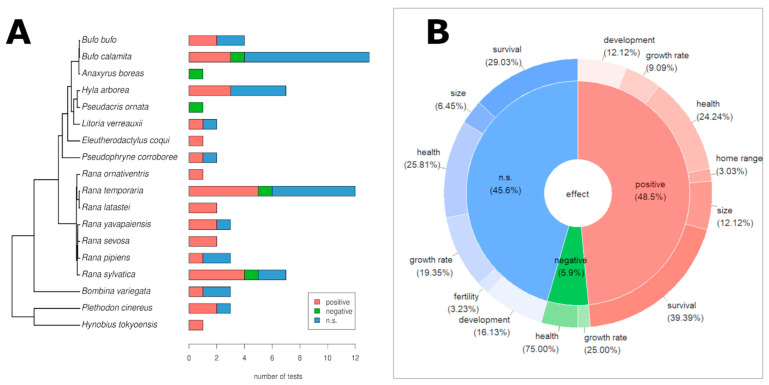
Endangered animals suffer from isolation of their habitats. Isolation leads to a reduction in population size as well as a decrease in genetic diversity and a concomitant increase in the risk of extinction. Amphibians are the most endangered vertebrate class. Besides habitat loss, fragmentation and isolation, amphibians are threatened by emerging diseases e.g., chytrid fungus or . By employing experiments, researchers investigate whether changes in genetic diversity within or among isolated populations affect amphibian fitness. While genetic diversity estimates are based on molecular markers, typically microsatellites, fitness is mostly measured as tadpole performance in rearing experiments often under varying environmental conditions. Tadpole performances (e.g., body mass, growth rate and survival) have been found to be negatively affected by low genetic diversity, as several studies have found a positive association between genetic diversity and these fitness traits. Moreover, infection with pathogens also seems to be more likely in individuals or populations with lower genetic diversity. Overall, these genetic-fitness correlations seem to be more pronounced or detectable in smaller, declining populations but not in larger populations. Genomic studies, which sample a larger fraction of the genome, are still scarce in the conservation genetic literature on amphibians. These are likely to increase in upcoming years and may reveal adaptive variants that protect against dangerous pathogens or environmental changes. Altogether, genetic-fitness correlation studies should be a priority in order to develop effective management plans for the genetic rescue of isolated, imperilled amphibian populations.
濒危动物面临栖息地隔离的问题。隔离导致种群数量减少,以及遗传多样性降低,随之而来的是灭绝风险增加。两栖动物是最濒危的脊椎动物类别。除了栖息地丧失、破碎化和隔离外,两栖动物还受到新出现疾病的威胁,例如壶菌或……通过开展实验,研究人员探究隔离种群内部或之间的遗传多样性变化是否会影响两栖动物的适应性。虽然遗传多样性估计基于分子标记,通常是微卫星,但适应性大多在饲养实验中以蝌蚪的表现来衡量,实验往往在不同环境条件下进行。已发现蝌蚪的表现(例如体重、生长率和存活率)会受到低遗传多样性的负面影响,因为多项研究发现遗传多样性与这些适应性特征之间存在正相关。此外,遗传多样性较低的个体或种群感染病原体的可能性似乎也更高。总体而言,这些遗传与适应性的相关性在较小的、数量正在减少的种群中似乎更为明显或可检测到,但在较大种群中并非如此。在关于两栖动物的保护遗传学文献中,对基因组更大比例进行采样的基因组研究仍然很少。在未来几年,这类研究可能会增加,并可能揭示出能抵御危险病原体或环境变化的适应性变异。总之,为了制定有效的管理计划,对孤立的、濒危两栖动物种群进行遗传拯救,遗传与适应性相关性研究应成为优先事项。