Bouqellah Nahla A, Farag Peter F
Department of Biology, College of Science, Taibah University, P.O. Box 344, Al Madinah Al Munawwarah 42317-8599, Saudi Arabia.
Department of Microbiology, Faculty of Science, Ain Shams University, Cairo 11566, Egypt.
Microorganisms. 2023 Oct 26;11(11):2632. doi: 10.3390/microorganisms11112632.
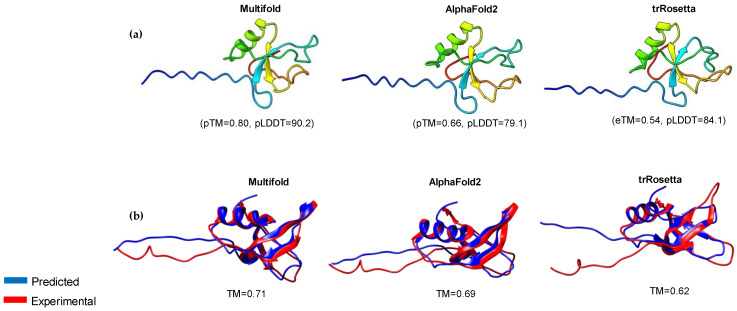
The class II hydrophobin group (HFBII) is an extracellular group of proteins that contain the HFBII domain and eight conserved cysteine residues. These proteins are exclusively secreted by fungi and have multiple functions with a probable role as effectors. In the present study, a total of 45 amino acid sequences of hydrophobin class II proteins from different phytopathogenic fungi were retrieved from the NCBI database. We used the integration of well-designed bioinformatic tools to characterize and predict their physicochemical parameters, novel motifs, 3D structures, multiple sequence alignment (MSA), evolution, and functions as effector proteins through molecular docking. The results revealed new features for these protein members. The ProtParam tool detected the hydrophobicity properties of all proteins except for one hydrophilic protein (KAI3335996.1). Out of 45 proteins, six of them were detected as GPI-anchored proteins by the PredGPI server. Different 3D structure templates with high pTM scores were designed by Multifold v1, AlphaFold2, and trRosetta. Most of the studied proteins were anticipated as apoplastic effectors and matched with the ghyd5 gene of as virulence factors. A protein-protein interaction (PPI) analysis unraveled the molecular function of this group as GTP-binding proteins, while a molecular docking analysis detected a chitin-binding effector role. From the MSA analysis, it was observed that the HFBII sequences shared conserved 2 Pro (P) and 2 Gly (G) amino acids besides the known eight conserved cysteine residues. The evolutionary analysis and phylogenetic tree provided evidence of episodic diversifying selection at the branch level using the aBSREL tool. A detailed in silico analysis of this family and the present findings will provide a better understanding of the HFBII characters and evolutionary relationships, which could be very useful in future studies.
II类疏水蛋白家族(HFBII)是一类细胞外蛋白,包含HFBII结构域和八个保守的半胱氨酸残基。这些蛋白仅由真菌分泌,具有多种功能,可能作为效应子发挥作用。在本研究中,从NCBI数据库中检索了来自不同植物病原真菌的45个II类疏水蛋白的氨基酸序列。我们使用精心设计的生物信息学工具进行整合,以表征和预测它们的物理化学参数、新基序、三维结构、多序列比对(MSA)、进化以及通过分子对接作为效应蛋白的功能。结果揭示了这些蛋白成员的新特征。ProtParam工具检测到除一种亲水性蛋白(KAI3335996.1)外所有蛋白的疏水性。在45种蛋白中,PredGPI服务器检测到其中六种为糖基磷脂酰肌醇(GPI)锚定蛋白。通过Multifold v1、AlphaFold2和trRosetta设计了具有高pTM分数的不同三维结构模板。大多数研究的蛋白被预测为质外体效应子,并与作为毒力因子的ghyd5基因匹配。蛋白质-蛋白质相互作用(PPI)分析揭示了该家族作为GTP结合蛋白的分子功能,而分子对接分析检测到其几丁质结合效应子作用。从MSA分析中观察到,除了已知的八个保守半胱氨酸残基外,HFBII序列还共享保守的2个脯氨酸(P)和2个甘氨酸(G)氨基酸。进化分析和系统发育树使用aBSREL工具在分支水平上提供了间歇性多样化选择的证据。对该家族进行详细的计算机分析以及本研究结果将有助于更好地理解HFBII的特征和进化关系,这在未来的研究中可能非常有用。