Schweizer Lisa, Krishnan Rahul, Shimizu Aasa, Metousis Andreas, Kenny Hilary, Mendoza Rachelle, Nordmann Thierry M, Rauch Sarah, Kelliher Lucy, Heide Janna, Rosenberger Florian A, Bilecz Agnes, Borrego Sanaa Nakad, Strauss Maximillian T, Thielert Marvin, Rodriguez Edwin, Müller-Reif Johannes B, Chen Mengjie, Yamada S Diane, Mund Andreas, Lastra Ricardo R, Mann Matthias, Lengyel Ernst
Proteomics and Signal Transduction, Max Planck Institute of Biochemistry, Martinsried, Germany.
Department of Obstetrics and Gynecology/Section of Gynecologic Oncology, University of Chicago, Chicago, IL, USA.
medRxiv. 2023 Nov 13:2023.11.13.23298409. doi: 10.1101/2023.11.13.23298409.
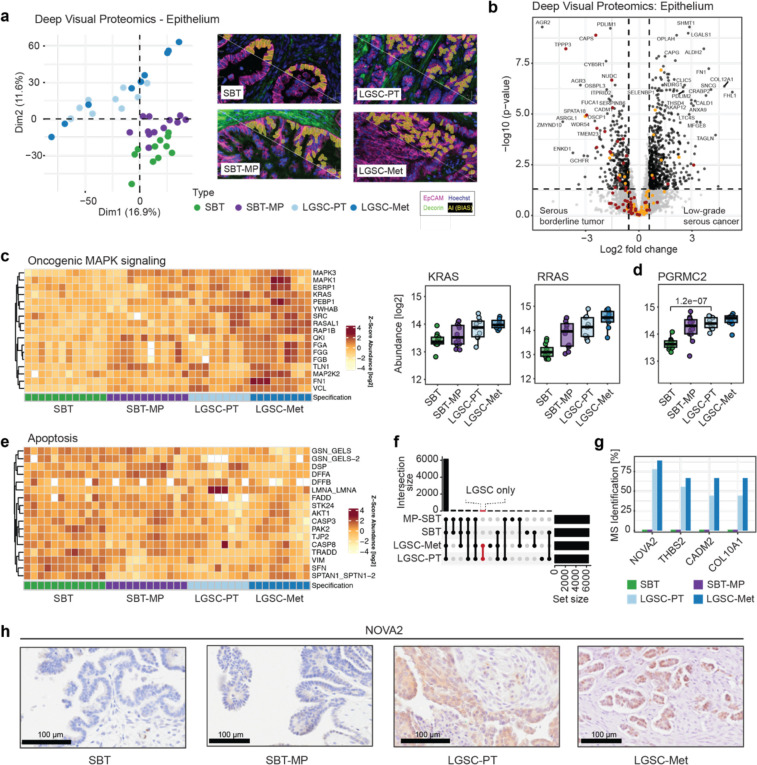
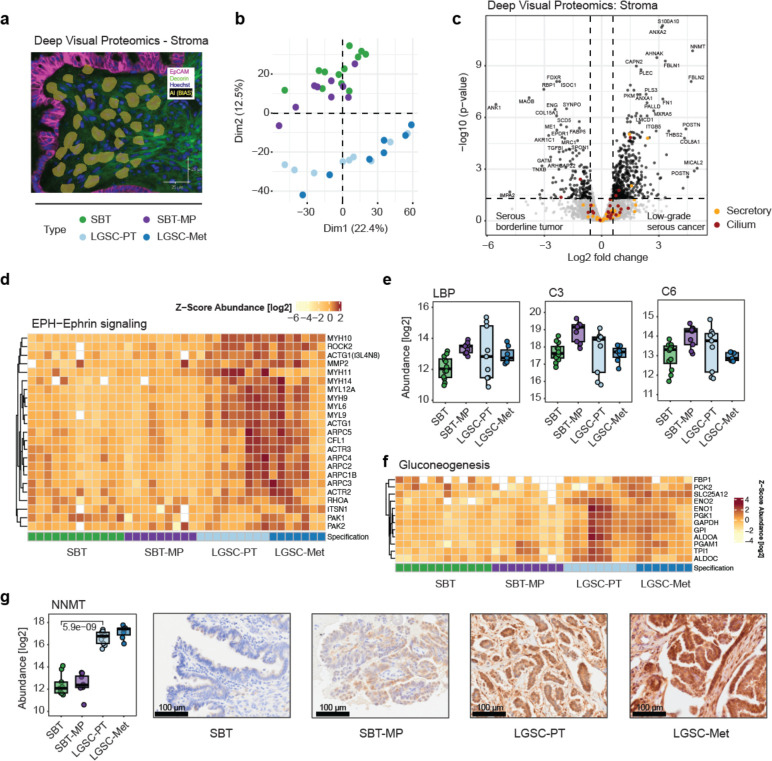
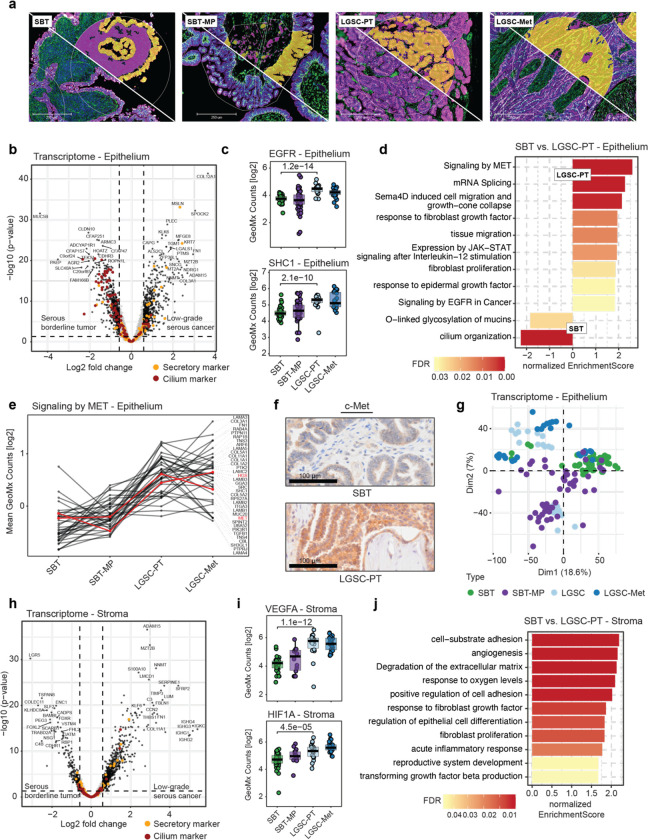
Serous borderline tumors (SBT) are epithelial neoplastic lesions of the ovaries that commonly have a good prognosis. In 10-15% of cases, however, SBT will recur as low-grade serous cancer (LGSC), which is deeply invasive and responds poorly to current standard chemotherapy. While genetic alterations suggest a common origin, the transition from SBT to LGSC remains poorly understood. Here, we integrate spatial proteomics with spatial transcriptomics to elucidate the evolution from SBT to LGSC and its corresponding metastasis at the molecular level in both the stroma and the tumor. We show that the transition of SBT to LGSC occurs in the epithelial compartment through an intermediary stage with micropapillary features (SBT-MP), which involves a gradual increase in MAPK signaling. A distinct subset of proteins and transcripts was associated with the transition to invasive tumor growth, including the neuronal splicing factor NOVA2, which was limited to expression in LGSC and its corresponding metastasis. An integrative pathway analysis exposed aberrant molecular signaling of tumor cells supported by alterations in angiogenesis and inflammation in the tumor microenvironment. Integration of spatial transcriptomics and proteomics followed by knockdown of the most altered genes or pharmaceutical inhibition of the most relevant targets confirmed their functional significance in regulating key features of invasiveness. Combining cell-type resolved spatial proteomics and transcriptomics allowed us to elucidate the sequence of tumorigenesis from SBT to LGSC. The approach presented here is a blueprint to systematically elucidate mechanisms of tumorigenesis and find novel treatment strategies.
浆液性交界性肿瘤(SBT)是卵巢的上皮性肿瘤性病变,通常预后良好。然而,在10%至15%的病例中,SBT会复发为低级别浆液性癌(LGSC),这种癌症具有深度侵袭性,对当前的标准化化疗反应不佳。虽然基因改变提示存在共同起源,但SBT向LGSC的转变仍知之甚少。在此,我们将空间蛋白质组学与空间转录组学相结合,以在分子水平上阐明SBT向LGSC的演变及其在基质和肿瘤中的相应转移。我们发现,SBT向LGSC的转变发生在上皮细胞区室,通过一个具有微乳头特征的中间阶段(SBT-MP),这涉及MAPK信号的逐渐增加。一组独特的蛋白质和转录本与向侵袭性肿瘤生长的转变相关,包括神经元剪接因子NOVA2,其仅限于在LGSC及其相应转移灶中表达。综合通路分析揭示了肿瘤微环境中血管生成和炎症改变所支持的肿瘤细胞异常分子信号。空间转录组学和蛋白质组学相结合,随后敲低变化最大的基因或对最相关靶点进行药物抑制,证实了它们在调节侵袭关键特征方面的功能意义。结合细胞类型解析的空间蛋白质组学和转录组学使我们能够阐明从SBT到LGSC的肿瘤发生序列。本文介绍的方法是系统阐明肿瘤发生机制并寻找新治疗策略的蓝图。