Department of Biochemistry, Charité - Universitätsmedizin Berlin, Berlin, Germany.
Molecular Biology of Metabolism Laboratory, The Francis Crick Institute, London, UK.
Nat Commun. 2022 Jul 8;13(1):3944. doi: 10.1038/s41467-022-31492-0.
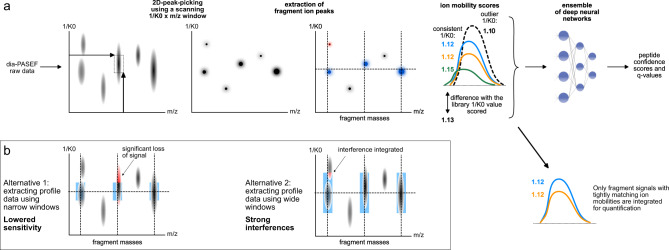
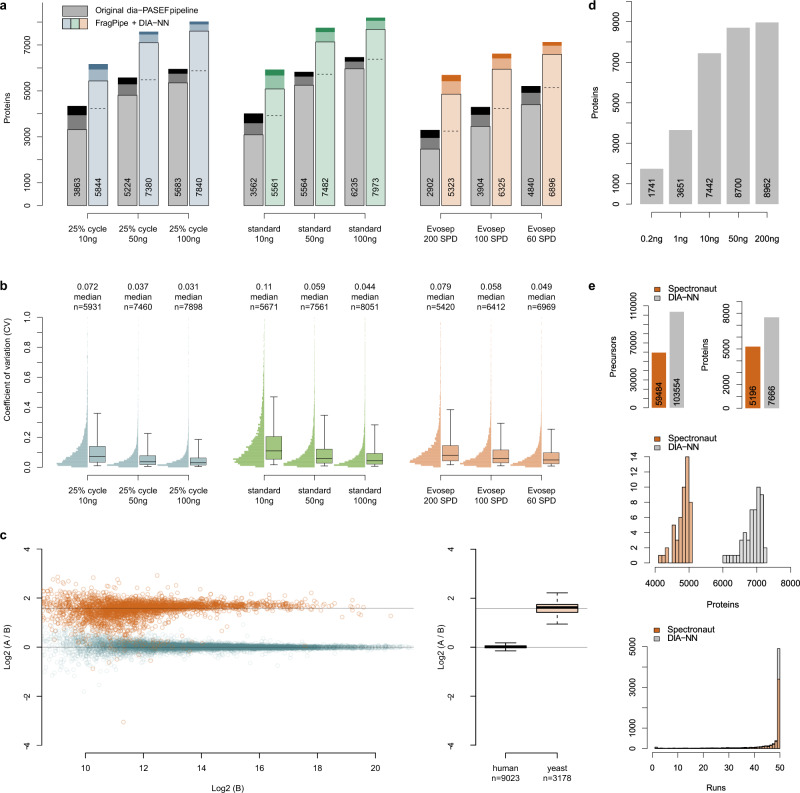
The dia-PASEF technology uses ion mobility separation to reduce signal interferences and increase sensitivity in proteomic experiments. Here we present a two-dimensional peak-picking algorithm and generation of optimized spectral libraries, as well as take advantage of neural network-based processing of dia-PASEF data. Our computational platform boosts proteomic depth by up to 83% compared to previous work, and is specifically beneficial for fast proteomic experiments and those with low sample amounts. It quantifies over 5300 proteins in single injections recorded at 200 samples per day throughput using Evosep One chromatography system on a timsTOF Pro mass spectrometer and almost 9000 proteins in single injections recorded with a 93-min nanoflow gradient on timsTOF Pro 2, from 200 ng of HeLa peptides. A user-friendly implementation is provided through the incorporation of the algorithms in the DIA-NN software and by the FragPipe workflow for spectral library generation.
dia-PASEF 技术利用离子淌度分离来减少蛋白质组学实验中的信号干扰并提高灵敏度。在这里,我们提出了一种二维峰提取算法和优化谱库的生成方法,并利用基于神经网络的 dia-PASEF 数据处理。与以前的工作相比,我们的计算平台将蛋白质组学的深度提高了 83%,特别是对快速蛋白质组学实验和低样本量的实验有益。它使用 Evosep One 色谱系统在 timsTOF Pro 质谱仪上以每天 200 个样本的通量记录单个进样,可定量超过 5300 种蛋白质,使用 timsTOF Pro 2 上的 93 分钟纳流梯度记录单个进样,可定量超过 9000 种蛋白质,来自 200ng 的 HeLa 肽。通过将算法整合到 DIA-NN 软件中,并通过 FragPipe 工作流程生成光谱库,提供了一个用户友好的实现。