ICMR-National Institute of Nutrition, Tarnaka, Osmania University, PO, Hyderabad, Telangana 500007, India.
Department of Biochemistry, Acharya Nagarjuna University, Nagarjuna Nagar, Guntur, Andhra Pradesh 522510, India.
Asian Pac J Cancer Prev. 2023 Nov 1;24(11):3795-3804. doi: 10.31557/APJCP.2023.24.11.3795.
Oxidative stress combined with nullity of xenobiotic metabolizing GSTT1/GSTM1/CYP2E1 genes may increase the susceptibility of agricultural workers to adverse health effects including cancer. The present study was conducted to determine; the prevalence of polymorphisms in GSTM1, GSTT1 and CYP2E1 genes, serum 8-hydroxy-2'-deoxygunosine levels, and the role of these markers in risk of cancer among agricultural workers occupationally exposed to pesticides.
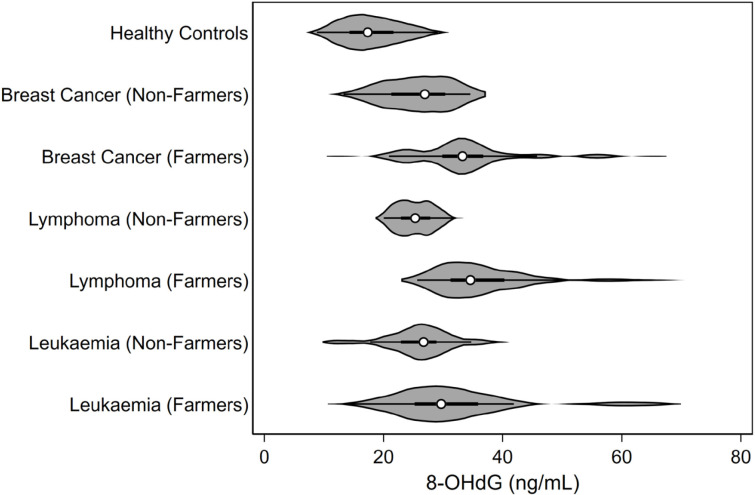
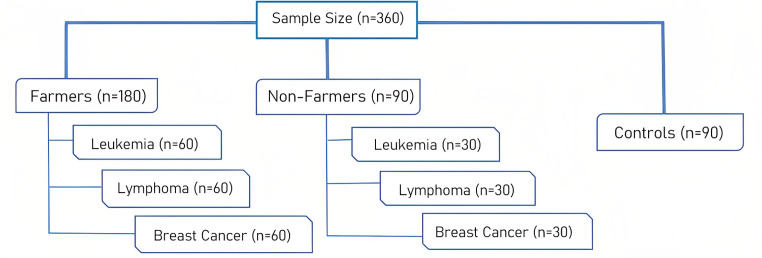
A total of 360 participants, of which 180 belonging to farming group diagnosed with leukemia (n=60), lymphoma (n=60) and breast cancers (n=60), 90 in non-farming group diagnosed with similar cancers and the other 90 as healthy controls with neither history of occupational exposure nor diagnosed with any type of cancers were recruited. Following the questionnaire survey, serum 8-OHdG and genetic polymorphisms in the three genes were determined using ELISA and PCR methods respectively.
The results of the study revealed that farm workers carrying GSTT1 null genotype had increased risk for lymphoma (OR = 5.34; 95% CI = 1.80-15.82) and breast cancer (OR=4.04; 95% CI = 1.24-13.07). For farm workers carrying GSTM1 null genotype, the risk was six-fold for breast cancer (OR = 6.88; 95% CI =1.88-25.99). Further, there found a significant difference between 8-OHdG and nullity of CYP2E1 among the farm workers diagnosed with leukemia.
The findings of the present study suggest that the polymorphisms in detoxifying genes among farm workers occupationally exposed to pesticides and the oxidative stress may likely be responsible for triggering the mechanism of malignancy.
氧化应激与异生物代谢 GSTT1/GSTM1/CYP2E1 基因的缺失相结合,可能会增加农业工人患癌症等不良健康影响的易感性。本研究旨在确定 GSTT1、GSTM1 和 CYP2E1 基因多态性、血清 8-羟基-2'-脱氧鸟苷水平的流行率,以及这些标志物在职业性接触农药的农业工人癌症风险中的作用。
共招募了 360 名参与者,其中 180 名属于农业组,被诊断为白血病(n=60)、淋巴瘤(n=60)和乳腺癌(n=60),90 名属于非农业组,被诊断为类似癌症,另外 90 名作为健康对照组,既没有职业暴露史,也没有被诊断出患有任何类型的癌症。在问卷调查后,使用 ELISA 和 PCR 方法分别测定血清 8-OHdG 和三个基因的遗传多态性。
研究结果表明,携带 GSTT1 缺失基因型的农业工人患淋巴瘤的风险增加(OR=5.34;95%CI=1.80-15.82)和乳腺癌(OR=4.04;95%CI=1.24-13.07)。对于携带 GSTM1 缺失基因型的农业工人,乳腺癌的风险增加六倍(OR=6.88;95%CI=1.88-25.99)。此外,在被诊断为白血病的农业工人中,发现 8-OHdG 和 CYP2E1 缺失之间存在显著差异。
本研究结果表明,职业性接触农药的农业工人解毒基因的多态性和氧化应激可能是引发恶性机制的原因。