Teodoro Michele, Briguglio Giusi, Fenga Concettina, Costa Chiara
Department of Biomedical and Dental Sciences and Morphofunctional Imaging - Occupational Medicine Section - University of Messina, Italy.
Department of Clinical and Experimental Medicine - Occupational Medicine Section - University of Messina, Italy.
Toxicol Rep. 2019 Jun 7;6:564-570. doi: 10.1016/j.toxrep.2019.06.004. eCollection 2019.
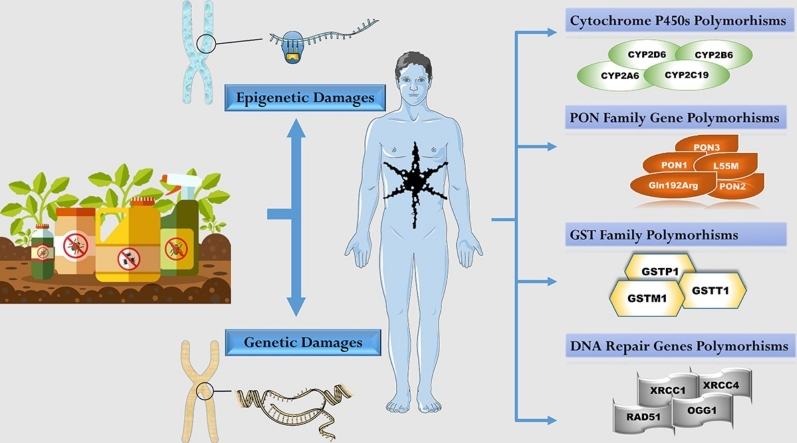
Occupational and environmental exposure to pesticides may induce harmful effects on human health by promoting the development of a wide range of disorders. Some of the most recently hypothesized mechanisms are oxidative stress and epigenetic modifications, however biological effects seem to be modulated mainly by the occurrence of genetic polymorphisms. The susceptibility to exposure can be evaluated by studying the most common polymorphisms of genes involved in the metabolism of organophosphorus compounds (cytochrome P450, glutathione transferase, acetyltransferases or paraoxonase 1). The aim of this article is to review recent literature data concerning the influence of genetic polymorphisms on pesticides-induced oxidative damage.
职业性和环境性接触农药可能通过引发多种疾病而对人类健康产生有害影响。一些最新提出的机制包括氧化应激和表观遗传修饰,然而生物学效应似乎主要由基因多态性的发生来调节。通过研究参与有机磷化合物代谢的基因(细胞色素P450、谷胱甘肽转移酶、乙酰转移酶或对氧磷酶1)的最常见多态性,可以评估接触农药的易感性。本文的目的是综述有关基因多态性对农药诱导的氧化损伤影响的最新文献数据。