Arenella Martina, Fanelli Giuseppe, Kiemeney Lambertus A, McAlonan Grainne, Murphy Declan G, Bralten Janita
Department of Forensic and Neurodevelopmental Science, Institute of Psychiatry, Psychology and Neuroscience, King's College London, London, United Kingdom.
Department of Human Genetics, Radboud University Medical Center, Nijmegen, the Netherlands.
Brain Behav Immun Health. 2023 Nov 3;34:100698. doi: 10.1016/j.bbih.2023.100698. eCollection 2023 Dec.
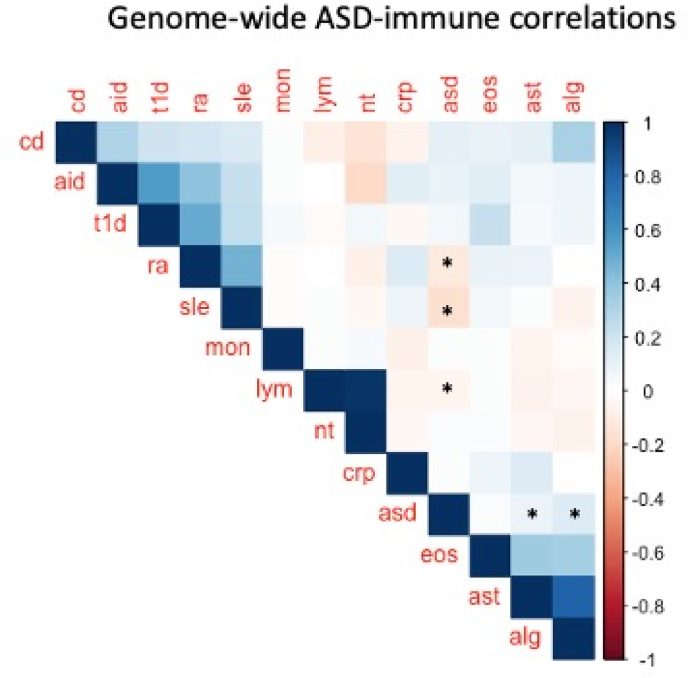
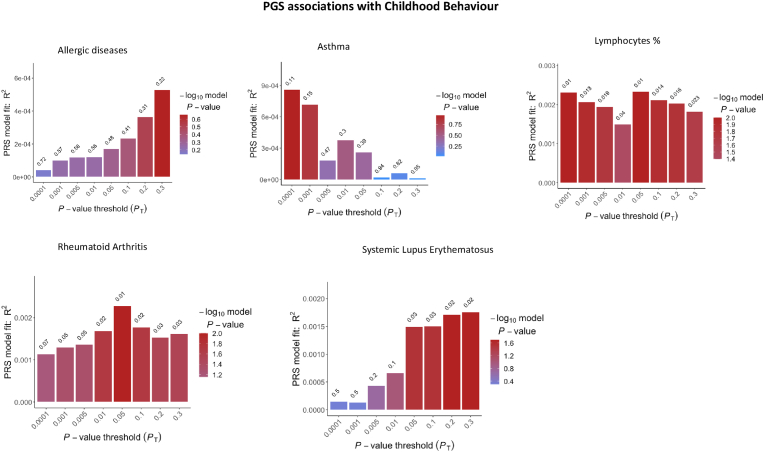
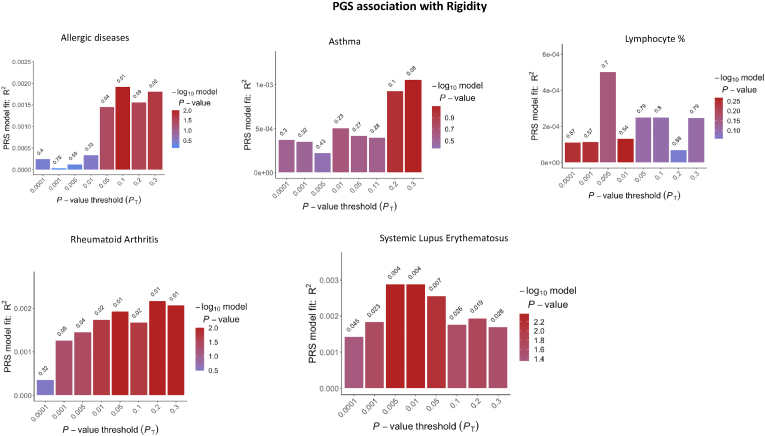
Autism spectrum disorder (ASD) is a common and complex neurodevelopmental condition. The pathophysiology of ASD is poorly defined; however, it includes a strong genetic component and there is increasing evidence to support a role of immune dysregulation. Nonetheless, it is unclear which immune phenotypes link to ASD through genetics. Hence, we investigated the genetic correlation between ASD and diverse classes of immune conditions and markers; and if these immune-related genetic factors link to specific autistic-like traits in the population. We estimated global and local genetic correlations between ASD (n = 55,420) and 11 immune phenotypes (n = 14,256-755,406) using genome-wide association study summary statistics. Subsequently, polygenic scores (PGS) for these immune phenotypes were calculated in a population-based sample (n = 2487) and associated to five autistic-like traits (i.e., attention to detail, childhood behaviour, imagination, rigidity, social skills), and a total autistic-like traits score. Sex-stratified PGS analyses were also performed. At the genome-wide level, ASD was positively correlated with allergic diseases (ALG), and negatively correlated with lymphocyte count, rheumatoid arthritis (RA), and systemic lupus erythematosus (SLE) (FDR-p = 0.01-0.02). At the local genetic level, ASD was correlated with RA, C-reactive protein, and granulocytes and lymphocyte counts (p = 5.8 × 10-0.002). In the general population sample, increased genetic liability for SLE, RA, ALG, and lymphocyte levels, captured by PGS, was associated with the total autistic score and with rigidity and childhood behaviour (FDR-p = 0.03). In conclusion, we demonstrated a genetic relationship between ASD and immunity that depends on the type of immune phenotype considered; some increase likelihood whereas others may potentially help build resilience. Also, this relationship may be restricted to specific genetic loci and link to specific autistic dimensions (e.g., rigidity).
自闭症谱系障碍(ASD)是一种常见且复杂的神经发育疾病。ASD的病理生理学定义尚不明确;然而,它包含很强的遗传成分,并且越来越多的证据支持免疫失调在其中所起的作用。尽管如此,目前尚不清楚哪些免疫表型通过遗传与ASD相关联。因此,我们研究了ASD与不同类型免疫疾病及标志物之间的遗传相关性;以及这些与免疫相关的遗传因素是否与人群中特定的自闭症样特征相关。我们使用全基因组关联研究汇总统计数据,估计了ASD(n = 55,420)与11种免疫表型(n = 14,256 - 755,406)之间的全局和局部遗传相关性。随后,在一个基于人群的样本(n = 2487)中计算了这些免疫表型的多基因评分(PGS),并将其与五种自闭症样特征(即注重细节、儿童行为、想象力、刻板性、社交技能)以及一个总的自闭症样特征评分相关联。还进行了按性别分层的PGS分析。在全基因组水平上,ASD与过敏性疾病(ALG)呈正相关,与淋巴细胞计数、类风湿性关节炎(RA)和系统性红斑狼疮(SLE)呈负相关(FDR-p = 0.01 - 0.02)。在局部遗传水平上,ASD与RA、C反应蛋白、粒细胞和淋巴细胞计数相关(p = 5.8 × 10 - 0.002)。在一般人群样本中,PGS所反映的SLE、RA、ALG和淋巴细胞水平的遗传易感性增加,与总的自闭症评分以及刻板性和儿童行为相关(FDR-p = 0.03)。总之,我们证明了ASD与免疫之间的遗传关系取决于所考虑的免疫表型类型;一些免疫表型会增加患病可能性,而另一些可能有助于增强恢复力。此外,这种关系可能仅限于特定的基因位点,并与特定的自闭症维度(如刻板性)相关。