AlSubai Abdulla, Baqai Muhammad Hadi, Agha Hifza, Shankarlal Neha, Javaid Syed Sarmad, Jesrani Eshika Kumari, Golani Shalni, Akram Abdullah, Qureshi Faiza, Ahmed Shaheer, Saran Simran
Royal College of Surgeons in Ireland, Dublin, Ireland.
Ziauddin Medical University, Karachi, Sindh, Pakistan.
SAGE Open Med. 2023 Nov 22;11:20503121231212093. doi: 10.1177/20503121231212093. eCollection 2023.
Preeclampsia is one of the most frequent pregnancy disorders, with a global incidence of 2%-8%. Serum 25-hydroxyvitamin D is an essential mineral for human health; some studies suggest link between 25-hydroxyvitamin D deficiency and preeclampsia, while others offer contradictory findings. Thus, the goal of this study is to evaluate the relationships between maternal 25- hydroxyvitamin D concentrations and the risk of preeclampsia. In addition to this, our study also evaluates the effects of 25- hydroxyvitamin D supplementation on the incidence of preeclampsia. Therefore, assessing 25- hydroxyvitamin D's potential as a possible intervention to lower the risk of preeclampsia.
The Medline database was queried from inception until July 2021 for randomized controlled trials and observational studies without any restrictions. The studies assessing the association between 25-hydroxyvitamin D deficiency and preeclampsia and the impact of 25-hydroxyvitamin D supplementation on the incidence of preeclampsia were incorporated. The results were reported using a random-effects meta-analysis and the Mantel-Haenszel odds ratio. A -value of <0.05 was considered significant for the analysis.
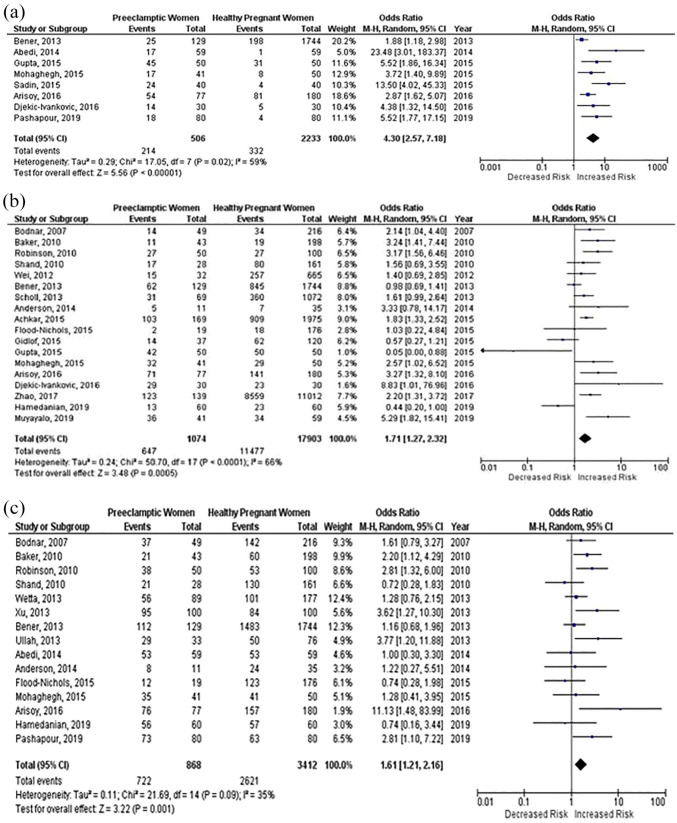
This analysis includes 34 papers, including 10 randomized controlled trials and 24 observational studies. According to our pooled analysis, 25-hydroxyvitamin D supplementation was significantly associated with a lower risk of preeclampsia in pregnant women (OR: 0.50; 95% CI: 0.40-0.63; = 0.00001), while 25-hydroxyvitamin D deficiency was significantly associated with an increased risk of preeclampsia (OR: 4.30; 95 % CI: 2.57-7.18; < 0.00001, OR: 1.71; 95 % Cl: 1.27-2.32; = 0.0005, OR 1.61; 95 % Cl: 1.21-2.16; = 0.001).
Results suggest that 25-hydroxyvitamin D has a significant relationship with preeclampsia as confirmed by the findings that low maternal 25-hydroxyvitamin D concentrations cause increased risk of preeclampsia while 25-hydroxyvitamin D supplementation reduces the incidence of preeclampsia. Our findings indicate that 25-hydroxyvitamin D supplementation can be used as a possible intervention strategy in preventing one of the most common causes of maternal mortality around the world, preeclampsia.
子痫前期是最常见的妊娠疾病之一,全球发病率为2%-8%。血清25-羟基维生素D是人体健康必需的矿物质;一些研究表明25-羟基维生素D缺乏与子痫前期之间存在关联,而其他研究则给出了相互矛盾的结果。因此,本研究的目的是评估孕妇25-羟基维生素D浓度与子痫前期风险之间的关系。除此之外,我们的研究还评估了补充25-羟基维生素D对子痫前期发病率的影响。因此,评估25-羟基维生素D作为降低子痫前期风险的可能干预措施的潜力。
检索Medline数据库从创建至2021年7月的随机对照试验和观察性研究,无任何限制。纳入评估25-羟基维生素D缺乏与子痫前期之间的关联以及补充25-羟基维生素D对子痫前期发病率影响的研究。结果采用随机效应荟萃分析和Mantel-Haenszel优势比报告。分析中P值<0.05被认为具有统计学意义。
该分析包括34篇论文,其中10项随机对照试验和24项观察性研究。根据我们的汇总分析,补充25-羟基维生素D与孕妇子痫前期风险显著降低相关(优势比:0.50;95%置信区间:0.40-0.63;P = 0.00001),而25-羟基维生素D缺乏与子痫前期风险显著增加相关(优势比:4.30;95%置信区间:2.57-7.18;P < 0.00001,优势比:1.71;95%置信区间:1.27-2.32;P = 0.0005,优势比1.61;95%置信区间:1.21-2.16;P = 0.001)。
结果表明,25-羟基维生素D与子痫前期存在显著关系,低孕妇25-羟基维生素D浓度会导致子痫前期风险增加,而补充25-羟基维生素D可降低子痫前期发病率,这一发现证实了这一点。我们的研究结果表明,补充25-羟基维生素D可作为一种可能的干预策略,用于预防全球孕产妇死亡的最常见原因之一子痫前期。