Fu Xianheng, Huang Yu, Fu Qi, Qiu Yingbo, Zhao Jiayi, Li Jiaxin, Wu Xicun, Yang Yihang, Liu Hongen, Yang Xian, Chen Huaihai
State Key Laboratory of Biocontrol, School of Ecology, Sun Yat-sen University, Shenzhen, Guangdong, China.
Front Plant Sci. 2023 Nov 10;14:1252821. doi: 10.3389/fpls.2023.1252821. eCollection 2023.
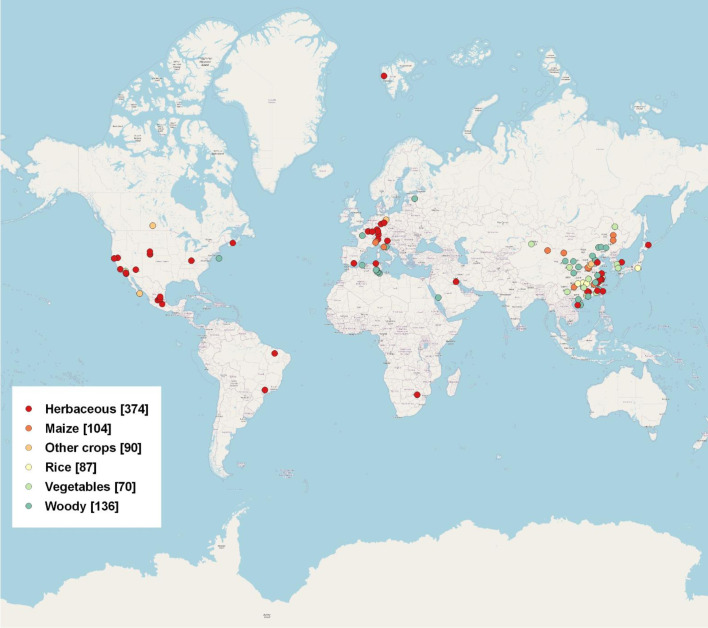
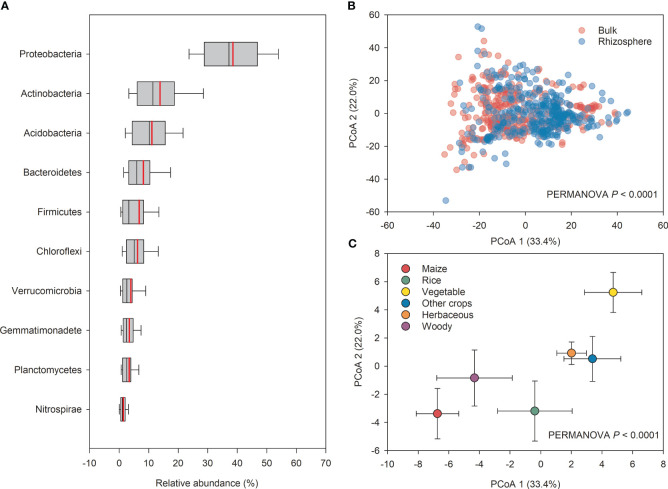
Over the years, microbial community composition in the rhizosphere has been extensively studied as the most fascinating topic in microbial ecology. In general, plants affect soil microbiota through rhizodeposits and changes in abiotic conditions. However, a consensus on the response of microbiota traits to the rhizosphere and bulk soils in various ecosystems worldwide regarding community diversity and structure has not been reached yet. Here, we conducted a meta-analysis of 101 studies to investigate the microbial community changes between the rhizosphere and bulk soils across various plant species (maize, rice, vegetables, other crops, herbaceous, and woody plants). Our results showed that across all plant species, plant rhizosphere effects tended to reduce the rhizosphere soil pH, especially in neutral or slightly alkaline soils. Beta-diversity of bacterial community was significantly separated between into rhizosphere and bulk soils. Moreover, r-strategists and copiotrophs (e.g. Proteobacteria and Bacteroidetes) enriched by 24-27% in the rhizosphere across all plant species, while K-strategists and oligotrophic (e.g. Acidobacteria, Gemmatimonadete, Nitrospirae, and Planctomycetes) decreased by 15-42% in the rhizosphere. Actinobacteria, Firmicutes, and Chloroflexi are also depleted by in the plant rhizosphere compared with the bulk soil by 7-14%. The Actinobacteria exhibited consistently negative effect sizes across all plant species, except for maize and vegetables. In Firmicutes, both herbaceous and woody plants showed negative responses to rhizosphere effects, but those in maize and rice were contrarily enriched in the rhizosphere. With regards to Chloroflexi, apart from herbaceous plants showing a positive effect size, the plant rhizosphere effects were consistently negative across all other plant types. Verrucomicrobia exhibited a significantly positive effect size in maize, whereas herbaceous plants displayed a negative effect size in the rhizosphere. Overall, our meta-analysis exhibited significant changes in microbial community structure and diversity responding to the plant rhizosphere effects depending on plant species, further suggesting the importance of plant rhizosphere to environmental changes influencing plants and subsequently their controls over the rhizosphere microbiota related to nutrient cycling and soil health.
多年来,根际微生物群落组成作为微生物生态学中最引人入胜的主题,已得到广泛研究。一般来说,植物通过根际分泌物和非生物条件的变化影响土壤微生物群。然而,关于全球各种生态系统中微生物群特征对根际和大土壤的反应,在群落多样性和结构方面尚未达成共识。在此,我们对101项研究进行了荟萃分析,以调查不同植物物种(玉米、水稻、蔬菜、其他作物、草本植物和木本植物)根际和大土壤之间的微生物群落变化。我们的结果表明,在所有植物物种中,植物根际效应往往会降低根际土壤pH值,尤其是在中性或微碱性土壤中。细菌群落的β多样性在根际和大土壤之间有显著差异。此外,在所有植物物种中,r策略者和富养菌(如变形菌门和拟杆菌门)在根际中富集了24%-27%,而K策略者和贫养菌(如酸杆菌门、芽单胞菌门、硝化螺旋菌门和浮霉菌门)在根际中减少了15%-42%。与大土壤相比,放线菌门、厚壁菌门和绿弯菌门在植物根际中也减少了7%-14%。除了玉米和蔬菜外,放线菌门在所有植物物种中均表现出一致的负效应量。在厚壁菌门中,草本植物和木本植物对根际效应均表现出负反应,但玉米和水稻中的厚壁菌门在根际中反而富集。关于绿弯菌门,除了草本植物表现出正效应量外,在所有其他植物类型中,植物根际效应均为负。疣微菌门在玉米中表现出显著的正效应量,而草本植物在根际中表现出负效应量。总体而言,我们的荟萃分析表明,微生物群落结构和多样性对植物根际效应有显著变化,这取决于植物物种,进一步表明植物根际对影响植物的环境变化以及随后对与养分循环和土壤健康相关的根际微生物群的控制的重要性。