Moreno-Peral P, Rodríguez-Morejón A, Bellón J A, García-Huércano C, Martínez-Vispo C, Campos-Paino H, Galán S, Reyes-Martín S, Sánchez Aguadero N, Rangel-Henriques M, Motrico E, Conejo-Cerón S
Biomedical Research Institute of Malaga (IBIMA Plataforma BIONAND), C. Severo Ochoa, 35, 29590 Málaga, Spain.
Chronicity, Primary Care and Health Promotion Research Network (RICAPSS), ISCIII, Gran Via de les Corts Catalanes, 587, àtic, 08007 Barcelona, Spain.
Internet Interv. 2023 Jun 22;34:100640. doi: 10.1016/j.invent.2023.100640. eCollection 2023 Dec.
To date, all preventive anxiety disorders interventions are one-fit-all and none of them are based on individual level and risk profile. The aim of this project is to design, develop and evaluate an online personalized intervention based on a risk algorithm for the universal prevention of anxiety disorders in the general population.
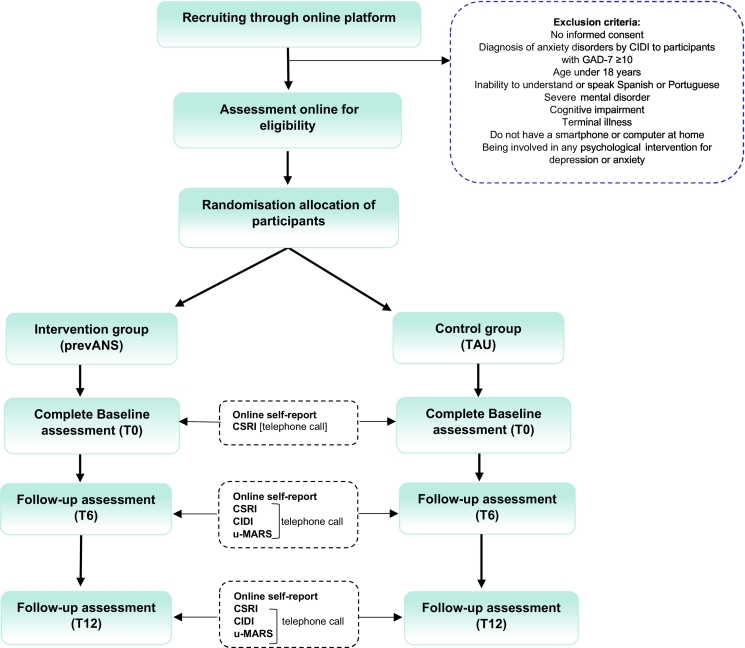
A randomized controlled trial (RCT) with two parallel arms (prevANS vs usual care) and 1-year follow-up including 2000 participants without anxiety disorders from Spain and Portugal will be conducted.The prevANS intervention will be self-guided and can be implemented from the prevANS web or from the participants' Smartphone (through an App). The prevANS intervention will have different intensities depending on the risk level of the population, evaluated from the risk algorithm for anxiety: predictA. Both low and moderate-high risk participants will receive information on their level and profile (risk factors) of anxiety disorders, will have access to stress management tools and psychoeducational information periodically. In addition, participants with a moderate-high risk of anxiety disorders will also have access to cognitive-behavioral training (problem-solving, decision-making, communication skills, and working with thoughts). The control group will not receive any intervention, but they will fill out the same questionnaires as the intervention group.Assessments will be completed at baseline, 6 and 12-month follow-up. The primary outcome is the cumulative incidence of anxiety disorders. Secondary outcomes include depressive and anxiety symptoms, risk probability of anxiety disorders (predictA algorithm) and depression (predictD algorithm), improvement in physical and mental quality of life, and acceptability and satisfaction with the intervention. In addition, cost-effectiveness and cost-utility analyses will also be carried out from two perspectives, societal and health system, and analyses of mediators and moderators will also be performed.
To the best of our knowledge, prevANS study will be the first to evaluate the effectiveness and cost-effectiveness of a personalized online intervention based on a risk predictive algorithm for the universal prevention of anxiety disorders.
ClinicalTrials.gov: NCT05682365.
迄今为止,所有预防性焦虑症干预措施都是一刀切的,没有一项是基于个体水平和风险状况的。本项目的目的是设计、开发和评估一种基于风险算法的在线个性化干预措施,用于在普通人群中普遍预防焦虑症。
将进行一项随机对照试验(RCT),有两个平行组(prevANS组与常规护理组),并进行1年随访,纳入2000名来自西班牙和葡萄牙且无焦虑症的参与者。prevANS干预将是自我指导的,可通过prevANS网站或参与者的智能手机(通过应用程序)实施。prevANS干预将根据人群的风险水平具有不同强度,该风险水平通过焦虑风险算法predictA进行评估。低风险和中度高风险参与者都将收到关于他们焦虑症的水平和状况(风险因素)的信息,将定期获得压力管理工具和心理教育信息。此外,有中度高风险焦虑症的参与者还将获得认知行为训练(解决问题、决策、沟通技巧以及处理思维)。对照组将不接受任何干预,但他们将填写与干预组相同的问卷。评估将在基线、6个月和12个月随访时完成。主要结局是焦虑症的累积发病率。次要结局包括抑郁和焦虑症状、焦虑症(predictA算法)和抑郁症(predictD算法)的风险概率、身心健康生活质量的改善以及对干预的可接受性和满意度。此外,还将从社会和卫生系统两个角度进行成本效益和成本效用分析,并进行中介和调节因素分析。
据我们所知,prevANS研究将是首个评估基于风险预测算法的个性化在线干预措施对普遍预防焦虑症的有效性和成本效益的研究。
ClinicalTrials.gov:NCT05682365。