Ericsson Leon, Hjalmarsson Adam, Akbar Muhammad Usman, Ferdian Edward, Bonini Mia, Hardy Brandon, Schollenberger Jonas, Aristova Maria, Winter Patrick, Burris Nicholas, Fyrdahl Alexander, Sigfridsson Andreas, Schnell Susanne, Figueroa C Alberto, Nordsletten David, Young Alistair A, Marlevi David
L.E., A.H., A.F., A.S., and D.M. are with Karolinska Institutet, Solna, Sweden. M.U.A. is with Linköping University, Linköping, Sweden. E.F. and A.A.Y. are with the University of Auckland, Auckland, New Zealand. M.B., B.H, N.B, C.A.F, and D.A.N. are with the University of Michigan, Ann Arbor, USA. J.S. is with the University of California San Francisco, San Francisco, CA, USA. M.A. ans S.S. are with Northwestern University, Chicago, USA. S.S. is also with the University of Greifswald, Germany. A.A.Y. is also with King's College London, London, UK. D.M. is also with Massachusetts Institute of Technology, Cambridge, USA.
ArXiv. 2023 Nov 21:arXiv:2311.11819v2.
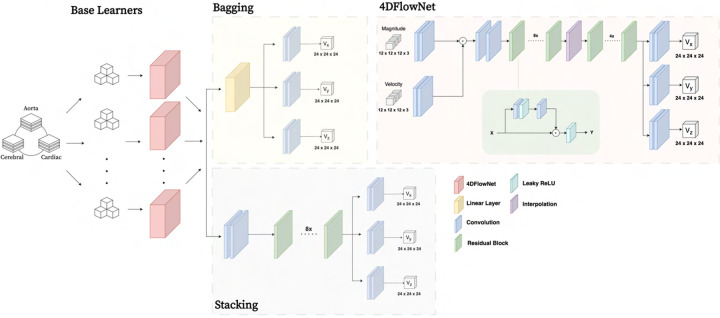
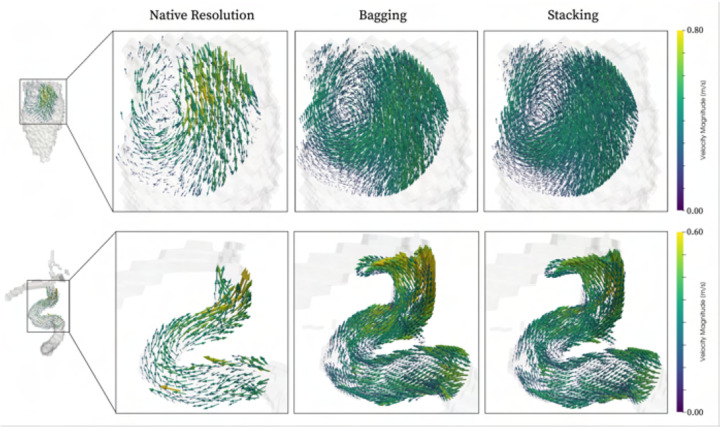
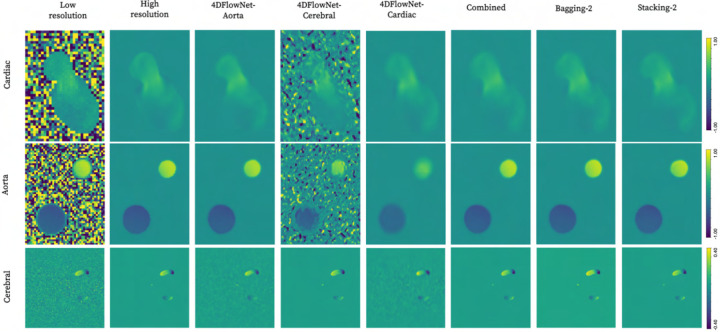
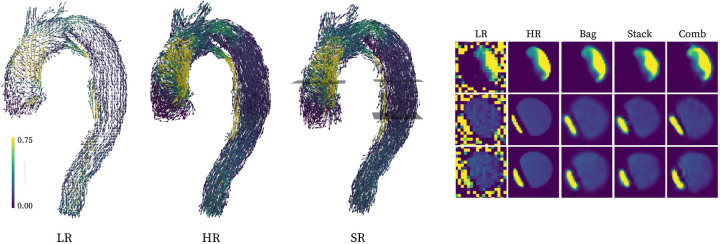
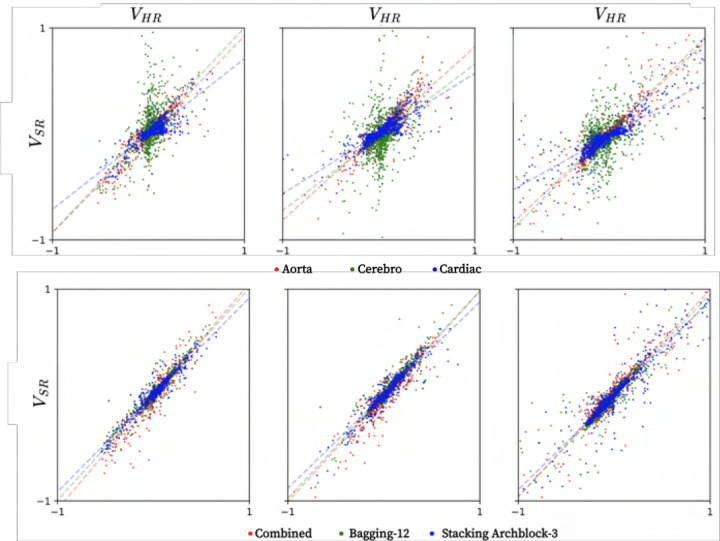
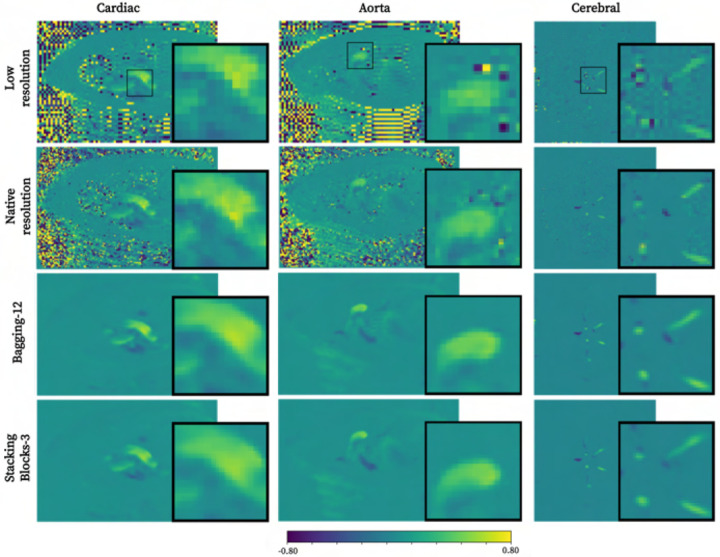
4D Flow Magnetic Resonance Imaging (4D Flow MRI) is a non-invasive measurement technique capable of quantifying blood flow across the cardiovascular system. While practical use is limited by spatial resolution and image noise, incorporation of trained super-resolution (SR) networks has potential to enhance image quality post-scan. However, these efforts have predominantly been restricted to narrowly defined cardiovascular domains, with limited exploration of how SR performance extends across the cardiovascular system; a task aggravated by contrasting hemodynamic conditions apparent across the cardiovasculature. The aim of our study was to explore the generalizability of SR 4D Flow MRI using a combination of heterogeneous training sets and dedicated ensemble learning. With synthetic training data generated across three disparate domains (cardiac, aortic, cerebrovascular), varying convolutional base and ensemble learners were evaluated as a function of domain and architecture, quantifying performance on both and acquired in-vivo data from the same three domains. Results show that both bagging and stacking ensembling enhance SR performance across domains, accurately predicting high-resolution velocities from low-resolution input data . Likewise, optimized networks successfully recover native resolution velocities from downsampled data, as well as show qualitative potential in generating denoised SR-images from clinicallevel input data. In conclusion, our work presents a viable approach for generalized SR 4D Flow MRI, with ensemble learning extending utility across various clinical areas of interest.
4D 流磁共振成像(4D 流 MRI)是一种能够对心血管系统中的血流进行量化的非侵入性测量技术。虽然实际应用受到空间分辨率和图像噪声的限制,但结合经过训练的超分辨率(SR)网络有可能在扫描后提高图像质量。然而,这些努力主要局限于狭义定义的心血管领域,对于 SR 性能如何在整个心血管系统中扩展的探索有限;心血管系统中明显的血流动力学条件差异加剧了这一任务的难度。我们研究的目的是使用异构训练集和专用集成学习的组合来探索 SR 4D 流 MRI 的通用性。通过在三个不同领域(心脏、主动脉、脑血管)生成的合成训练数据,评估了不同的卷积基和集成学习器作为领域和架构的函数,量化了对来自相同三个领域的模拟和采集的体内数据的性能。结果表明,装袋法和堆叠法集成均能提高跨领域的 SR 性能,从低分辨率输入数据中准确预测高分辨率速度。同样,优化后的网络成功地从下采样数据中恢复了原始分辨率速度,并在从临床水平输入数据生成去噪 SR 图像方面显示出定性潜力。总之,我们的工作提出了一种可行的通用 SR 4D 流 MRI 方法,集成学习扩展了在各个感兴趣的临床领域的实用性。