Department of Public Health, School of Public Health, Asrat Weldeyes Health Science Campus, Debre Berhan University, Debre Birhan, Ethiopia.
Department of Social and Behavioral Change, School of Public Health, University for Development Studies, Tamale, Ghana.
BMC Womens Health. 2023 Dec 6;23(1):650. doi: 10.1186/s12905-023-02814-1.
The consumption of Sugar-Sweetened Beverages (SSBs) has been linked to the global epidemic of obesity and chronic disease. Following the economic growth, urbanization, and attractive market for beverage companies, the consumption of SSBs is a rising public health challenge in low and middle-income countries. Hence, this study aimed to assess the magnitude of SSBs consumption and associated factors among women of reproductive age group in two SSA countries.
This cross-sectional study used data from Integrated Public Use Micro Data Series-Performance Monitoring for Action (IPUMS-PMA) with a total sample of 3759 women aged 15-49 years old in Burkina Faso and Kenya. The data was collected on June - August 2018 in Burkina Faso, and May -August 2018 in Kenya. SSBs consumption was measured by asking a woman if she drank SSBs yesterday during the day or night, whether at home or anywhere else. A mixed-effect logistic regression model was employed to identify associated factors.
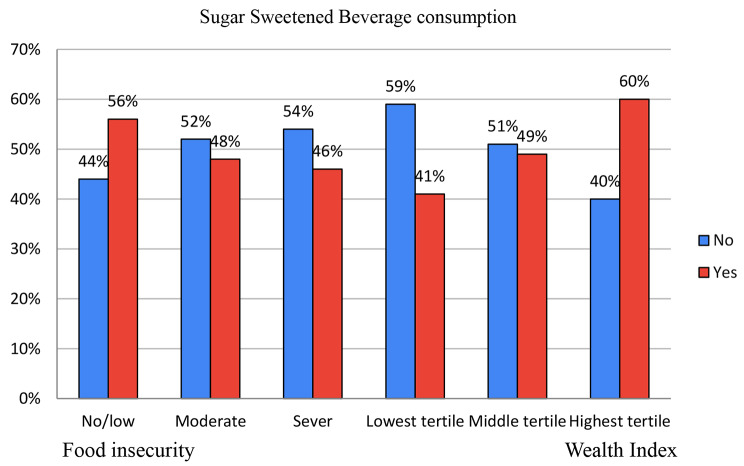
Half (50.38%) [95%CI; 46.04, 54.71] of women consumed SSBs. Sociodemographic characteristics like primary education (AOR = 1.35; 95%CI: 1.05-1.74), secondary education (AOR = 1.46; 95%CI: 1.13-1.90), being employed (AOR = 1.28; 95%CI: 1.05-1.56),and dietary characteristics like consumption of savory and fried snack (AOR = 1.61; 95%CI = 1.24-2.09), achieved minimum dietary diversity (AOR = 1.67; 95%CI: 1.38-2.01), moderate household food insecurity (AOR = 0.74, 95% CI: 0.58, 0.95), and sever household food insecurity (AOR = 0.71, 95% CI: 0.56, 0.89) had significant statistical association with SSBs consumption.
Consumption of SSBs among women in two Sub-Saharan African countries (Burkina Faso and Kenya) is high. Having higher educational status, being employed, achieved minimum dietary diversity, and having low/no household food in-security were found to be significantly associated with SSBs compared with their counterparts. We recommend for further study in other African countries using objective measurements of SSBs consumption.
糖饮料(SSBs)的消费与肥胖和慢性病的全球流行有关。随着经济增长、城市化和饮料公司的吸引力,SSBs 的消费成为低收入和中等收入国家日益严峻的公共卫生挑战。因此,本研究旨在评估撒哈拉以南非洲两个国家育龄妇女 SSBs 消费的程度及其相关因素。
本横断面研究使用综合公共使用微观数据系列-绩效监测行动(IPUMS-PMA)的数据,总样本量为布基纳法索和肯尼亚 3759 名 15-49 岁的妇女。数据于 2018 年 6 月至 8 月在布基纳法索和 2018 年 5 月至 8 月在肯尼亚收集。SSBs 的消费通过询问女性昨天白天或晚上是否在家或其他地方喝过 SSBs 来衡量。采用混合效应逻辑回归模型确定相关因素。
一半(50.38%)[95%CI; 46.04, 54.71]的女性消费 SSBs。社会人口特征,如小学教育(AOR=1.35;95%CI:1.05-1.74)、中学教育(AOR=1.46;95%CI:1.13-1.90)、就业(AOR=1.28;95%CI:1.05-1.56),以及饮食特征,如食用咸味和油炸小吃(AOR=1.61;95%CI:1.24-2.09)、实现最低饮食多样性(AOR=1.67;95%CI:1.38-2.01)、中度家庭粮食不安全(AOR=0.74,95%CI:0.58,0.95)和严重家庭粮食不安全(AOR=0.71,95%CI:0.56,0.89)与 SSBs 消费有显著统计学关联。
撒哈拉以南非洲两个国家(布基纳法索和肯尼亚)的妇女 SSBs 消费率较高。与同龄人相比,较高的教育程度、就业、实现最低饮食多样性和较低/无家庭粮食不安全与 SSBs 消费显著相关。我们建议在其他非洲国家进一步研究 SSBs 消费的客观测量。