Robinson Research Institute, University of Adelaide, North Adelaide, Australia; Adelaide Medical School, University of Adelaide, North Adelaide, Australia.
UCD Institute of Food and Health and School of Agriculture and Food Science, University College Dublin, Belfield, Dublin, Ireland.
Nutrition. 2022 Nov-Dec;103-104:111794. doi: 10.1016/j.nut.2022.111794. Epub 2022 Jul 17.
This study aimed to explore psychological distress, lifestyle, and demographic factors, as well as their relationship to discretionary choices in women of reproductive age during the coronavirus disease 2019 pandemic in Australia.
Reproductive-aged women (18-50 y) in Australia participated in a national online survey. Psychological distress score (using a validated 10-item Kessler Psychological Distress Scale questionnaire) was the primary exposure of interest, and key outcomes were frequencies of discretionary choices (sugar-sweetened beverages [SSBs], alcohol, and discretionary foods). Sociodemographic and physical activity data were also collected. Logistic regression was used to report adjusted odds ratio (aOR) and 95% confidence interval to predict SSBs (less than weekly; most days/daily), total discretionary foods (none/<2 times/d; ≥3 times/d), and alcohol use (never/less than monthly; most weeks/daily).
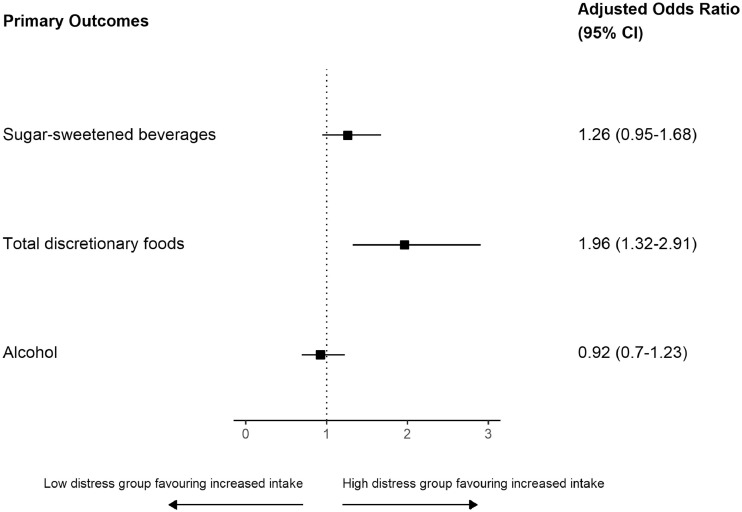
A total of 1005 women were included in the study, of whom 40% had a high level of psychological distress. Women with high psychological distress (aOR: 1.96; 95% CI, 1.32-2.91) and those who gained weight during the pandemic (aOR: 1.71; 95% CI, 1.10-2.65) were more likely to consume discretionary foods ≥3 times/d. There was no association between psychological distress and SSB intake or alcohol; however, Australian, New Zealander, or Pacific Islander background (aOR: 1.68; 95% CI, 1.21-2.33) and more hours of sitting time (aOR: 1.88; 95% CI, 1.07-3.29) were associated with SSB consumption on most days/daily. Older age (aOR: 1.70; 95% CI, 1.00-2.89), higher household income (aOR: 1.44; 95% CI, 1.08-1.92), and moderate or high physical activity (aOR: 1.75; 95% CI, 1.10-2.80) were associated with alcohol intake on most weeks/daily.
Public health messaging to promote healthy eating should take into account the effect of psychological distress on health behavior. Messages aimed at maintaining a positive relationship between food intake and mental wellbeing, particularly among vulnerable groups, are warranted.
本研究旨在探讨心理困扰、生活方式和人口统计学因素,以及它们与澳大利亚新冠疫情期间生育年龄女性的可自由支配选择之间的关系。
澳大利亚的生育年龄女性(18-50 岁)参与了一项全国性的在线调查。心理困扰评分(使用经过验证的 10 项 Kessler 心理困扰量表问卷)是主要的暴露因素,主要结果是可自由支配选择的频率(含糖饮料[SSB]、酒精和可自由支配的食物)。还收集了社会人口统计学和身体活动数据。使用逻辑回归报告调整后的优势比(aOR)和 95%置信区间,以预测 SSB(每周少于一次;大多数天/每天)、总可自由支配食物(无/<2 次/天;≥3 次/天)和酒精使用(从不/每月少于一次;大多数周/每天)。
共有 1005 名女性参与了这项研究,其中 40%的女性存在高水平的心理困扰。心理困扰程度高的女性(aOR:1.96;95%CI,1.32-2.91)和在大流行期间体重增加的女性(aOR:1.71;95%CI,1.10-2.65)更有可能每天食用≥3 次可自由支配的食物。心理困扰与 SSB 摄入量或酒精摄入量之间没有关联;然而,澳大利亚、新西兰或太平洋岛民背景(aOR:1.68;95%CI,1.21-2.33)和更长的坐姿时间(aOR:1.88;95%CI,1.07-3.29)与大多数天/每天的 SSB 消费相关。年龄较大(aOR:1.70;95%CI,1.00-2.89)、家庭收入较高(aOR:1.44;95%CI,1.08-1.92)和中高强度的身体活动(aOR:1.75;95%CI,1.10-2.80)与大多数周/每天的酒精摄入有关。
促进健康饮食的公共卫生信息应考虑心理困扰对健康行为的影响。值得向弱势群体传达旨在保持食物摄入和心理健康之间积极关系的信息。