Zha Qiaozhi, Aliaga Diego, Krejci Radovan, Sinclair Victoria A, Wu Cheng, Ciarelli Giancarlo, Scholz Wiebke, Heikkinen Liine, Partoll Eva, Gramlich Yvette, Huang Wei, Leiminger Markus, Enroth Joonas, Peräkylä Otso, Cai Runlong, Chen Xuemeng, Koenig Alkuin Maximilian, Velarde Fernando, Moreno Isabel, Petäjä Tuukka, Artaxo Paulo, Laj Paolo, Hansel Armin, Carbone Samara, Kulmala Markku, Andrade Marcos, Worsnop Douglas, Mohr Claudia, Bianchi Federico
Institute for Atmospheric and Earth System Research / Physics, University of Helsinki, Helsinki00014, Finland.
Joint International Research Laboratory of Atmospheric and Earth System Sciences, Nanjing University, Nanjing210023, China.
Natl Sci Rev. 2023 May 15;11(1):nwad138. doi: 10.1093/nsr/nwad138. eCollection 2024 Jan.
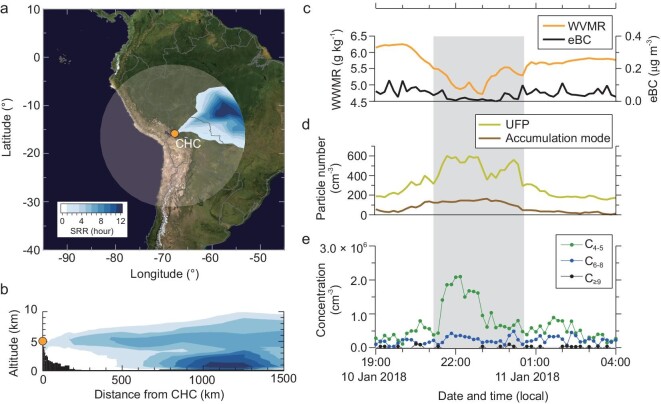
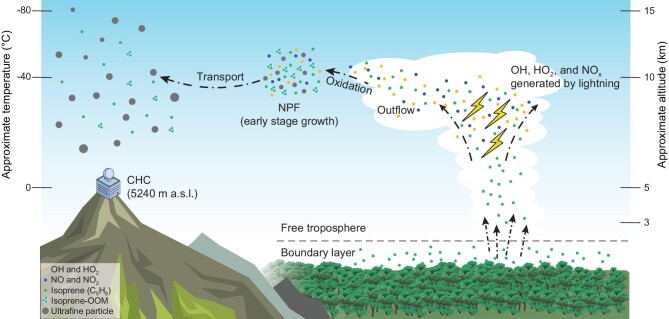
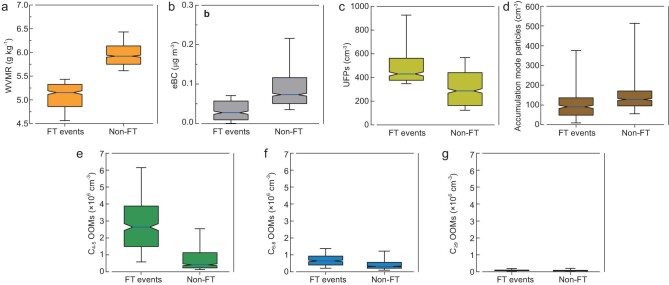
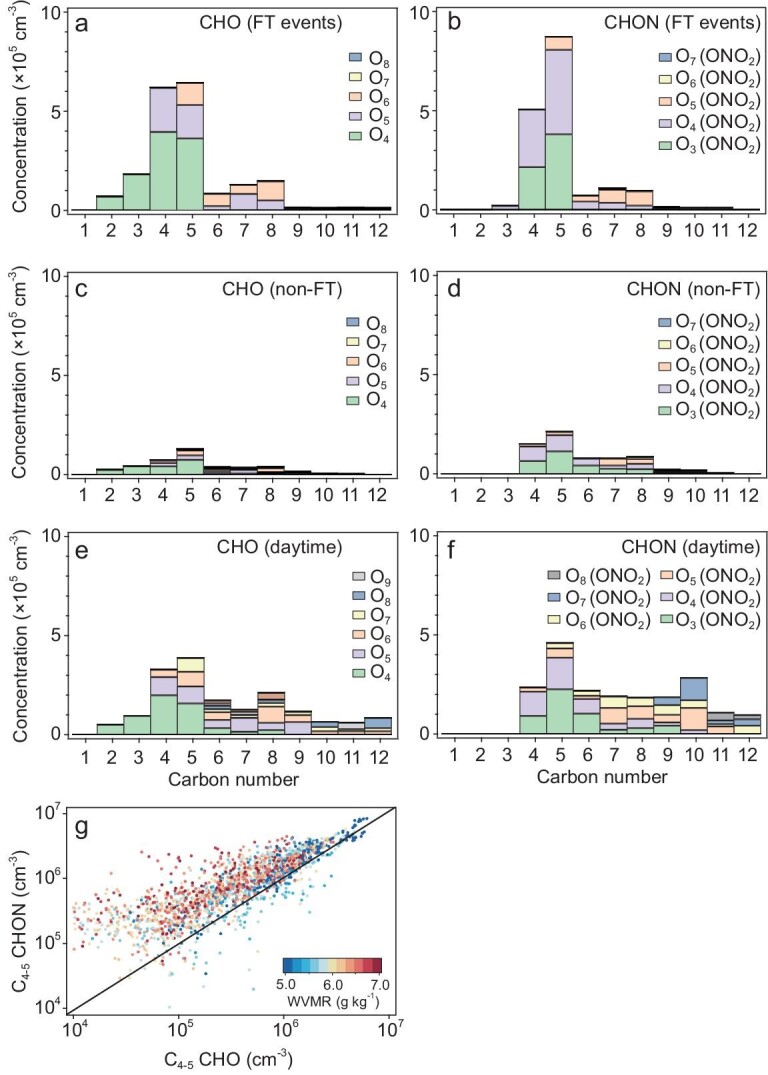
New particle formation (NPF) in the tropical free troposphere (FT) is a globally important source of cloud condensation nuclei, affecting cloud properties and climate. Oxidized organic molecules (OOMs) produced from biogenic volatile organic compounds are believed to contribute to aerosol formation in the tropical FT, but without direct chemical observations. We performed molecular-level OOMs measurements at the Bolivian station Chacaltaya at 5240 m above sea level, on the western edge of Amazonia. For the first time, we demonstrate the presence of OOMs, mainly with 4-5 carbon atoms, in both gas-phase and particle-phase (in terms of mass contribution) measurements in tropical FT air from Amazonia. These observations, combined with air mass history analyses, indicate that the observed OOMs are linked to isoprene emitted from the rainforests hundreds of kilometers away. Based on particle-phase measurements, we find that these compounds can contribute to NPF, at least the growth of newly formed nanoparticles, in the tropical FT on a continental scale. Thus, our study is a fundamental and significant step in understanding the aerosol formation process in the tropical FT.
热带对流层上层(FT)中的新粒子形成(NPF)是全球云凝结核的重要来源,影响着云的特性和气候。由生物源挥发性有机化合物产生的氧化有机分子(OOMs)被认为是热带对流层上层气溶胶形成的原因之一,但缺乏直接的化学观测。我们在海拔5240米的玻利维亚查卡亚站进行了分子水平的OOMs测量,该站位于亚马逊西部边缘。首次在来自亚马逊地区的热带对流层上层空气中的气相和颗粒相(按质量贡献计算)测量中证实了OOMs的存在,主要含有4-5个碳原子。这些观测结果与气团历史分析相结合,表明观测到的OOMs与数百公里外雨林中排放的异戊二烯有关。基于颗粒相测量,我们发现这些化合物在大陆尺度上对热带对流层上层的新粒子形成有贡献,至少对新形成的纳米颗粒的生长有贡献。因此,我们的研究是理解热带对流层上层气溶胶形成过程的重要基础步骤。