Faculty of Physics, University of Vienna, 1090 Vienna, Austria.
Institute for Ion Physics and Applied Physics, University of Innsbruck, 6020 Innsbruck, Austria.
Proc Natl Acad Sci U S A. 2018 Sep 11;115(37):9122-9127. doi: 10.1073/pnas.1807604115. Epub 2018 Aug 28.
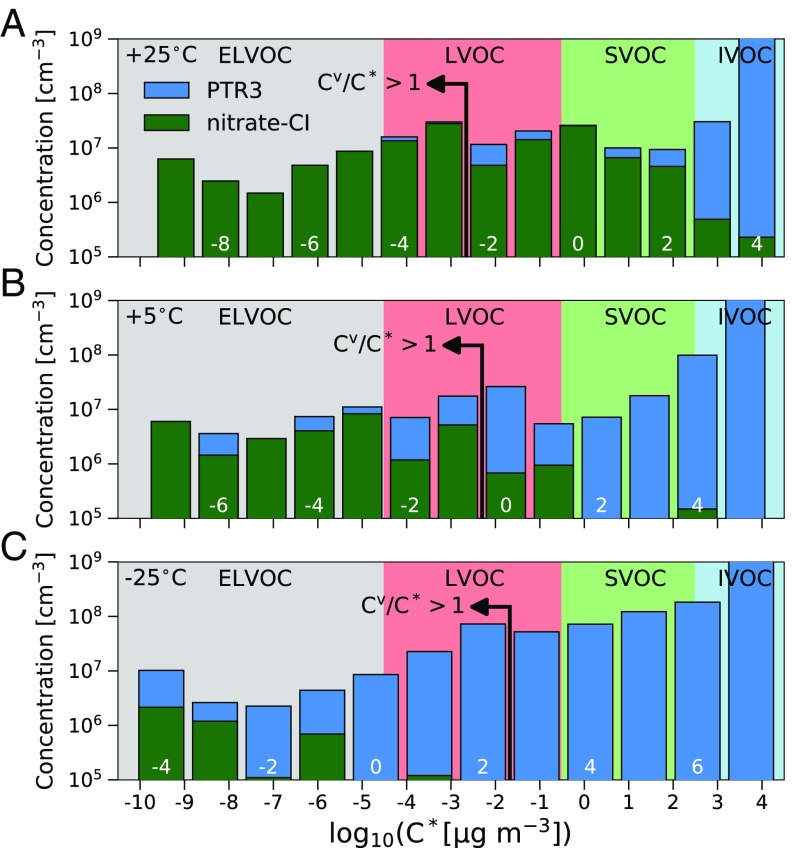
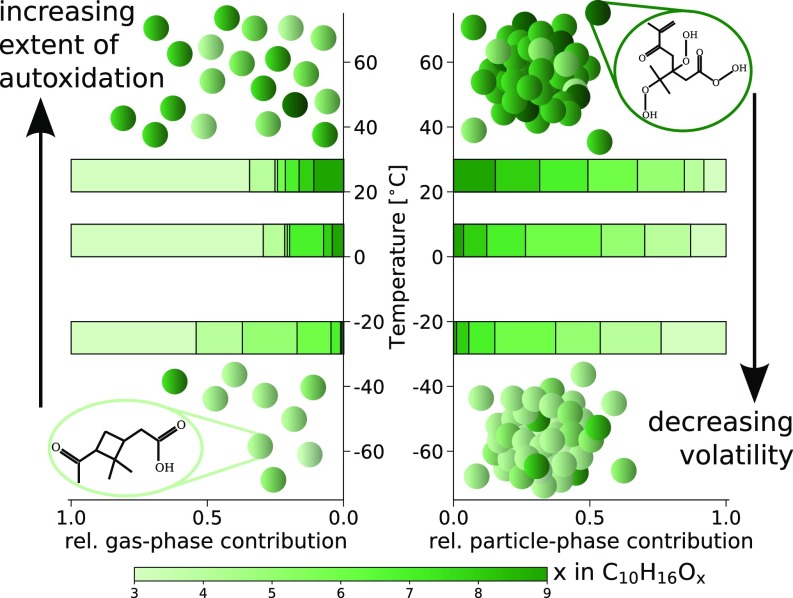
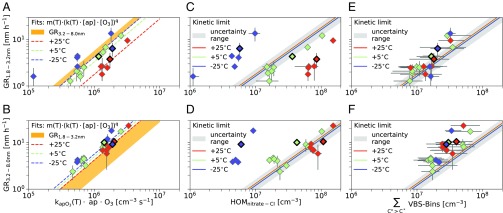
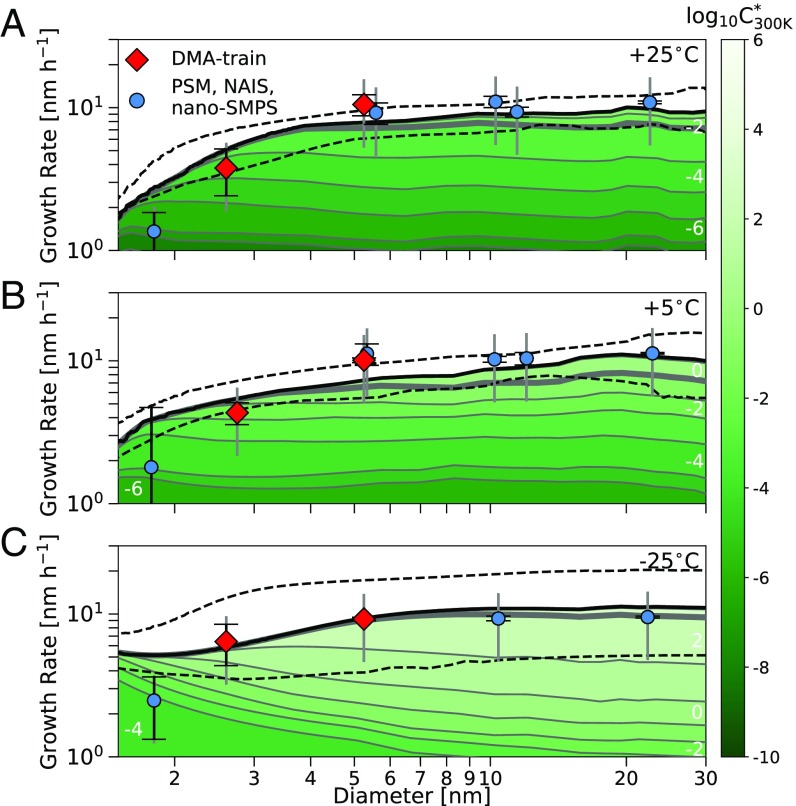
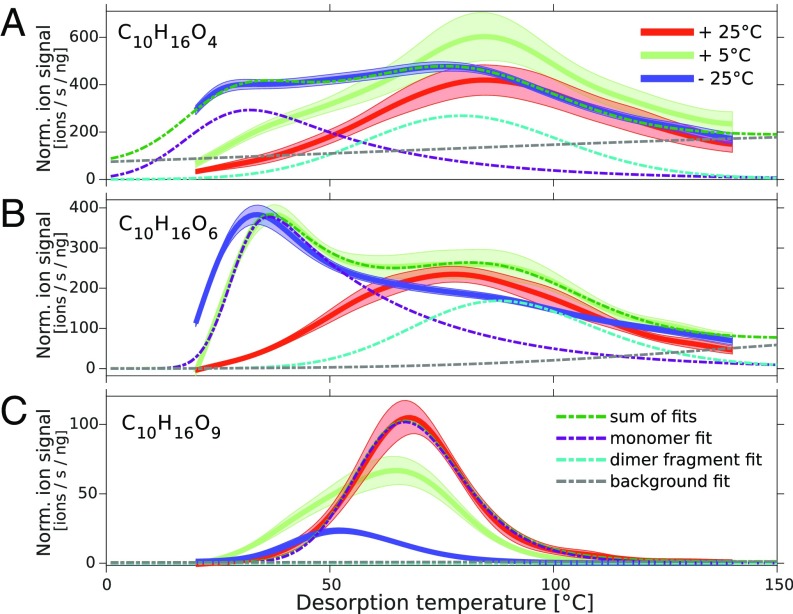
Nucleation and growth of aerosol particles from atmospheric vapors constitutes a major source of global cloud condensation nuclei (CCN). The fraction of newly formed particles that reaches CCN sizes is highly sensitive to particle growth rates, especially for particle sizes <10 nm, where coagulation losses to larger aerosol particles are greatest. Recent results show that some oxidation products from biogenic volatile organic compounds are major contributors to particle formation and initial growth. However, whether oxidized organics contribute to particle growth over the broad span of tropospheric temperatures remains an open question, and quantitative mass balance for organic growth has yet to be demonstrated at any temperature. Here, in experiments performed under atmospheric conditions in the Cosmics Leaving Outdoor Droplets (CLOUD) chamber at the European Organization for Nuclear Research (CERN), we show that rapid growth of organic particles occurs over the range from [Formula: see text]C to [Formula: see text]C. The lower extent of autoxidation at reduced temperatures is compensated by the decreased volatility of all oxidized molecules. This is confirmed by particle-phase composition measurements, showing enhanced uptake of relatively less oxygenated products at cold temperatures. We can reproduce the measured growth rates using an aerosol growth model based entirely on the experimentally measured gas-phase spectra of oxidized organic molecules obtained from two complementary mass spectrometers. We show that the growth rates are sensitive to particle curvature, explaining widespread atmospheric observations that particle growth rates increase in the single-digit-nanometer size range. Our results demonstrate that organic vapors can contribute to particle growth over a wide range of tropospheric temperatures from molecular cluster sizes onward.
气溶胶颗粒从大气蒸汽中形核和生长是全球云凝结核(CCN)的主要来源。达到 CCN 大小的新形成颗粒的分数对颗粒生长速率非常敏感,特别是对于<10nm 的颗粒大小,其中凝聚损失到较大的气溶胶颗粒最大。最近的结果表明,一些生物源挥发性有机化合物的氧化产物是颗粒形成和初始生长的主要贡献者。然而,氧化有机物是否在整个大气温度范围内促进颗粒生长仍然是一个悬而未决的问题,并且在任何温度下都尚未证明有机生长的定量质量平衡。在这里,在欧洲核子研究组织(CERN)的宇宙离户外液滴(CLOUD)室中在大气条件下进行的实验中,我们表明有机颗粒在从[Formula: see text]C 到[Formula: see text]C 的范围内快速生长。在较低温度下自动氧化的程度较低,通过所有氧化分子的挥发性降低得到补偿。这通过颗粒相组成测量得到证实,表明在低温下相对含氧产物的吸收增强。我们可以使用完全基于从两种互补质谱仪获得的氧化有机分子的实验测量气相谱的气溶胶生长模型来再现测量的生长速率。我们表明,生长速率对颗粒曲率敏感,解释了广泛的大气观测结果,即颗粒生长速率在个位数纳米尺寸范围内增加。我们的结果表明,有机蒸汽可以从分子簇大小开始在整个大气温度范围内促进颗粒生长。