School of Medicine, Imperial College London, London, UK.
Lee Kong Chian School of Medicine, Nanyang Technological University, Singapore, Singapore.
BMC Med Educ. 2023 Dec 20;23(1):981. doi: 10.1186/s12909-023-04962-2.
Despite shifting global attitudes, mental illness remains highly stigmatised amongst practicing doctors. This has wider implications on doctors' training to care for patients with mental illness. There is need for exploration of the presence and mitigation of stigma in early medical education to prevent such attitudes propagating into clinical practice. Thus, this study explores whether stigmatising attitudes are detectable amongst medical students in London and Singapore and examines whether they are ameliorated by specific curricular and welfare features of formal medical education, utilising the Mental Illness Stigma Framework (MISF).
A mixed-methods approach was adopted. Medical students at Imperial College London (UK; n = 211) and Nanyang Technological University (Singapore; n = 141) completed a validated scale (the OMS-HC-15) to assess attitudes towards mental illness. Semi-structured interviews were conducted (Imperial: n = 12, NTU: n = 8) until theoretical saturation was reached. Quantitative data were analysed descriptively and comparatively using SPSS and interview data subjected to inductive thematic analysis.
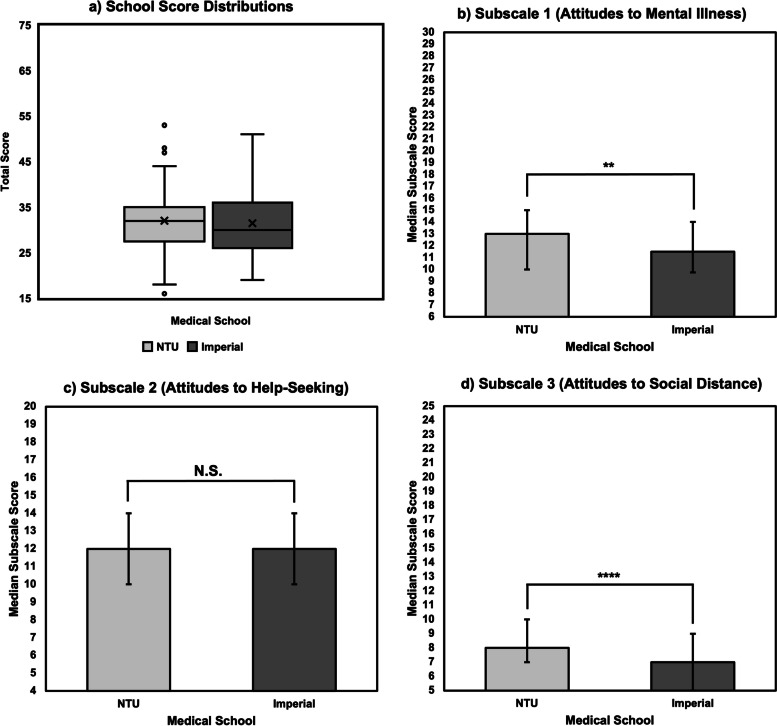
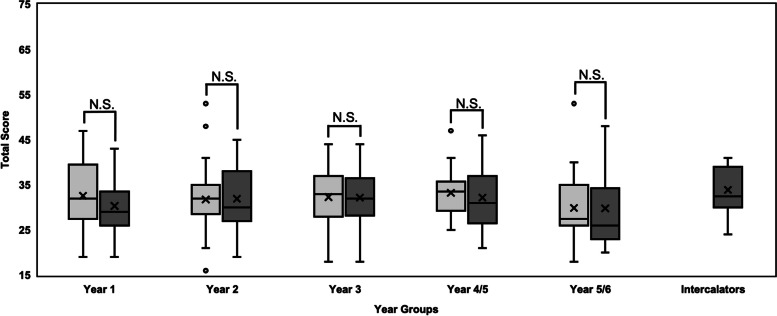
Total OMS-HC-15 scores ranged from 19-51 for Imperial (n = 211) and 16-53 for NTU (n = 141). No significant differences in overall stigma scores were found between the two schools (p = 0.24), nor when comparing year groups within each school. Four themes were identified across interview data: student perceptions, impacts of medical school culture, university support, and curricular impacts on mental illness perceptions. Themes allowed identification of aspects of medical school that were well-received and warranted further emphasis by students, alongside areas for improvement.
Mental health stigma was identified in two medical schools, with differing cultures. Mean stigma scores obtained were comparable between both UK and Singaporean medical students. Nuanced differences were identified via subgroup analysis, and the MISF identified both shared and country-specific drivers for this stigma across the qualitative data. Actionable recommendations to mitigate this were hypothesised. Curricular improvements such as earlier psychiatric teaching and sharing of personal stories may improve future stigma scores as students' progress through the course. Specific welfare-based changes to formal support systems were also deemed to be beneficial by students. The impacts of welfare and curricular redesign in relation to societal influence on students' attitudes warrants further investigation, as does medical students' self-stigma.
尽管全球态度有所转变,但精神疾病在执业医生中仍然受到高度污名化。这对医生培训照顾精神疾病患者产生了更广泛的影响。需要探讨早期医学教育中污名化的存在和减轻情况,以防止这种态度在临床实践中传播。因此,本研究探讨了伦敦和新加坡的医学生是否存在污名化态度,并利用精神疾病污名框架(MISF)检查了特定的课程和福利特征是否可以减轻这种态度。
采用混合方法。伦敦帝国理工学院(英国;n=211)和南洋理工大学(新加坡;n=141)的医学生完成了一项经过验证的量表(OMS-HC-15),以评估他们对精神疾病的态度。进行了半结构化访谈(帝国理工学院:n=12,南洋理工大学:n=8),直到达到理论饱和。使用 SPSS 对定量数据进行描述性和比较分析,对访谈数据进行归纳主题分析。
帝国理工学院的 OMS-HC-15 总分范围为 19-51(n=211),南洋理工大学的总分范围为 16-53(n=141)。两所学校的总体污名评分无显著差异(p=0.24),也没有比较两所学校内的不同年级。访谈数据中确定了四个主题:学生的看法、医学院文化的影响、大学支持以及课程对精神疾病看法的影响。主题确定了医学院中深受学生欢迎并值得进一步强调的方面,以及需要改进的方面。
两所医学院都存在心理健康污名化现象,文化不同。英国和新加坡医学生的平均污名评分相似。通过亚组分析确定了细微的差异,MISF 在定性数据中确定了这种污名的共同和特定国家驱动因素。假设提出了减轻这种污名的可行建议。随着学生在课程中的进步,课程改进(如早期精神病学教学和分享个人故事)可能会提高未来的污名评分。学生还认为对正式支持系统进行特定的福利和课程重新设计也将是有益的。需要进一步研究福利和课程设计的改变与社会对学生态度的影响之间的关系,以及医学生的自我污名化。