Melbourne School of Psychological Sciences, The University of Melbourne, Parkville Campus, Melbourne, Victoria, 3010, Australia.
Graeme Clark Institute for Biomedical Engineering, The University of Melbourne, Melbourne, Victoria, Australia.
Behav Res Methods. 2024 Sep;56(6):6349-6362. doi: 10.3758/s13428-023-02306-y. Epub 2023 Dec 21.
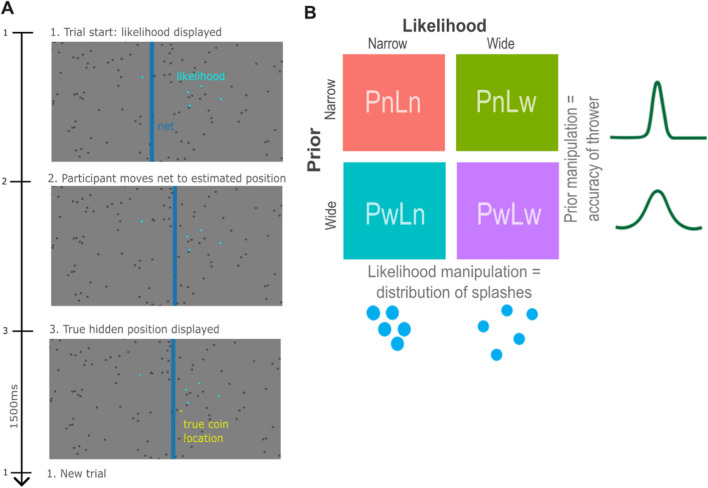
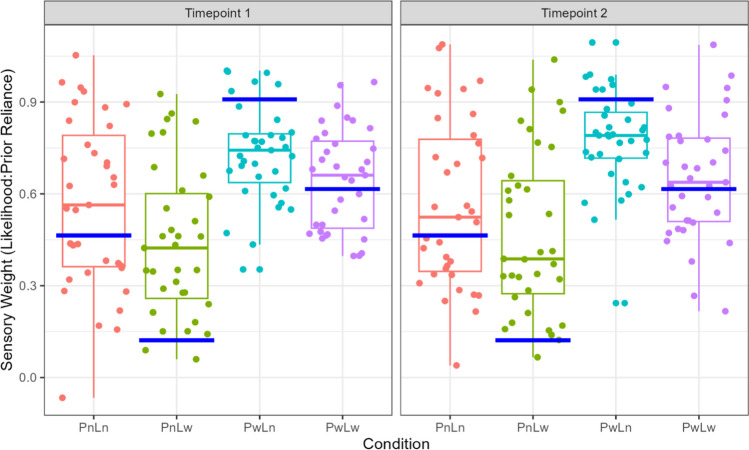
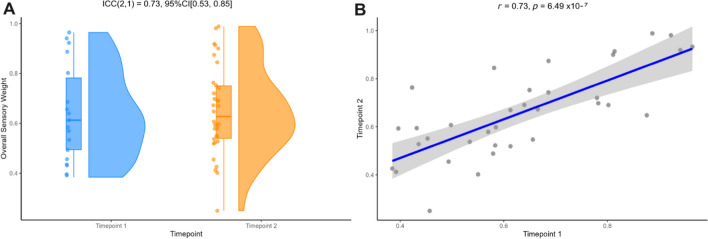
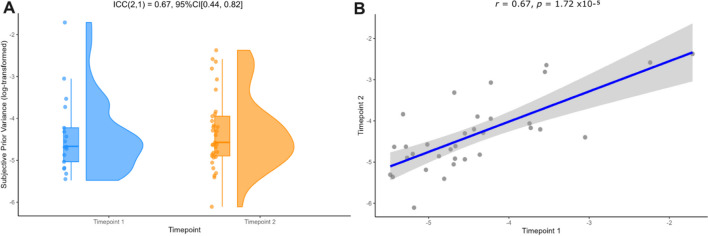
Bayesian inference suggests that perception is inferred from a weighted integration of prior contextual beliefs with current sensory evidence (likelihood) about the world around us. The perceived precision or uncertainty associated with prior and likelihood information is used to guide perceptual decision-making, such that more weight is placed on the source of information with greater precision. This provides a framework for understanding a spectrum of clinical transdiagnostic symptoms associated with aberrant perception, as well as individual differences in the general population. While behavioral paradigms are commonly used to characterize individual differences in perception as a stable characteristic, measurement reliability in these behavioral tasks is rarely assessed. To remedy this gap, we empirically evaluate the reliability of a perceptual decision-making task that quantifies individual differences in Bayesian belief updating in terms of the relative precision weighting afforded to prior and likelihood information (i.e., sensory weight). We analyzed data from participants (n = 37) who performed this task twice. We found that the precision afforded to prior and likelihood information showed high internal consistency and good test-retest reliability (ICC = 0.73, 95% CI [0.53, 0.85]) when averaged across participants, as well as at the individual level using hierarchical modeling. Our results provide support for the assumption that Bayesian belief updating operates as a stable characteristic in perceptual decision-making. We discuss the utility and applicability of reliable perceptual decision-making paradigms as a measure of individual differences in the general population, as well as a diagnostic tool in psychiatric research.
贝叶斯推断表明,感知是从对周围世界的先前上下文信念与当前感官证据(可能性)的加权综合中推断出来的。与先前和可能性信息相关的感知精度或不确定性用于指导感知决策,从而对精度更高的信息源赋予更大的权重。这为理解与异常感知相关的一系列临床跨诊断症状以及普通人群中的个体差异提供了一个框架。虽然行为范式常用于将感知的个体差异描述为稳定特征,但这些行为任务中的测量可靠性很少得到评估。为了弥补这一差距,我们通过实证评估了一种量化个体差异的感知决策任务的可靠性,该任务根据先前和可能性信息提供的相对精度加权来衡量贝叶斯信念更新(即感官权重)。我们分析了两次执行此任务的参与者(n=37)的数据。我们发现,当平均参与者时,以及使用层次模型在个体水平上,先前和可能性信息提供的精度表现出高度的内部一致性和良好的测试-重测可靠性(ICC=0.73,95%CI[0.53,0.85])。我们的结果支持了这样的假设,即贝叶斯信念更新在感知决策中作为一个稳定的特征运作。我们讨论了可靠的感知决策范式作为普通人群中个体差异的衡量标准以及精神病学研究中的诊断工具的实用性和适用性。