De Martino Benedetto, Bobadilla-Suarez Sebastian, Nouguchi Takao, Sharot Tali, Love Bradley C
Institute of Cognitive Neuroscience, University College London, WC1N 3AZ London, United Kingdom,
Alan Turing Institute, British Library, London NW1 2DB, United Kingdom, and.
J Neurosci. 2017 Jun 21;37(25):6066-6074. doi: 10.1523/JNEUROSCI.3880-16.2017. Epub 2017 May 31.
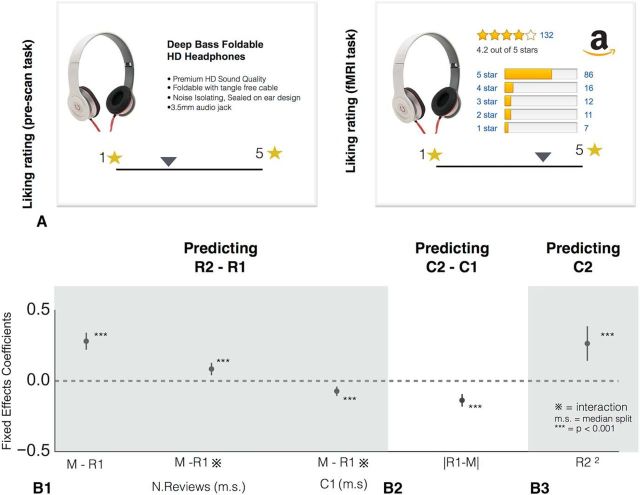
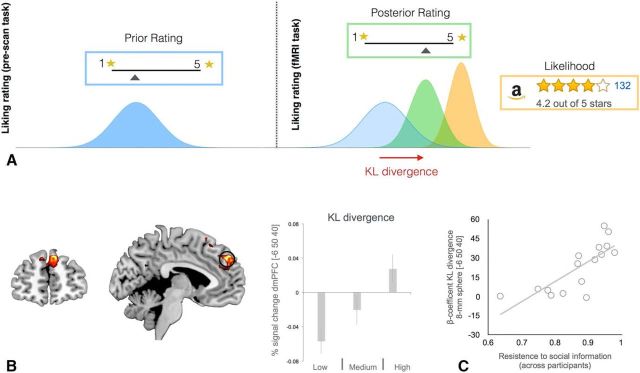
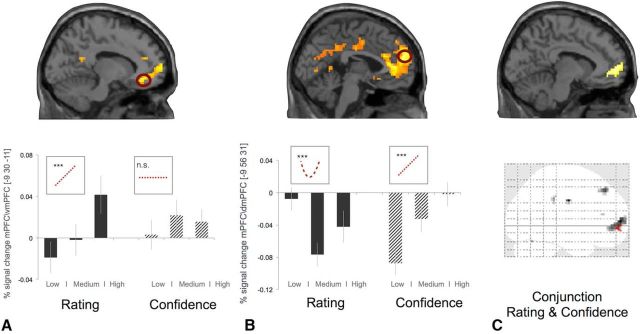
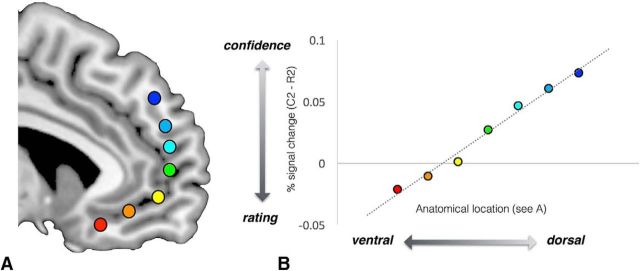
How much we like something, whether it be a bottle of wine or a new film, is affected by the opinions of others. However, the social information that we receive can be contradictory and vary in its reliability. Here, we tested whether the brain incorporates these statistics when judging value and confidence. Participants provided value judgments about consumer goods in the presence of online reviews. We found that participants updated their initial value and confidence judgments in a Bayesian fashion, taking into account both the uncertainty of their initial beliefs and the reliability of the social information. Activity in dorsomedial prefrontal cortex tracked the degree of belief update. Analogous to how lower-level perceptual information is integrated, we found that the human brain integrates social information according to its reliability when judging value and confidence. The field of perceptual decision making has shown that the sensory system integrates different sources of information according to their respective reliability, as predicted by a Bayesian inference scheme. In this work, we hypothesized that a similar coding scheme is implemented by the human brain to process social signals and guide complex, value-based decisions. We provide experimental evidence that the human prefrontal cortex's activity is consistent with a Bayesian computation that integrates social information that differs in reliability and that this integration affects the neural representation of value and confidence.
我们对某事物的喜爱程度,无论是一瓶葡萄酒还是一部新电影,都会受到他人意见的影响。然而,我们所接收的社会信息可能相互矛盾,其可靠性也各不相同。在此,我们测试了大脑在判断价值和信心时是否会纳入这些统计信息。参与者在有在线评论的情况下对消费品进行价值判断。我们发现,参与者以贝叶斯方式更新他们最初的价值和信心判断,同时考虑到他们初始信念的不确定性以及社会信息的可靠性。背内侧前额叶皮层的活动跟踪了信念更新的程度。类似于较低层次的感知信息是如何整合的,我们发现人类大脑在判断价值和信心时会根据社会信息的可靠性对其进行整合。感知决策领域已经表明,感觉系统会根据各自的可靠性整合不同的信息源,这正如贝叶斯推理方案所预测的那样。在这项研究中,我们假设人类大脑实施了一种类似的编码方案来处理社会信号并指导基于价值的复杂决策。我们提供了实验证据,表明人类前额叶皮层的活动与整合可靠性不同的社会信息的贝叶斯计算相一致,并且这种整合会影响价值和信心的神经表征。