Shi Bin, Yue Zan, Yin Shuai, Zhao Junyang, Wang Jing
Xi'an Research Institute of High-Technology, Xi'an, Shaanxi, China.
Institute of Robotics and Intelligent System, School of Mechanical Engineering, Xi'an Jiaotong University, Xi'an, China.
Front Hum Neurosci. 2023 Dec 7;17:1292428. doi: 10.3389/fnhum.2023.1292428. eCollection 2023.
Brain-computer interface (BCI) systems based on motor imagery (MI) have been widely used in neurorehabilitation. Feature extraction applied by the common spatial pattern (CSP) is very popular in MI classification. The effectiveness of CSP is highly affected by the frequency band and time window of electroencephalogram (EEG) segments and channels selected.
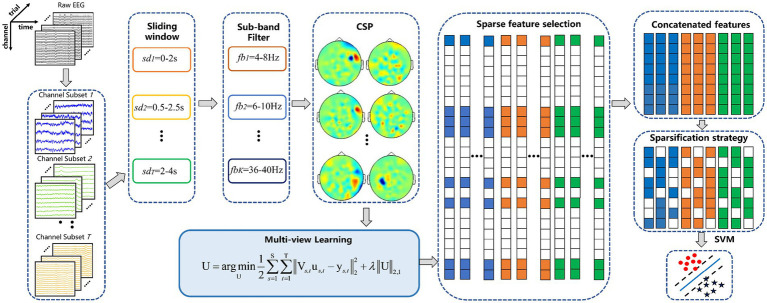
In this study, the multi-domain feature joint optimization (MDFJO) based on the multi-view learning method is proposed, which aims to select the discriminative features enhancing the classification performance.
The channel patterns are divided using the Fisher discriminant criterion (FDC). Furthermore, the raw EEG is intercepted for multiple sub-bands and time interval signals. The high-dimensional features are constructed by extracting features from CSP on each EEG segment. Specifically, the multi-view learning method is used to select the optimal features, and the proposed feature sparsification strategy on the time level is proposed to further refine the optimal features.
Two public EEG datasets are employed to validate the proposed MDFJO method. The average classification accuracy of the MDFJO in Data 1 and Data 2 is 88.29 and 87.21%, respectively. The classification result of MDFJO was significantly better than MSO ( < 0.05), FBCSP ( < 0.01), and other competing methods ( < 0.001).
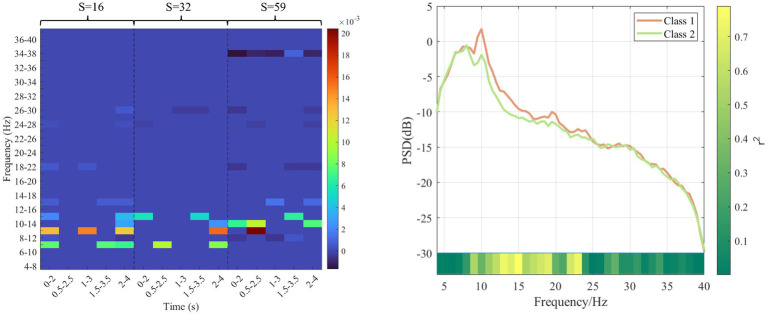
Compared with the CSP, sparse filter band common spatial pattern (SFBCSP), and filter bank common spatial pattern (FBCSP) methods with channel numbers 16, 32 and all channels as well as MSO, the MDFJO significantly improves the test accuracy. The feature sparsification strategy proposed in this article can effectively enhance classification accuracy. The proposed method could improve the practicability and effectiveness of the BCI system.
基于运动想象(MI)的脑机接口(BCI)系统已广泛应用于神经康复领域。通过共同空间模式(CSP)进行的特征提取在MI分类中非常流行。CSP的有效性受到脑电图(EEG)片段的频段、时间窗以及所选通道的高度影响。
本研究提出基于多视图学习方法的多域特征联合优化(MDFJO),旨在选择具有判别力的特征以提高分类性能。
使用Fisher判别准则(FDC)划分通道模式。此外,截取原始EEG的多个子带和时间间隔信号。通过对每个EEG片段提取CSP特征来构建高维特征。具体而言,采用多视图学习方法选择最优特征,并提出在时间层面上的特征稀疏化策略以进一步优化最优特征。
使用两个公开的EEG数据集验证所提出的MDFJO方法。MDFJO在数据集1和数据集2中的平均分类准确率分别为88.29%和87.21%。MDFJO的分类结果显著优于MSO(<0.05)、FBCSP(<0.01)以及其他竞争方法(<0.001)。
与通道数为16、32以及所有通道的CSP、稀疏滤波带共同空间模式(SFBCSP)、滤波器组共同空间模式(FBCSP)方法以及MSO相比,MDFJO显著提高了测试准确率。本文提出的特征稀疏化策略能够有效提高分类准确率。所提方法可提高BCI系统的实用性和有效性。