Department of Rehabilitation Medicine, Asan Medical Center, University of Ulsan College of Medicine, Seoul 05505, Republic of Korea.
Department of Rehabilitation Medicine, Gangnam Severance Hospital, Yonsei University College of Medicine, Seoul 06273, Republic of Korea.
Toxins (Basel). 2023 Dec 12;15(12):697. doi: 10.3390/toxins15120697.
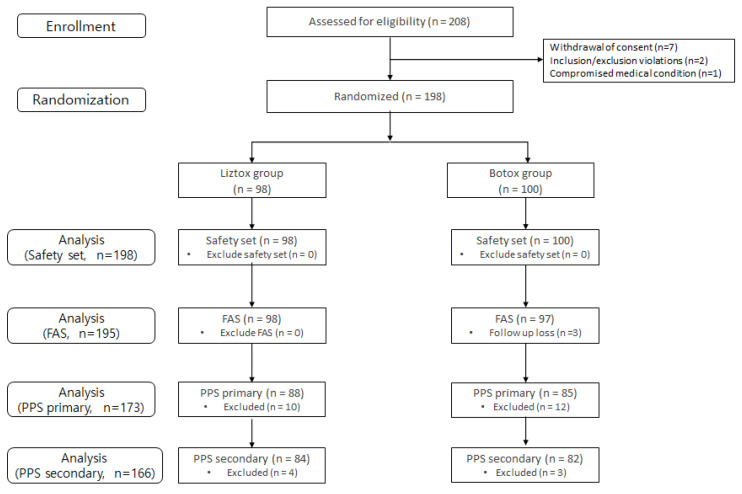
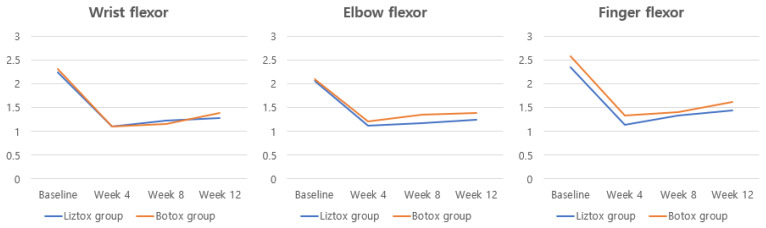
Botulinum toxin type A (BTX-A) injection is a commonly used therapeutic intervention for upper limb spasticity in stroke patients. This study was designed as a randomized, active-drug-controlled, double-blind, multicenter, phase 3 clinical trial to evaluate the safety and efficacy of Liztox in comparison to onabotulinum toxin A (Botox) for individuals with post-stroke upper limb spasticity. The primary outcome was the alteration in wrist flexor muscle tone from the initial assessment to the fourth week, evaluated using the modified Ashworth scale (MAS). Secondary outcomes included MAS score changes for the wrist at weeks 8 and 12 from baseline; MAS score changes for finger and elbow flexors; and changes in the Disability Assessment Scale (DAS), Subject's Global Assessment (SGA), the Investigator's Global Assessment (IGA), and Caregiver Burden Scale (CBS) at weeks 4, 8, and 12 from baseline. The MAS score for wrist flexor spasticity decreased by -1.14 ± 0.59 in the Liztox group and -1.22 ± 0.59 in the Botox group from baseline to week 4. The difference [97.5% confidence interval (CI)] between the test and control groups was 0.08 [-∞, 0.26], confirming the non-inferiority of the test group compared to the control group. Furthermore, there were consistent improvements in the IGA, SGA, and CBS scores across all assessment intervals, with no statistically significant variances detected between the two groups. No safety-related concerns were reported during the study. In conclusion, Liztox injection proved to be a secure and efficacious intervention for managing upper extremity spasticity in post-stroke patients.
A型肉毒毒素(BTX-A)注射是治疗脑卒中患者上肢痉挛的常用治疗方法。本研究是一项随机、阳性药物对照、双盲、多中心、3 期临床试验,旨在评估利司妥与注射用 A 型肉毒毒素(Botox)治疗脑卒中后上肢痉挛患者的安全性和有效性。主要结局指标是改良 Ashworth 量表(MAS)评估的从基线到第 4 周腕屈肌肌张力的变化。次要结局指标包括从基线到第 8 周和第 12 周腕、指、肘屈肌 MAS 评分的变化;残疾评定量表(DAS)、患者总体评估(SGA)、研究者总体评估(IGA)和照顾者负担量表(CBS)评分的变化。利司妥组和博妥组从基线到第 4 周腕屈肌痉挛 MAS 评分分别降低了 -1.14 ± 0.59 和-1.22 ± 0.59。试验组与对照组差值[97.5%置信区间(CI)]为 0.08 [-∞,0.26],证实试验组与对照组的非劣效性。此外,在所有评估间隔内,IGA、SGA 和 CBS 评分均持续改善,两组间无统计学差异。研究过程中未报告与安全性相关的问题。总之,利司妥注射治疗脑卒中后患者上肢痉挛安全有效。