
基于神经网络的仿生光感受器,用于识别和分类手语手势。
Bioinspired Photoreceptors with Neural Network for Recognition and Classification of Sign Language Gesture.
机构信息
Electrical Engineering Department, Faculty of Engineering, University of Santiago of Chile, Las Sophoras 165, Estación Central, Santiago 9170020, Chile.
出版信息
Sensors (Basel). 2023 Dec 6;23(24):9646. doi: 10.3390/s23249646.
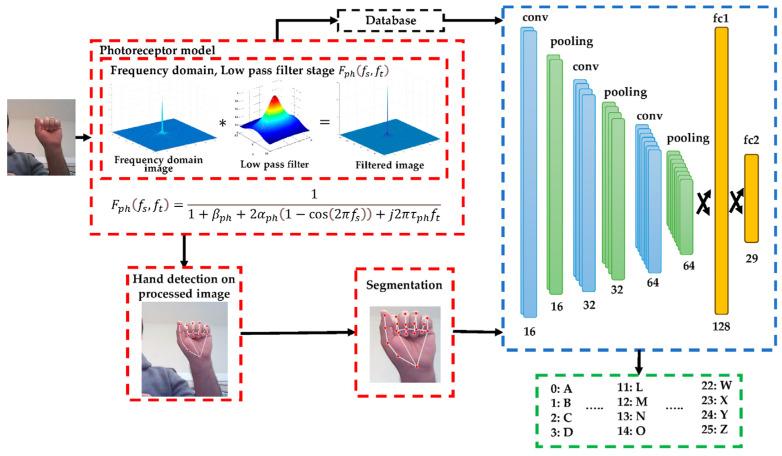
This work addresses the design and implementation of a novel PhotoBiological Filter Classifier (PhBFC) to improve the accuracy of a static sign language translation system. The captured images are preprocessed by a contrast enhancement algorithm inspired by the capacity of retinal photoreceptor cells from mammals, which are responsible for capturing light and transforming it into electric signals that the brain can interpret as images. This sign translation system not only supports the effective communication between an agent and an operator but also between a community with hearing disabilities and other people. Additionally, this technology could be integrated into diverse devices and applications, further broadening its scope, and extending its benefits for the community in general. The bioinspired photoreceptor model is evaluated under different conditions. To validate the advantages of applying photoreceptors cells, 100 tests were conducted per letter to be recognized, on three different models (V1, V2, and V3), obtaining an average of 91.1% of accuracy on V3, compared to 63.4% obtained on V1, and an average of 55.5 Frames Per Second (FPS) in each letter classification iteration for V1, V2, and V3, demonstrating that the use of photoreceptor cells does not affect the processing time while also improving the accuracy. The great application potential of this system is underscored, as it can be employed, for example, in Deep Learning (DL) for pattern recognition or agent decision-making trained by reinforcement learning, etc.
这项工作旨在设计和实现一种新型的光学生物滤波器分类器 (PhBFC),以提高静态手语翻译系统的准确性。通过一种受哺乳动物视网膜光感受器细胞能力启发的对比度增强算法对捕获的图像进行预处理,这些细胞负责捕捉光并将其转化为大脑可以解释为图像的电信号。这种手语翻译系统不仅支持代理和操作员之间的有效通信,也支持有听力障碍的社区和其他人之间的有效通信。此外,这项技术可以集成到各种设备和应用中,进一步扩大其范围,并为整个社区带来更多的好处。生物启发的光感受器模型在不同条件下进行了评估。为了验证应用光感受器细胞的优势,对要识别的每个字母进行了 100 次测试,在三个不同的模型(V1、V2 和 V3)上进行,在 V3 上平均获得了 91.1%的准确率,而在 V1 上获得了 63.4%的准确率,在每个字母分类迭代中,V1、V2 和 V3 的平均帧率为 55.5 帧/秒,这表明使用光感受器细胞不会影响处理时间,同时还提高了准确性。该系统具有巨大的应用潜力,例如在深度学习 (DL) 中用于模式识别或通过强化学习进行代理决策等。




 Zotero 插件